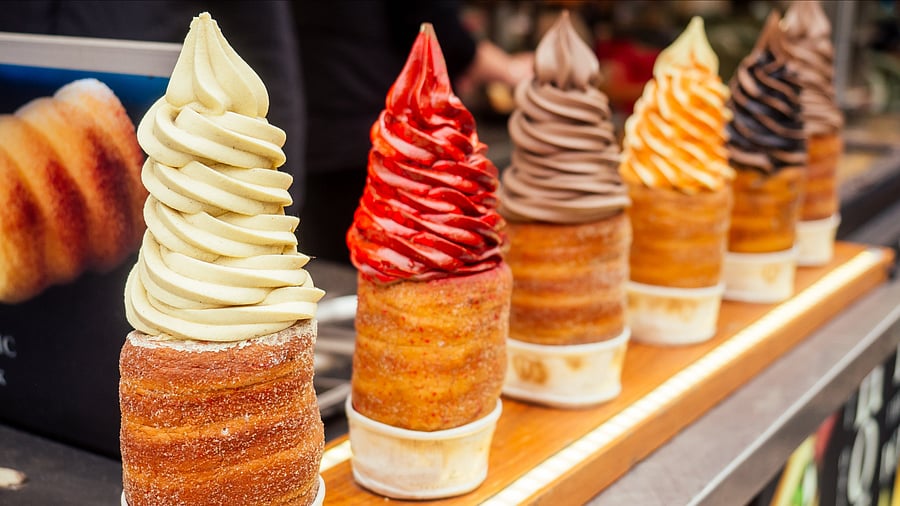
Traditional chimney cake sold on a Prague street.
Credit: iStock Photo
The whiff of cinnamon and baked dough tantalises anyone walking the lanes of Old Town in Prague. Step into any bakery here and you will find trdelník, or chimney cake—made with dough on a wooden stick, baked to perfection with mascarpone on top of a fire spit. Sometimes luscious berries or ice cream adorn the chimney top. The word trdelník itself comes from the Slovak word ‘trdlo’, the wooden tool used to wrap the dough around, giving the cake its traditional hollow shape.
Spit-cooked cakes are found across Central and Eastern Europe—from Hungary to Romania—reflecting an ancient way of baking dough over fire. Part of trdelník’s charm lies in that primal allure—the warmth, smoke, and slow spin of the spit.
But, trdelník isn’t quite Czech at all, and yet it is everywhere in Prague. According to some locals, it’s a sugar-dusted illusion that tourists devour, mistaking it for a centuries-old local delicacy. They, however, insist it’s more marketing than heritage. Yet, despite its “Old Bohemian” branding in Gothic script almost at every shop, trdelník is a modern creation for tourists, blending nostalgia with clever reinvention.
An origin story of the wildly popular Prague must-have, is that it takes after a similar pastry from Transylvania (now Romania). A 15th-century manuscript in Germany mentions a similar pastry, and by 1784, it appeared in a Transylvanian cookbook. From there, it journeyed west through Hungary—where it’s known as kürtöskalács—before settling in Slovakia’s town of Skalica. The legend says a Hungarian general named József Gvadányi brought a cook to Skalica who imported (or stole, accounts vary) a recipe for this traditional ‘chimney cake’ in ancient times. Only later, thanks to Czechoslovakia’s shared borders, did the trdelník rise again—this time as a Czech “classic” born of clever marketing reinvention.
Evolution of Czech cuisine
Czech cuisine is a mosaic of European influences, shaped by centuries of shifting empires and borders—a cuisine as layered and improvised as the nation’s story. Tourism in Prague truly took off after 1989, following the fall of the Communist regime and the peaceful split from Slovakia in 1993. The nation’s 2004 entry into the EU placed Prague firmly at the heart of Europe, and in the imagination of millions of travellers. As tourism grew, so did the demand for a tangible “past”, something that felt authentically Czech. Food became the easiest way to serve that sense of history. Trdelník fits perfectly into this patchwork as an edible emblem of heritage for curious visitors. Its invented authenticity reflects the Czechs’ capacity to adapt, endure, and reinvent—qualities that define the nation more than any single dish ever could.
Rolled and layered love
The country’s love for rolled desserts goes beyond Prague. From Horické trubicky—delicate wafer rolls with sweet fillings to Lázenské oplatky—spa wafers from Karlovy Vary with hazelnut or cinnamon filling, Czechia’s wafer heritage is rich. In the town of Horice in the Hradec Králové region, the making of the tube wafer stands as a graceful blend of precision and tradition. Sheets of delicate wafer dough are cut with modern machines for perfect uniformity, yet it’s the artisans’ light, swift hands that brings them to life. Each wafer is deftly rolled around a slender wooden stick while still warm, forming airy, crisp cylinders with a gentle firmness.
In spa towns like Karlovy Vary, Lázenské oplatky, or the spa wafers are crafted with quiet artistry. Thin layers of dough are baked to a delicate blush, their circular forms pressed with ornate patterns recalling 19th-century elegance. The essence, however, remains in the baker’s touch—brushing them with hazelnut, vanilla, or chocolate filling, before sealing them gently to fuse the layers in perfect symmetry.
The result is a crisp, fragrant wafer that captures both the finesse of Czech confectionery and the slow, indulgent rhythm of spa-town life.