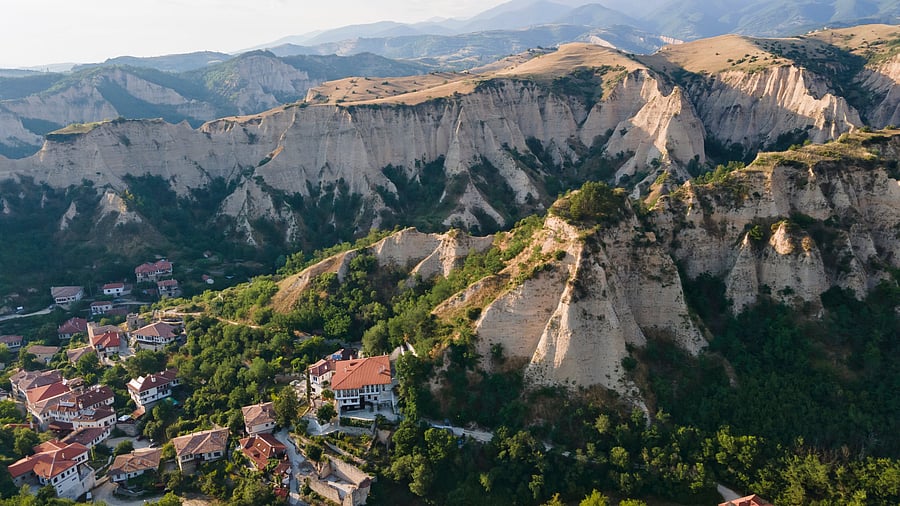
The trail to the pyramids winds through crumbling sandstone and scrub.
Credit: iStock Photo
It’s hard to believe that a town of barely 200 residents could hold so much beauty, history, and wine. But that’s UNESCO-listed Melnik—Europe’s smallest town and one of Bulgaria’s grandest surprises. Tucked into the sunbaked foothills of the Pirin Mountains near the Greek border, Melnik feels both forgotten and eternal, carved by wind, wine, and whispered legend.
The drive from Sofia wound through pine-scented passes before the landscape began to glow gold. Suddenly, the Melnik pyramids appeared—vast sand formations rising like molten spires against the sky. Up to 100 meters high, these jagged, flame-coloured towers are nature’s answer to Egypt’s monuments.
Scientists call them “erosion pyramids,” shaped by wind and rain over millions of years. Standing before them, though, they felt too deliberate, as if ancient gods—not geology—had built them.
Crossing a creaky bridge into town, I found Melnik’s cobbled main street—a storybook lane lined with vine-draped houses, rose-scented shops, and wine cellars. A silver-haired woman waved me into her souvenir shop. “Dobredoshli!” she beamed. Her shelves overflowed with rose oil, embroidered linens, and tiny amphorae once used for wine. She pressed a bottle into my hand. “Taste this—Shiroka Melnishka Loza. It grows only here.”
Native wine
She wasn’t exaggerating. The Broadleaf Melnik vine, native to this valley, doesn’t thrive anywhere else in the world. It yields rich, peppery reds once coveted by kings—Tsar Nicholas II ordered it for his palace, and Winston Churchill reportedly had 500 litres shipped yearly. Melnik’s dry soil and fierce sun make wines that are spicy, earthy, and unforgettable.
Following her advice, I wandered to the Kordopulov House, the town’s pride and relic of its merchant past. Built in 1754, it’s a showpiece of the Bulgarian Revival—wide eaves, carved ceilings, and secret corridors once used to dodge Ottoman tax collectors. My guide Stefan led me downstairs into a vast 200-meter wine cellar carved into sandstone. “The tunnels stay cool all year,” he said, running a hand along the barrels. “The Kordopulovs traded with Venice and Vienna long before refrigeration.”
He poured me a glass of deep ruby red. It tasted of dark fruit and woodsmoke—a sip of liquid history.From the house’s balcony, the view swept across red-tiled roofs to the pyramids blazing under the afternoon sun. Hard to believe that in the 17th century, this now-quiet hamlet was home to 25,000 people, a bustling hub of traders dealing in silk, tobacco, and wine.
As dusk settled, I dined at a cozy taverna where the owner, Ivan, served kavarma—a clay-baked pork stew—with homemade bread and fiery rakia. “Everything you see, we grow,” he said proudly. As the pyramids turned indigo, locals began singing a folk ballad, voices rising in harmony with the crickets. I couldn’t understand the words, but the emotion was unmistakable—part melancholy, part joy, all belonging.
Stunning pyramids
The next morning, I laced up my shoes to hike among the pyramids. The trail wound upward through thyme-scented scrub and crumbling sandstone. Each turn revealed new shapes—ridges, cones, and natural towers, shifting in hue from ochre to rose. From the top, the view was spellbinding: vineyards spread like green lace below, and beyond them, the white domes of the Rozhen Monastery, one of Bulgaria’s oldest, peeked through the pines.
The wind whistled through the gullies, and I picked up a handful of fine, warm sand. Locals say the pyramids are still alive—eroding and reforming each year. Time here is tangible; you can feel it sliding between your fingers.
Melnik’s quiet streets hum with history. Ivy-covered houses lean into each other like gossiping elders. Cats laze on Ottoman-era fountains. Atop the cliffs, ruins of a 13th-century fortress recall Despot Alexius Slav, the medieval ruler who made Melnik his capital. Once a prosperous trading post on the route between the Aegean and the Danube, the town declined after the Balkan Wars, its population drifting away until barely a few dozen families remained. Yet the past lingers in the air—sweet, smoky, stubborn.
Before leaving, I revisited the shop where my journey had begun. The silver-haired woman was still there, arranging jars of rose honey. When I told her I was heading back to Sofia, she smiled knowingly. “People always say that,” she said. “But Melnik keeps them.”
Microcosm of world’s treasures
Driving out, I looked one last time at the pyramids blazing gold against the sky. Vineyards shimmered, and the air smelled of sunbaked sand and ripe grapes. The road twisted upward, giving me a final glimpse of rooftops glowing in the late-day light—a postcard view I knew would stay with me.
Melnik may be small, but it holds multitudes: a living museum of geology, history, and human warmth. Its sand pyramids rival Egypt’s for grandeur, its wines rival France’s for soul, and its people, with their laughter and open arms, rival anywhere in the world for heart.
As the mountains swallowed the road behind me, I realised the truth of the shopkeeper’s words. Melnik doesn’t just charm visitors—it claims them. Its magic seeps under your skin, like the slow warmth of good wine. And once you’ve tasted both, you never really leave.