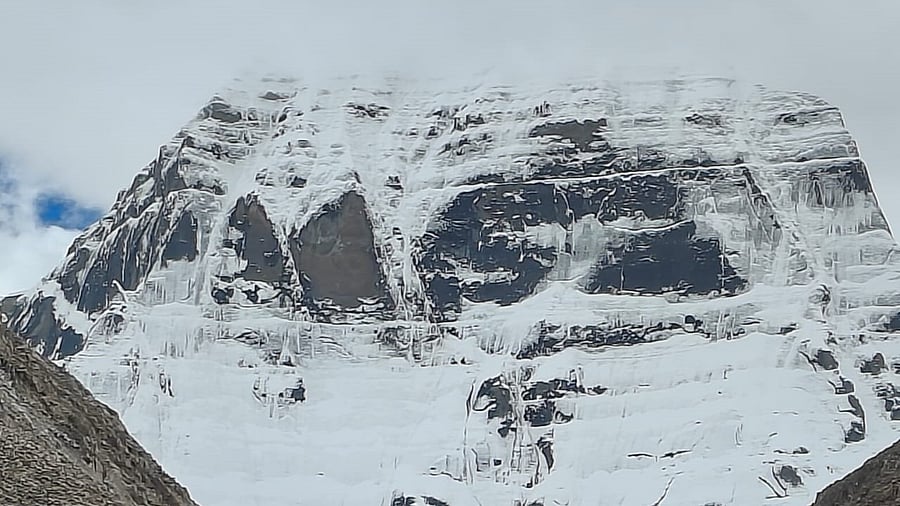
The north face of Mount Kailash, which is among the most coveted of views.
(Photo by author)
“There is a kind of magicness about going far away and then coming back all changed.” This is a famous quote from the American author Kate Douglas Wiggin’s ‘New Chronicles of Rebecca’.
I don’t know about the latter part of the quote but I can say ‘there is a kind of magicness’ in Kailash.
In 2025, the government in China opened the Kailash-Mansarovar route to Indians, after five years. On a whim, I decided to explore this sacred mountain in Western Tibet. Mount Kailash is located in the Tibet Autonomous Region of China. The visa is processed as a part of group application through an authorised tour operator. (Important tip: Choose your tour operator wisely. Also, it is up to the visa issuing authorities to grant a visa or reject it.)
I knew that I would be visiting tough, rugged terrain with unpredictable weather. But little did I imagine that the journey to the Mount Kailash region right from Kathmandu would be more challenging than the actual Kailash kora (an approximately 52-kilometre pilgrimage route or parikrama around Mount Kailash).
Though there are a couple of routes to travel to Mount Kailash from India (Nathu La Pass, Sikkim, and via the Lipulekh Pass in Uttarakhand), the more common route is via Nepal, either by road or by helicopter. Unfortunately, exactly 45 days before our trip, the Friendship Bridge in Nepal, a crucial crossing over River Bhotekoshi, which connects Nepal and Tibet region, was swept away by flash floods.
From Kathmandu, we reached Kodari, which was officially opened for the Kailash yatra. It was from here that we started our trek towards the Nepal-Tibet border. You would have to cross Tatopani and Kodari towns to reach the Tibetan border. The beauty of these towns was mesmerising — the journey from Tatopani to the Tibet border was an engrossing one, with the entire stretch surrounded by waterfalls.
Heavenly Tibet
After our Chinese immigration, we began our onward journey toward Nyalam County, a very beautiful small town in Tibet. This was the route designated for the Kailash yatra after a bridge collapsed on the Gyirong route. Nyalam has an elevation of 3,750m and it is from here that we started our high-altitude journey, taking in the stunning landscapes and spectacular views of the Himalayas.
Because a gradual ascent is preferred, those who take this route typically stay at Nyalam, and proceed towards Saga. En route, you get to drive along the mighty Brahmaputra and also feast your eyes on Peiku Tso Lake, one of the most beautiful lakes located at 4,595m. Though it is a nearly seven-hour drive, good roads and views of snow-clad mountains and valleys ensure that you never get tired.
Lalung La Pass on the Friendship Highway (the 800-kilometre route in Tibet connecting Lhasa to the Nepal border,) offers stunning views and you can take in the entire Tibetan plateau from here. The high altitude may give you the feeling that it’s an endless journey but you wouldn’t want to trade the beauty of the panoramic Himalayan ranges for anything.
Saga (4,640m) is a bustling town and an important stopover for pilgrims visiting Mount Kailash. With many hotels and shops, pilgrims and tourists throng this place to buy essentials for Kailash kora. Our excitement continued as we were just two stops away from Kailash-Lake Mansarovar (known as Mapam Yumtso, a freshwater lake) and Darchen (a small town in Ngari, western Tibet).
And finally, Mansarovar
Lake Mansarovar is truly divine — the stillness and the star-filled night sky casting reflections in the water, will transport you to another world. Even as you take in the sheer beauty of Lake Mansarovar, head to Lake Rakshastal. Though Lake Mansarovar and Rakshastal are just four km apart, they are distinct — the latter is known as Ravana Tal, (‘Lake of the Demon’), and is saline. While birds and fish thrive at Mansarovar, there’s none around Rakshastal, which is also marked by a lack of vegetation around.
Sights of Mount Kailash
From Mansarovar, we proceeded to Darchen. It took us seven days to get here, and a three-day kora or parikrama (circumabulation) started from Yam dwar, known as the ‘Gateway of the God of Death’.
At Yam dwar, you can spot the south face of Mount Kailash (provided there is no heavy snow or thick fog). The west face comes into view as you walk further. As the first day of the parikrama comes to a close, and you reach Dirapuk monastery (approximately 5,200m), you are rewarded with the sight of the most well-known northern face of Mount Kailash. Temperatures swing dramatically, from extreme cold to rain, sunshine and strong winds. The light of sunrise and sunset strike the peak and it shimmers like gold, and hence the name ‘gold face’.
On the second day, considered the most challenging, you get to Zuthulpuk via the Dolma La Pass, the highest point of the pilgrimage. From here, you descend to Gauri kund. The east face of Kailash is visible from here. After an overnight stay, you can return to Darchen, which takes a couple of hours. Irrespective of how long you travel and how many kilometres you manage to walk, the sight of prayer flags and snow-capped Mount Kailash will be etched in the memories of travellers. Its stunning beauty and experience are beyond bliss.
CHECKLIST
•Travel agencies have started opening registrations for Kailash Mansarovar yatra 2026 (anywhere between May and October).
•Before you begin your Mount Kailash visit, prioritise acclimatisation so that you can prevent any altitude sickness. Acclimatisation is the process of adjusting your body to high altitudes where oxygen levels are low.
•You need a Tibet travel permit and a China group visa to enter the region. Mostly, tour agents will take care of all documents and all you need to do is follow their instructions.
•You can reach Kailash by road, helicopter or air. You can also choose aerial darshan. While shorter helicopter tours are available from Lucknow, air routes start with a flight to Lhasa, following which you can cover the distance by road.
•Costs can range between Rs 3 lakh and Rs 4 lakh depending on your mode of travel
•Don't miss mysterious colourful lights at Lake Manasarovar in early mornings (from 2.30 to 4 am)
HOW READY ARE YOU?
•Now is the time to put on your walking shoes and begin basic breathing exercises. If you think it's too early, think again — a six-month preparation is a must for a hassle-free journey. Since the trip involves high altitudes, you need to walk on challenging terrain.
•Select proper hiking boots, use two trekking poles for balance.
•Maintain a slow, steady pace.
•Thermal wear, a warm pullover, waterproof jacket, hat, UV protection sunglasses, and gloves are a must. Pack only minimal clothes.
•Carry high-energy snacks including dry fruits.
•Ensure you carry a lightweight durable duffel bag.
•Since the journey involves challenging terrain, give importance to mental preparation as well.