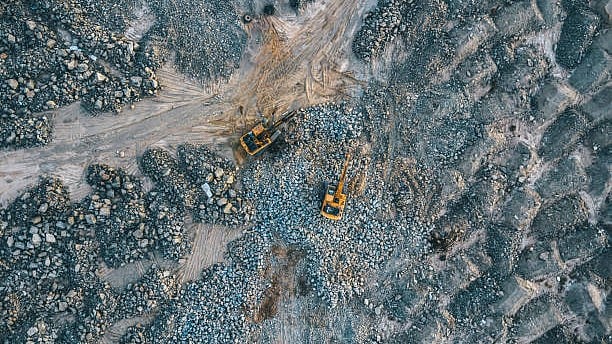
A strategic race for critical minerals. iStock photo
Globally, critical minerals are increasingly recognised as strategic assets rather than conventional commodities, particularly as the mining industry faces growing pressure to deliver higher production with reduced energy, water, and environmental footprints. India, endowed with a wide variety of mineral resources, stands at a pivotal juncture. The strategic challenge lies not merely in locating these resources but in systematically exploring, mining, processing, and integrating them into the domestic value chains to drive national growth, employment, energy security, and strategic autonomy.
Countries designate minerals as critical based on their economic priorities, industrial requirements, technological ambitions, security considerations, and natural endowments. In line with this approach, the Ministry of Mines, Government of India, identified 30 critical minerals in 2023. These are antimony, beryllium, bismuth, cadmium, cobalt, copper, gallium, germanium, graphite, hafnium, indium, lithium, molybdenum, niobium, nickel, platinum group elements (PGEs), phosphorus, potash, rare earth elements (REEs), rhenium, silicon, strontium, tantalum, tellurium, tin, titanium, tungsten, vanadium, zirconium, and selenium. These minerals form the backbone of technologies that support electric mobility, clean energy systems, electronics, and India’s defence and aerospace sectors.
India’s emphasis on critical minerals is closely aligned with its long-term development objectives and climate commitments. Achieving net-zero emissions by 2070 necessitates a gradual but substantial transition towards renewable energy, electric mobility, grid-scale energy storage, and other low-carbon technologies. This transition is inherently mineral-intensive, with lithium, cobalt, nickel, copper, and rare earth elements playing key roles in batteries, power electronics, electric motors, and wind energy systems. Ensuring secure, affordable, and diversified access to these minerals is, therefore, essential for meeting climate goals while strengthening industrial competitiveness.
This evolving mineral strategy is reshaping the country’s approach to energy security, industrial growth, and strategic independence. Although often invisible in everyday life, critical minerals are indispensable inputs for clean energy technologies, advanced electronics, and defence systems, making them central to the trajectory of India’s future development.
From a policy and technology perspective, India’s expanding research and innovation ecosystem represents a significant strength. Current efforts span the entire value chain, from exploration and mineral processing to the recovery of metals from end-of-life batteries, electronic waste, and industrial scrap. Technologies for extracting lithium, cobalt, nickel, manganese, precious metals, tungsten, and other critical elements are increasingly transitioning from laboratory-scale research to industrial applications, supporting import substitution and circular economy objectives.
To provide focused and coordinated direction to these efforts, the Government of India launched the National Critical Mineral Mission (NCMM) in January 2025. With a budgetary outlay of Rs 16,300 crore and an expected investment of Rs 18,000 crore, the mission seeks to strengthen domestic capabilities across the full value chain – from exploration and mining to processing, recycling, and downstream manufacturing – thereby enhancing energy security and supply-chain resilience.
Policies must meet
rising demand
Global developments underscore the urgency of these initiatives. According to the International Energy Agency’s Global Critical Minerals Outlook 2025, the demand for minerals used in batteries and low-carbon technologies is projected to increase sharply under net-zero scenarios. This spike is likely to intensify global competition for secure supplies. The demand for lithium is expected to rise by about six times by 2030, 14 times by 2040, and 17 times by 2050, while the demand for nickel may grow by about six times by 2030 and seven times by 2040. Manganese and rare earth elements also show substantial long-term growth trends, reflecting their expanding roles in energy storage, electric mobility, and advanced manufacturing. The demand for copper is projected to increase steadily, driven by electrification and renewable energy deployment.
In support of investment and transparent resource governance, the Government of India revised royalty rates for select critical minerals in June 2025. Concurrently, the Geological Survey of India (GSI) is implementing around 227 critical mineral projects during 2025-26, while government and private exploration agencies, industry, research institutions, and academia are encouraged to pursue domestic exploration as well as overseas mineral assets.
While the development of critical minerals presents significant technical, environmental, and economic challenges, it also offers opportunities for
innovation, advanced technology adoption, and sustainable practices. Realising this potential will depend on coherent policies, institutional coordination, and proactive decision-making. Ultimately, critical minerals must be treated not as ordinary raw materials, but as strategic national assets. Decisions taken today – on exploration, mining, processing, recycling, refining, and international partnerships – will shape India’s ability to build a resilient, sustainable, and technologically advanced economy.
(The writer, a former executive director of The Hutti Gold Mines Co Ltd., is
currently with the National Institute of Advanced Studies)
Disclaimer: The views expressed above are the author's own. They do not necessarily reflect the views of DH.