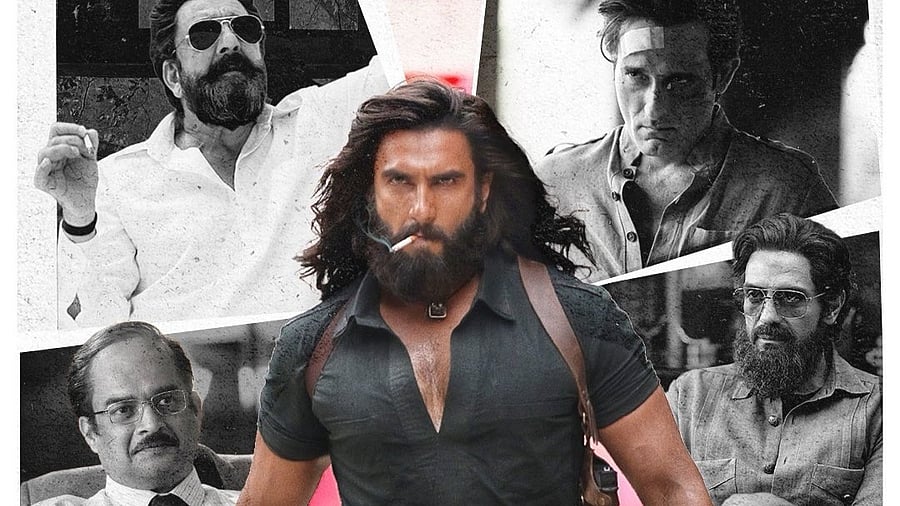
Poster of Dhurandhar.
Credit: Jio Studios
The box office success of mainstream Indian cinema is increasingly dependent upon its grandeur and entertainment quotient, now loosely captured as the ‘theatre experience’. Explanations on the massive success of Aditya Dhar’s Dhurandhar are also on a similar track, where it is argued that the film mostly serves the populist-spectacle narrative, catering to the sensibilities of the general cinemagoer.
Film critics often have this urge to reduce contemporary popular cinema either as works that further political propaganda or masala escapism. A deeper examination of these films will, of course, demonstrate that their themes overtly supplement the political values of the governing elites (Dhar’s Uri: The Surgical Strike endorses the current regime’s claims about its anti-Pakistan military actions), propagate patriarchal and conservative ideas (Kabir Singh), and utilise a communal rhetoric to villainise the Muslim (The Kashmir Files and The Kerala Story). However, to reduce the majority of successful films merely as ideological tools or banal entertainers is to ignore the creative artistry that makes this form of cinema consistently resonate with the viewer.
Many critics of Dhurandhar fall into similar territory. They question the political instrumentality of the film’s narrative that propagates hatred against Pakistan, supplements the hyper-nationalist rhetoric of the dispensation, and distorts facts around sensitive events that are relevant to national security. Such criticism risks reducing the art of cinema to an ideological instrument, utilised by the dominant elites to serve their political and commercial interests. There is merit in this assessment, but the argument that films like Dhurandhar shall represent the historic truth in authentic and politically correct ways is fundamentally flawed.
Popular films work on an emotional core, imaginative narrative arcs, and creative autonomy. Films based on real events, especially, cannot be made without these elements. Without the rich infusion of drama (like in The Legend of Bhagat Singh), emotional connect (Gandhi), or a good musical score (Razia Sultan), they could end up as dull docu-fiction.
Mainstream cinema has often engaged with history in its own creative ways. In Hollywood, Steven Spielberg’s Schindler’s List has used imaginative symbols to create an emotional truth that facts alone cannot convey. Cinema does not have to be based upon raw fact-sheets; it requires emotional scales and relatable characters to create an interesting viewer experience. Tweaking history and creating imaginative subplots have produced hugely entertaining cinema, like Quentin Tarantino’s Inglourious Basterds.
The classic Hindi film Mughal-e-Azam is a fine example, where characters from history are dramatised to build a strong, emotional story. Another example of this style is seen in Anurag Kashyap’s Black Friday. The film is centred on a gritty police investigation into the 1993 blasts in Mumbai; it showcases real events and people, but uses a fictional subtext. Though the film claims to represent recent history, without the help of fictional bridges and emotional values, retelling such sensitive events would be unwieldy. The film also balances the moral binaries and does not fall into the trap of political correctness.
Biographies such as Paan Singh Tomar and Bhaag Milkha Bhaag have also utilised imaginative methods to create convincing, entertaining cinema. Do they portray history as absolute or their leading men with all their inherent complexities? These films may not be authentic representations of what really happened with the protagonists, but a certain creative liberty is critical to the overall experience a film delivers. Beyond political correctness, it is the creative impulse that makes these films work.
The aesthetic solace
Dhurandhar shall be judged not only as a populist right-wing political expression, but also as a bold cinematic experiment. The narrative is fictional, but when packaged with a political subtext and a few smartly placed references to real-life events, the film becomes more compelling than the average escapist fare. The film’s visual finesse is striking – the audience connects with it not entirely for its right-wing propaganda; it also comes with a good music score, impressive writing, ace performances, and exciting action choreography.
Dhurandhar may fit a larger genre of pro-establishment cinema. However, its stunning commercial success is not dependent upon its political identity alone. It is difficult to divorce cinema from its purpose to serve the dominant social and political ideas. Filmmakers have often utilised cinematic liberties to supplement the ideological values of the powers-that-be. But this exercise becomes even more influential when cinema offers superior aesthetic values, technical competence, and innovative narrative styles, ensuring an emotional connection with the audience.
(The writer is an assistant professor at the Centre for Political Studies, School of Social Sciences, Jawaharlal Nehru University)