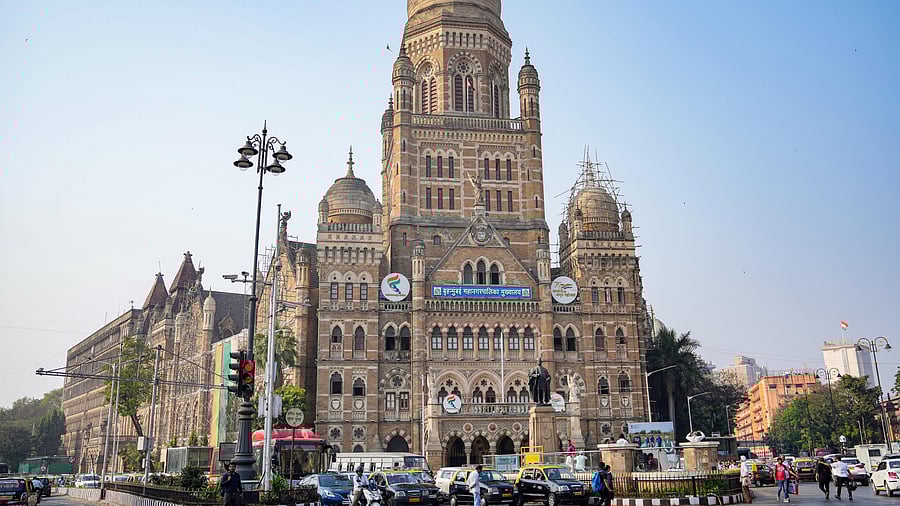
The Brihanmumbai Municipal Corporation building in Mumbai.
Credit: PTI File Photo
Recently, Mumbai’s municipal commissioner was forced to apologise apologise in person to the Bombay High Court for having directly requisitioned the services of court staff for election duty, overruling the chief metropolitan magistrate’s letter saying they were exempt.
Rarely does a bureaucrat overrule a judicial order as soon as it is passed. What prompted this?
Elections to the Brihanmumbai Municipal Corporation (BMC) will be held on January 15, after almost a decade. The last election was in 2017. Since 2022, when the terms of the elected corporators expired, Asia’s richest municipal body has been under the control of the state government, with its commissioner reporting only to the chief minister, and with no elected representatives present to question his actions.
Was it this unbridled power that led to the commissioner daring to flout the chief metropolitan magistrate’s order? In his defence in court, 59-year-old IAS officer Bhushan Gagrani did what senior babus mostly do: blamed a junior for what he described as an “error”. Not satisfied, the court asked him to come back after three weeks with a detailed explanation.
Soon, elected corporators will occupy the BMC, and such examples of hubris will hopefully reduce. But will Mumbaikars finally get a representative city administration? Citizens’ charters, drawn up by upper-middle-class voters, emphasise pothole-free roads, proper footpaths, and air pollution. Slum dwellers complain about food inflation, deteriorating municipal hospitals, and the threat of ‘redevelopment’ of their homes without their consent.
But these concerns have been drowned by the cries of ‘danger to Marathi asmita’ or Marathi identity, the dominant issue in the election campaign.
While it is true that Marathi-speaking residents are gradually being pushed out of the city’s traditional working-class areas, where, after the closure of textile mills, fancy towers replaced chawls, it is ironic that those responsible for this development are vociferously raising the issue.
Both sides of the political divide invoke Bal Thackeray as the guardian of Marathi asmita, but the BMC was under the Shiv Sena chief’s remote control when the builder-contractor lobby began influencing its policies.
Its grip has only got stronger in the last decade, to the extent that today the BMC is shutting down its Marathi-medium schools, saying they are unsafe, so that the land on which they stand can be given to builders. That’s the allegation made by parents as well as the Marathi Abhyas Kendra, an NGO working for Marathi language and culture. Since 2023, of the 28 municipal schools closed citing ‘redevelopment’, 17 were Marathi medium.
Letters to the BMC commissioner demanding details of structural audits conducted on these schools have gone unanswered.
For the last three years, the BMC has starved the city’s pride, the BEST, of funds; encouraged the use of buses on contract from private agencies, and made no bones about wanting to sell land occupied by bus depots to builders.
Notwithstanding the hypocrisy over this issue by both sides, the alleged danger to Marathi asmita resonates with voters. The last municipal elections, too, were fought on this plank.. Indeed, the first time the Shiv Sena emerged as the largest single party in the BMC was because of this issue, way back in 1985.
This victory was handed to the Shiv Sena by the then Congress chief minister Vasantdada Patil. To spite Mumbai Congress chief Murli Deora, Patil raised the bogey of a centrally-administered Mumbai, separate from Maharashtra.
Thackeray went to town with it, and won 74 seats. In the 2009 Lok Sabha polls, the Congress played a similar trick. It ensured victory by encouraging Raj Thackeray’s fledgling Maharashtra Navnirman Sena (MNS) to contest, knowing that his ‘Mumbai-for-Marathis’ plank would divide the Marathi vote, which would have otherwise gone to the Shiv Sena. This was after the MNS had gone on a rampage against North Indians, calling them ‘outsiders’..
Identity politics continues to reign supreme in India’s financial capital. Chief Minister Devendra Fadnavis was candid about the reason the BJP needed to ally with the Shiv Sena (Eknath Shinde) faction in the BMC polls: each had its own ‘vote bank’, he said.
The BJP’s campaign has relied heavily on the imaginary imminent takeover of Mumbai by Muslims, the ‘Mamdanisation of Mumbai’; ‘a Khan as Mayor’. Everyone knows that the mayor is just a ceremonial post, but why miss out on the chance to win votes by spreading hate!
Given the nature of the campaign, it will be left to Mumbaikars to pressurise their elected corporators to make their city less dangerous, more liveable, and restore its status as a metropolis where everyone feels they belong.
The writer is a senior journalist.
(Disclaimer: The views expressed above are the author's own. They do not necessarily reflect the views of DH.)