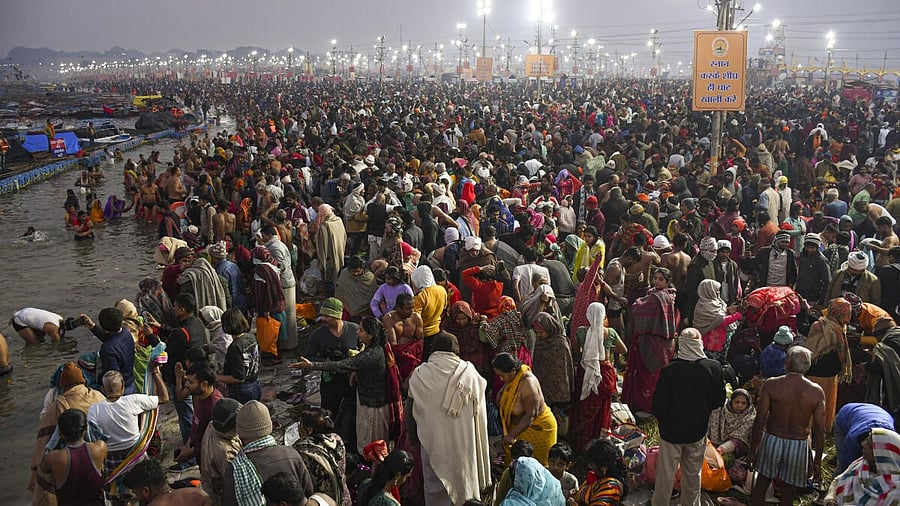
People gather to take a holy dip at the Sangam on the occasion of 'Makar Sankranti' festival, during the ongoing 'Magh Mela', in Prayagraj.
Credit: PTI Photo
When Uttar Pradesh Deputy Chief Minister and senior BJP leader Keshav Prasad Maurya appealed to Swami Avimukteshwarananda, the Shankaracharya of the Jyotish Peeth, to calm his anger following alleged mistreatment of his disciples—including Brahmin batuks (children receiving Vedic education)—by the police at the Magh Mela (an annual ritual on the banks of the Ganga), it signalled the prevailing unease within the saffron party over perceived resentment in the Brahmin community in the state.
Videos purportedly showing policemen pushing and shoving sadhus and batuks, followed by the Shankaracharya sitting on a dharna in protest, went viral on social media, triggering anger among Brahmins.
Avimuktehswarananda claimed that the police had acted on the instructions of Chief Minister Yogi Adityanath and said the fight today was between asli (real) and nakli (fake) Hindus.
Several Brahmin organisations came out in support of the Shankaracharya and demanded an apology from the state government. “The UP government should apologise to Avimukteshwarananda and punish those who misbehaved with his disciples,” said Man Mohan Sharma, president of the All India Brahmin Mahasabha’s Uttarakhand unit.
Large religious gatherings on the banks of the Ganga and at the Sangam—the confluence of the Ganga, Yamuna and the mythical Saraswati at Prayagraj—have historically witnessed gatherings such as Dharm Sansad, where decisions pertaining to Hinduism and politics have often been articulated by seers.
At the Kumbh Dharm Sansad in 2013, the Vishwa Hindu Parishad had demanded the projection of Narendra Modi as the BJP’s prime ministerial candidate, claiming it would “advance” the cause of Hindutva. At the 2019 Kumbh Dharm Sansad as well, seers had demanded the scrapping of Article 370 and the announcement of a date for the commencement of the Ram temple construction in Ayodhya.
While saints and seers appeared divided over the Shankaracharya’s protest, a senior state administrative service official, Alankar Agnihotri—a Brahmin and then city magistrate of Bareilly—resigned, describing the state government as “anti-Brahmin” and protesting against the alleged ‘humiliation’ of Avimukteshwarananda.
In his resignation letter, Agnihotri said the manner in which the Shankaracharya’s disciples—including young boys and elderly men—were beaten by the police has deeply hurt him. “They were dragged by their shikha (choti, which, for the
Brahmins and other Hindus, is a sacred tuft of hair kept at the crown of the
head symbolising devotion and adherence to Vedic traditions). This was very humiliating,” he wrote.
Agnihotri said the incident, a matter of grave concern, reflected an anti-
Brahmin mindset within the administration and government. “Sadly, those who claim to represent the Brahmins are silent,’’ he added. He also slammed the BJP over the incident.
These developments come close on the heels of a meeting of the Brahmin MLAs of the BJP to discuss what they termed the “marginalisation” of their community in UP’s electoral politics. Some MLAs reportedly said their community members were being “insulted” and that the administration routinely ignored their concerns. They stressed the need for Brahmin legislators to be more “assertive” in state politics.
Alarmed by the meeting, state BJP president Pankaj Chaudhary warned the MLAs against holding caste-specific meetings, saying such actions would be viewed as “indiscipline”.
At least one MLA who had attended the meeting, however, chose to publicly challenge the leadership. “Brahmins are considered guides and thinkers in Sanatan traditions. Wherever the Brahmins gather, there is discussion on knowledge and reason that strengthens Hindu identity. Brahmins unite society, not divide it,” BJP lawmaker Panchananda Pathak said in a post on X (formerly Twitter).
Lucknow-based media analyst Sharat Pradhan says Brahmins are unhappy with the BJP. “It seems the BJP has taken the Brahmin support for granted. It thinks the Brahmins have nowhere else to go,’’ Pradhan told DH.
“Brahmins may not be numerically strong (around 10% of the electorate), but they are influential,” he added.
Another analyst pointed to what he described as different yardsticks adopted by the government in dealing with resignations by two senior officials: Alankar Agnihotri, who resigned in protest against the “humiliation” of Brahmins, and Prashant Kumar Singh, Ayodhya deputy GST commissioner, who resigned in support of Adityanath. While Agnihotri was suspended, no action was taken against Singh, a Thakur.
Interestingly, almost all the middle-level leaders, around half a dozen, who resigned from the BJP in protest against the UGC’s Promotion of Equity in Higher Educational Institutions Regulations were from the Brahmin community.
While the state BJP leaders dismiss any resentment within the Brahmin community, rival parties such as the Samajwadi Party, Congress and the BSP have already begun efforts to woo the community.
Brahmins can influence the outcome in 60-70 seats across about two dozen districts, mainly in the eastern, central and Bundelkhand regions. In the 2007 Assembly polls, the community had backed the BSP under Mayawati. Since 2014, however, Brahmins have formed a core BJP support base—and any shift in their support could adversely impact the party’s electoral prospects.
(Disclaimer: The views expressed above are the author's own. They do not necessarily reflect the views of DH.)