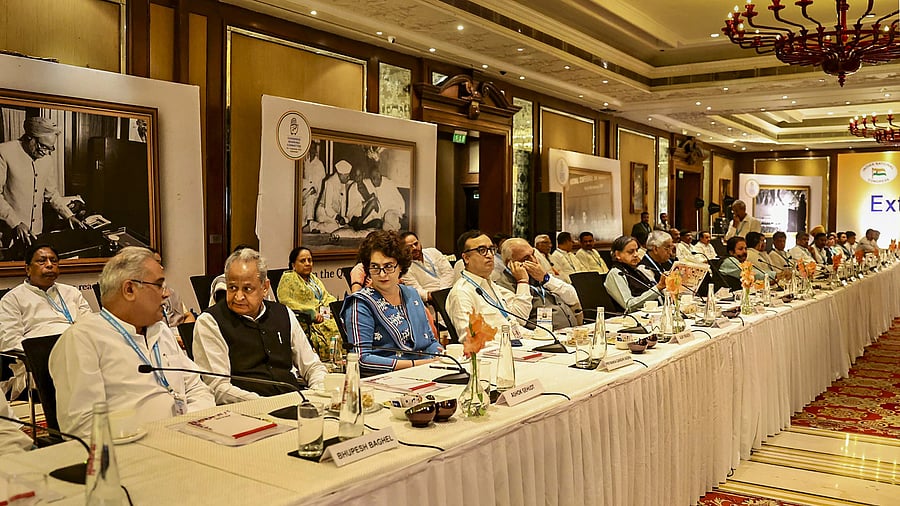
Congress leaders during the second day of Congress Working Committee (CWC) meeting, in Hyderabad, Sunday, Sept. 17, 2023.
Credit: PTI Photo
The first meeting of the newly constituted Congress Working Committee (CWC), which was held on September 16 and 17, didn’t really break any fresh ground, as some may believe, but it did show glimpses of potential. There is a possibility that in its new avatar, it can build something even for the immediate term.
What did the CWC meeting tell us? First, we received confirmation that the Gandhi family remains at the centre. The agenda will be set to a large extent by Rahul Gandhi, in conjunction with his mother and sister, even though he doesn’t currently hold any office in the party. The question, however, is how he will function: will he follow a path of broad-based consensus, or continue to operate through a clique?
The clue lies in the role party president Mallikarjun Kharge seems to already have adopted. Kharge is not a rubber stamp. There was every indication before the CWC met that he had a more expansive role than most people had thought he’d have — managing the Karnataka election was the acid test. It was enough of a demonstration that Kharge was a proactive party president.
The process of constituting the new CWC had also demonstrated two things: that Kharge did indeed have some amount of autonomy, despite the fact that in the ultimate analysis, the Gandhis run the party; and, that the new style was to be more inclusive than that of the past four years. Members of the G23 were brought on board and efforts were made to keep as many interest groups in the loop as possible.
A jumbo committee was the inevitable result, but given one element of the Congress’ history, beginning with its mass phase under Mohandas Gandhi’s tutelage, this problem can be dealt with. The Congress has always favoured functioning through a top-led consensus. That is, whenever serious differences of opinion or political contests surface, an oligarchy — which came to be known as the ‘high command’ — would propose and dispense solutions that would eventually cohere as a consensus. That is possibly what will continue to happen, with the Gandhis leading the oligarchy, navigating turbulences, and making sure that solutions are proposed and accepted.
But for that style to work the Congress will have to undertake some tasks that it avoided at the just-concluded session, perhaps because of imperatives imposed by the special session of Parliament that began on September 18. These are principally organisational. If there was ever any doubt that organisational strength and coherence are key elements of specifically electoral and generally political success, the past decade or so and the Bharatiya Janata Party (BJP)’s extraordinary successes should dispel them.
The CWC was big on rhetoric — we’ve heard most of what was said at the meeting before. We also already knew that the party has decided not to get sucked into debates on primordial and identitarian issues and cleave closely to those of bread and butter, and repression, to expose the regime. Perhaps it was necessary to reiterate them from the CWC pulpit. But once the special session of Parliament is over on September 22, the CWC must immediately begin the work of organisational consolidation. This means that in a general sense, it must refurbish its organisation in key states, district level upwards, to begin with.
But assembly elections are impending in Chhattisgarh, Madhya Pradesh, Rajasthan, Telangana, and Manipur. In these states, the organisational consolidation must be inflected to meet the exigencies of electioneering — so, refurbishment must proceed upwards from booth committees. It’s a task that cannot be avoided. It is also necessary for the CWC to announce the itinerary for the next phase of the Bharat Jodo Yatra, which could carry forward the game-changing programme.
Before we end, a word on the Opposition’s decision to boycott some ‘news’ channels and anchors. The BJP, risibly, has accused the Congress of curtailing the freedom of the press, given Prime Minister Narendra Modi’s virtual boycott of the press since coming to power and State-sponsored attacks on journalists and the media that we have seen and continue to see.
But there is an equally important issue: a significant section of the electronic media and ‘star’ anchors have been responsible for helping the ruling party subvert the democratic process. In doing so, they have subverted the foundations of the media itself. The Indian National Developmental Inclusive Alliance (I.N.D.I.A) has done India, no pun intended, a favour by calling them out.
We have seen the green shoots — but the Grand Old Party must tend to them carefully.
(Suhit K Sen is author of ‘The Paradox of Populism: The Indira Gandhi Years, 1966-1977’.)
Disclaimer: The views expressed above are the author's own. They do not necessarily reflect the views of DH.