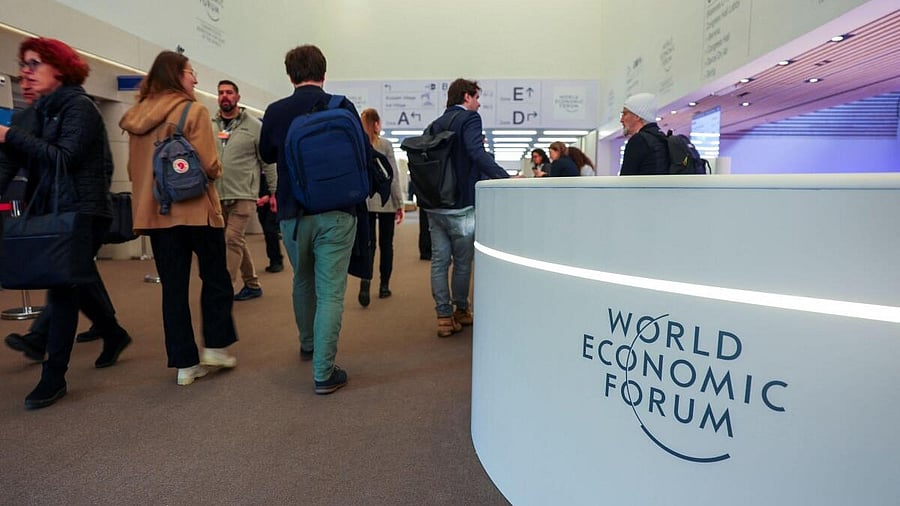
56th annual World Economic Forum (WEF) meeting in Davos.
Credit: Reuters photo
Davos has perfected a rare human skill: the ability to speak continuously without saying anything new.
It is an echo chamber, but not an accidental one. It exists precisely to reassure important people that they are important, and to let them announce what they had already decided to do before arriving.
The mountain air helps. So does the exclusivity. For five days every year, the world pretends that a town square can be rented, ticketed, and curated, and that history can be nudged politely over coffee or something even stronger.
Yet this year, something slipped through the choreography. Beneath the declarations and applause, there was anxiety. Not performative concern for the planet or inclusive capitalism, but the old-fashioned fear of self-preservation. Governments, it turns out, are selfish. This is not a revelation. But Davos usually disguises this instinct under the language of co-operation. This time, it did not try very hard.
No more pretensions
United States President Donald Trump’s speech made that explicit. He spoke less like a custodian of a global order and more like a real estate negotiator with nuclear codes. Greenland, he said again, was necessary for the US’ security. Allies were reminded of their price tags. Trade, defence, and geography were discussed as assets to be acquired, not relationships to be managed. The important thing was not whether these positions were new, but that they were stated so plainly on a platform designed for diplomatic euphemisms.
Canada’s prime minister responded with unusual candour for Davos. The post-War order, he suggested, was cracked. Rules were fraying because power had lost patience with them. Europe, meanwhile, appeared genuinely startled. The idea that the US could speak of taking Greenland forced a long-deferred awakening. For years now, Europe has behaved like a landed aristocracy in decline, living off inherited security and moral authority, outsourcing hard power while hosting conferences on values. It only began to worry about geopolitics when geopolitics arrived at its doorstep.
This is what Davos revealed in 2026, despite itself. The world is no longer pretending very hard that shared ideals matter more than national survival. The language of collaboration is being replaced by the grammar of leverage. Middle powers are being told, not unkindly, that nostalgia is not a strategy.
Chronic discomfort with strategic networking
Against this backdrop, India’s behaviour at Davos looked strangely disconnected from reality. India’s delegations arrived in impressive numbers, armed with optimism, slogans and memoranda of understanding. State governments announced MoUs with Indian companies, often from their own states, as if Davos were a distant cousin’s wedding where one must make an appearance to prove relevance.
There is something deeply Indian about this. We are excellent at ceremony and uneasy with follow-through. The MoUs serve a civic purpose: they reassure citizens that their state matters globally. Whether these agreements translate into investment or jobs is a later, less photogenic question. We are tolerant of such ambiguity. We are used to promises that mature slowly, or not at all. Look at the state of our cities as an example.
But the larger problem is not the MoUs. It is our chronic discomfort with strategic networking. Indians go to Davos and meet other Indians. They behave as if they have gathered at a hill station version of The Belvedere, exchanging greetings with familiar faces they often meet in Mumbai or Delhi. The global elite becomes a backdrop for domestic networking. Photo opportunities substitute for global heft.
It reflects an elite culture that is inward-looking, status-conscious, and suspicious of long-term alliances that demand intellectual preparation and patience. Strategic engagement requires curiosity about how others think, what they fear, and what they want.
A risky habit
As great powers shed the pretence of benevolence, countries like India need to cultivate relationships that survive shocks. Not friendships of convenience, but networks of trust built through sustained engagement. Davos could be useful for that, if treated as a starting point rather than a stage.
Instead, we perform national confidence while avoiding strategic intimacy. We congratulate ourselves on being noticed, while missing the harder task of being needed. In a world that is re-organising itself around interests rather than ideals, this is a risky habit.
The outrage, of course, has been generous. Davos has been meme-farmed, ridiculed on X, and denounced as a playground of hypocrisy by people who will never be invited and by some who once were. This criticism is not entirely wrong, but it is also largely irrelevant. We confuse the satisfaction of calling out elites with the harder work of understanding power. Amid this noise, one inconvenient truth survives: Davos still matters, not because it is virtuous, but because the people who make uncomfortable decisions continue to show up there.
This year even produced an inconvenient moment of honesty, when a former leader of the IMF, an Indian by origin and global standing, stated plainly that India worries more about GDP than about the air its citizens breathe. It was the kind of remark that should have unsettled policymakers and administrators, but it passed without residue, because air quality demands accountability rather than applause.
Around it, a couple of Indian politicians spoke earnestly of Davos as a place to learn how to solve women’s issues and MSME challenges, a revealing choice of theatre for problems that require proximity, humility, and domestic seriousness, not Alpine endorsement.
Choreographed warmth
Nationalism, when reduced to performance, starts to look like submission to political ambition and corporate capital rather than faith in national capacity — a confusion mirrored by sections of the media that prefer choreographed warmth, playful snowball throwing theatrics, and privileged proximity over the inconvenience of fact-based reporting. This is not journalism so much as edutainment, offered in exchange for access, applause, and the fleeting comfort of relevance.
Davos this year was not about climate pledges or inclusive growth, whatever the brochures said. It was about power quietly reasserting itself. Those who understand this will adapt.
Srinath Sridharan is a corporate adviser and independent director on corporate boards. X: @ssmumbai.
Disclaimer: The views expressed above are the author's own. They do not necessarily reflect the views of DH.