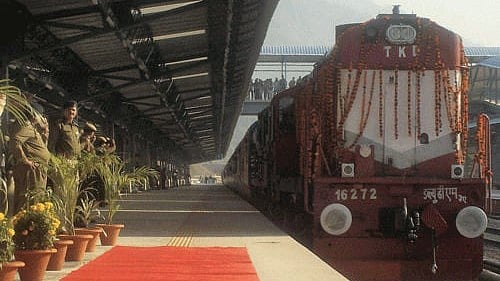
Representational image.
Credit: PTI Photo
Amidst much table thumping, Union Finance Minister Nirmala Sitharaman announced a new dedicated east-west freight corridor from Dankuni in West Bengal to Surat in Gujarat during her Budget Speech. Except there was nothing new in the announcement!
A dedicated freight corridor from Kharagpur to Mumbai was announced by then railway minister Suresh Prabhu in 2016. The extra distance Sitharaman’s announcement covers, between Mumbai and Surat, is approximately 300 kilometres.
Now would be a good time to revisit previous rail budgets to see what else has been reheated and served afresh.
Dankuni is the easternmost end of the freight corridor announced in 2006, which begins from Ludhiana and is operational up to Sonnagar in Bihar. The Sonnagar to Andal section of the EFC, planned in PPP mode, is operational on existing railway tracks.
That there are few takers for the PPP model in railway infrastructure projects is another matter, but the Andal to Dankuni section of the EFC had been dropped altogether till the Bharatiya Janata Party (BJP) remembered now in Budget 2026, perhaps because assembly polls in West Bengal are around the corner.
Couldn’t the government find the funds for the last 500-odd kilometres of the 1,337 km-long EFC that passed through Opposition-ruled states of Jharkhand and West Bengal?
The Budget is silent on the other dedicated freight corridors announced also by Prabhu about a decade back: the Delhi-Chennai or the North-South corridor, and the Kharagpur to Vijayawada East Coast corridor. The third corridor was the East-West corridor from Kharagpur to Mumbai, announced by Prabhu and later extended to Dankuni and Palghar. Some of these projects were to be completed in the PPP mode. As of last year, the detailed project reports had been submitted, and none of the projects have been sanctioned.
While the Railways takes up the work of beautifying railway stations across India at top speed, even though it is the tracks that need improvement, attention is drawn to yet another announcement in the Budget: Seven new high-speed rail corridors connecting Mumbai, Pune, Hyderabad, Chennai, Bengaluru, Delhi, Varanasi, and Siliguri.
In Railway parlance, high speeds are 250 kmph upwards, and such trains are known by another nomenclature as well: bullet trains. The Ahmedabad-Mumbai high-speed corridor project continues to languish even though it is funded by the Japanese, and the estimated cost was about Rs 2 lakh-crore for the 508 km stretch. The current 4,000 km high-speed corridor is estimated to cost Rs 16 lakh-crore. The capital-intensive infrastructure exclusively meant for passenger traffic won’t be able to fall back on cross-subsidisation of a freight corridor to fund itself.
Returning to bombastic speeches, one is reminded of some interesting announcements made by the newly minted government in 2014. The Gati Shakti Vishwavidyalaya, described as India’s first railway university, was proposed in the July 2014 Budget by then railway minister D V Sadananda Gowda. It was announced again in 2015 by Prabhu, and yet again by Prabhu in 2016. In 2017, the Cabinet once again gave its nod for the university, and this time, with the railway budget being merged with the Union Budget, the finance minister once again made the announcement. In 2018, Arun Jaitley made the announcement.
Except the ‘university’ wasn’t being built afresh. Commissioned by the Maharajah of Baroda in 1908 and completed in 1914, the 55 acres of sprawling heritage with ancient trees and lush lawns is already a training institute for officers for orientation and specialised training. It was the equivalent of the Lal Bahadur Shastri National Academy of Administration in Mussorie for training IAS officers or the Sardar Vallabhai Patel National Police Academy.
Will the Railways be in a position to absorb students year after year, and could a new university not have been built, instead of taking over an existing training institute? There are few takers for these questions in the government. Meanwhile, like with the railway stations, the construction of new buildings at the heritage property continues at a furious pace.
Meetu Jain is a senior journalist.
Disclaimer: The views expressed above are the author's own. They do not necessarily reflect the views of DH.