
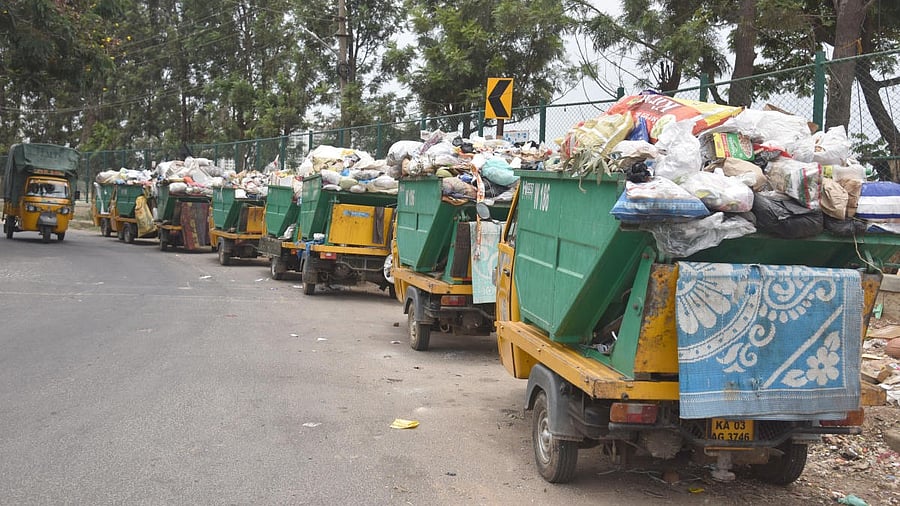
Tipper autos collect garbage from Bengaluru eighbourhoods.
Credit: DH Photo by S K Dinesh
Deputy Chief Minister D K Shivakumar’s recent lament about a powerful mafia choking Bengaluru’s garbage clearance has now been followed by action. The new 33-package garbage tender floated by the Bangalore Solid Waste Management Limited (BSWML) marks a serious attempt to impose discipline on a system long defined by chaos, cartels, and collusion. It signals intent; whether it delivers outcomes will depend on how firmly the state holds the line. At the heart of the new policy is a penalty-driven framework. Contractors can be fined Rs 5,000 for failing to clean markets, gardens or accumulated debris. If more than 10% of sanitation workers are absent, a penalty of Rs 500 per missing worker will apply. Crucially, 20% of monthly payments will be withheld and released only after penalties are deducted, reversing the traditional problem of chasing defaulters after full payment. Monitoring will rely on attendance logs, GPS data, and verified complaints, reducing discretion and, in theory, corruption.
These are welcome reforms. Bengaluru’s waste management history is littered with ghost workers, fake vehicle trips and inflated tonnage scams, all shielded by a nexus of contractors and local politicians. Consolidating 89 ward-level packages into 33 larger ones is also a strategic attempt to weaken the grip of local syndicates and attract more professional operators. However, the tender has visible blind spots. The Rs-100 fine per black spot is laughably low. For a contractor, it may be cheaper to absorb the penalty than to permanently monitor a chronic dumping site. This risks institutionalising filth rather than eliminating it. More importantly, the policy punishes contractors for failures that often stem from flawed civic design. Bengaluru’s ‘no public dustbin’ philosophy works only when door-to-door collection is perfectly timed, but the ground reality is different. Employees working night shifts often miss early morning collection vehicles. With no alternatives, waste inevitably lands on street corners, creating black spots for which contractors are fined.
Part of the solution may lie in reintroducing strategically placed segregation dustbins, which can act as overflow buffers, but they may prove counterproductive if not cleared regularly. Evening collection rounds in high-density corridors and a rapid expansion of ‘kasa kiosks’ – designated drop-off stations for pre-segregated waste into colour-coded bins – are essential. The government must invest with the same seriousness in scientific waste treatment, decentralised processing, and waste-to-energy solutions, rather than continuing an unsustainable dependence on landfills. The new tender narrows the grey areas in which the garbage mafia thrives. But only consistent enforcement will prevent it from being scuttled by vested interests. Bengaluru does not merely need a well-written contract; it needs the courage to implement it.