
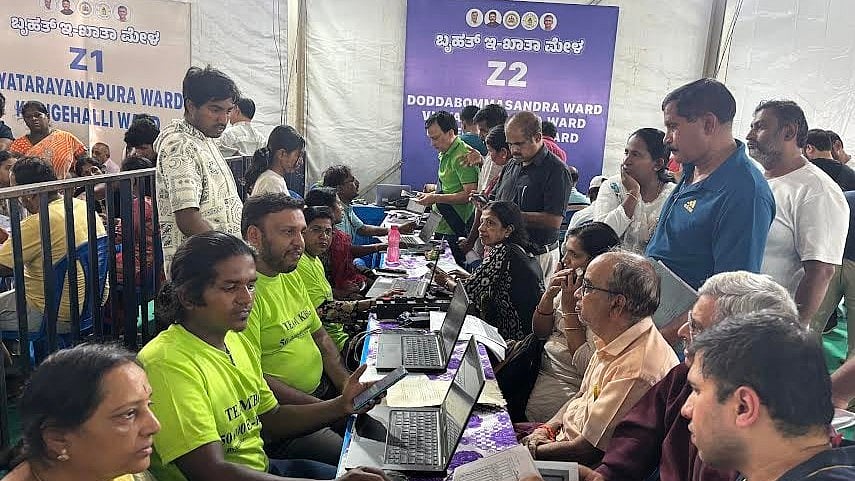
Property owners at the e-khata mela in Byatarayanapura on Sunday. Around 4,000 people had arrived, and 1,679 applications were processed.
Credit: DH PHOTO/Naveen Menezes
The e-khata was conceived as a reform that would spare Bengalureans the agony of running from pillar to post for a basic property document. Instead, it has become a telling example of how digitisation, when layered over a broken administrative culture, can amplify rather than eliminate citizen suffering. That even a retired High Court judge and former chief secretary were reportedly denied e-khata should alarm the government.
For lakhs of property owners, securing an e-khata has turned into a months-long ordeal marked by opaque rejections, technical glitches, and the ever-present shadow of corruption. In the last three months alone, thousands of applications have been rejected within the Greater Bengaluru Area, often without a credible explanation.
According to senior officials, many rejections lacked genuine grounds. A Jayanagar resident who has lived on his property since 1959 had his application approved by a case worker, only to be later rejected on false grounds. It took multiple complaints and top-level intervention to expose the fraud, leading to the suspension of the revenue officer and the zonal deputy commissioner involved.
Such cases point not to isolated misconduct but to a systemic breakdown. The e-Aasthi portal, designed to be “faceless and contactless”, is riddled with software mismatches and backend inconsistencies. Applications are rejected without clear reasons, forcing citizens to guess what went wrong.
The supposedly digital process still depends on human intervention at multiple levels, creating artificial bottlenecks and a fertile ground for corruption. Errors in draft e-khatas – misspelt names or incorrect measurements – cannot be corrected online, pushing citizens back into the very offices digitisation was meant to bypass. Predictably, this opacity has fuelled an ecosystem of touts and middlemen.
Lokayukta raids and recent suspensions have exposed how digital files are stalled or illegally manipulated to extract bribes. The belated decision to constitute special surveillance teams to scrutinise rejected applications is itself an admission that internal checks have failed. The government’s proposal to introduce passport seva kendra-style facilitation centres with defined timelines and accountability is a welcome corrective, but it comes late in the day.
Ultimately, the state government, and particularly Revenue Minister Krishna Byre Gowda, must answer why a reform pushed so aggressively has been allowed to degenerate into a harassment machine. Suspending errant officials is necessary, but not sufficient. Without structural reform, transparency in rejections, and political accountability, e-khata will remain what it has become today: a digital façade masking an unchanged culture of arbitrariness and extortion.