
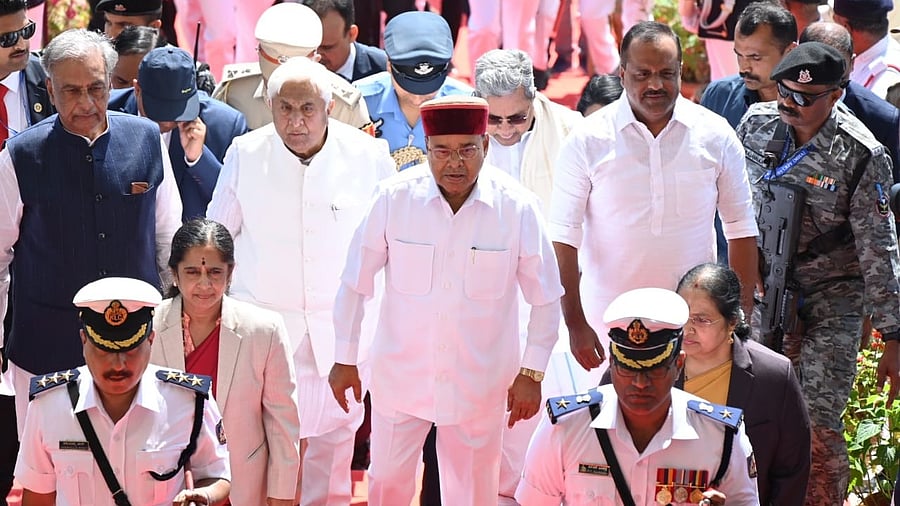
Governor Thawarchand Gehlot leaves without reading the speech.
Credit: DH Photo/ B K Janardhan
It appears that no customary address by a Governor to the legislative assembly in an Opposition-ruled state is now complete without an act of impropriety – refusal to read out the address, skipping parts of it or adding some to the original text, even dramatic walkouts, like Karnataka Governor Thaawarchand Gehlot’s, on Thursday. Gehlot chose not to read the full text prepared by the state government and limited his address to three lines from the draft. The governor’s action conflicts with a constitutional convention and has been described by Chief Minister Siddaramaiah as an insult to the House. In Tamil Nadu, Governor RN Ravi, who has been a serial violator of gubernatorial norms, also declined to read out the drafted address and walked out of the Assembly on Tuesday. Rajendra Arlekar, the Governor of Kerala, skipped some sentences in his address and made additions of his own. The Assembly, opposing the changes, resolved that the address as prepared by the Cabinet would be on record.
Controversies around the customary address have added theatrics to the ongoing tussle between governors and state governments over issues such as assent to bills and appointment of university vice-chancellors. At the centre of this confrontation is the governors’ tendency to undermine their functions as a constitutional link between the Centre and the states, and to act as political agents of the Central government. That these incidents occur only in states with non-BJP governments tells the story.
These annual shows of disruption present the governors and the constitutional office they hold in a poor light. They also deny the right of the legislative assembly to listen to the government. The Constitution does not provide a choice to the Governor in this regard. It has been asserted by several constitutional authorities that the Governor is required to read out the exact text of the speech that is prepared by the state government, spelling out its views and policies. The state government has the right to criticise the Central government, and the Governor has no authority to disapprove of this criticism. An obstructionist office that is guided by political interests and gets in the way of an elected state government has no place in a federal system. Tamil Nadu Chief Minister M K Stalin has suggested that a constitutional amendment be made to scrap the practice of the Governor addressing the first session of the state assembly. This may be considered favourably as it will spare the people of the unsavoury annual spectacle of governors breaking established conventions.