
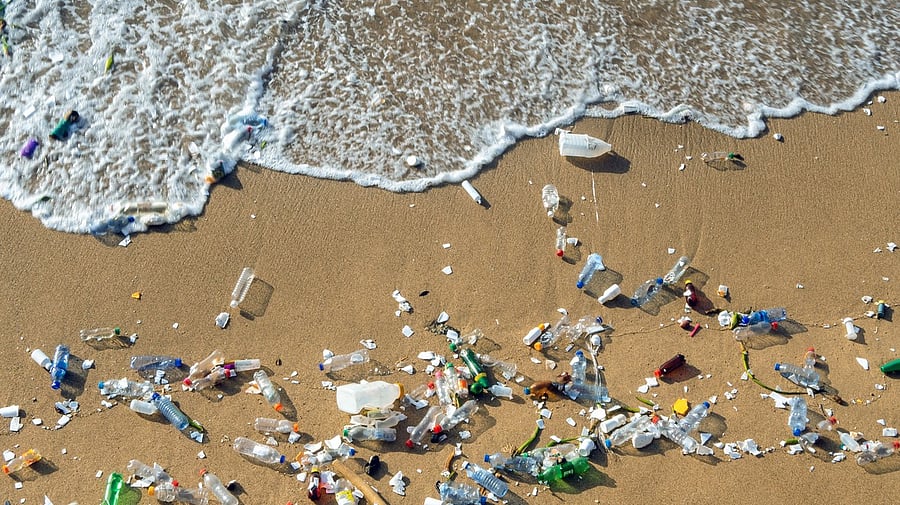
Image for representational purposes.
Credit: iStock Photo
Recent reports of plastic waste from Southeast Asian countries such as Thailand, Malaysia, and Myanmar being found in the Andaman and Nicobar Islands reveal how pollution is taking a distressing, ‘globalised’ turn. The islands, often identified with pristine beaches, have been grappling with plastic debris that adversely impacts their environment. Litter – plastic bottles and bags, parts of fishing gear, and microplastics – impacting reefs, marine species, and food chains has been a global problem.
Every year, more than 11 million metric tonnes of plastic are estimated to enter the oceans. Waste washed ashore from other countries adds a layer to the crisis in India and underlines, yet again, the rampant abuse of oceans in the name of tourism. It appears that no place is now immune to the litter surge.
India was once seen as a dumping ground for plastic refuse, but the import of waste has come down after the country imposed restrictions from 2019. While there are reports of surreptitious arrival of polluting material, they are not in large quantities. But with a long coastline, India remains vulnerable; it has to cope with polluting trash that gets naturally dumped on its shores, damaging the environment and posing serious threats to marine life.
Many of the country’s beaches have been reporting large-scale trashing, but efforts to keep the coasts clean have worked only in isolation. There is no room for complacency. Mitigation has to be anchored in a focused, continuous drive where the waste is efficiently collected and recycled. Existing systems are not equipped to handle these volumes. Furthermore, clean-up efforts cannot be successful without the involvement of local communities.
What is visible on the shores and the seafloors across the world is a mere portion of the millions of tonnes of plastic waste generated every year. Conservative estimates say about 25,000 tonnes of plastic waste, in various forms, are generated every day in India, contributing to a pile of over nine million tonnes a year; only about 60% of it is recycled.
The four ‘R’s prescribed as the long-term approach – reduce, reuse, recycle, and recover – present a compelling model, but have not translated into results on the ground. That even the enforcement of legal bans on the use of plastic bags remains patchy reveals the extent of the problem. Without targeted strategies at the local, national, and global levels, this becomes a race against time, the results of which will shape the health of the environment and future generations.