
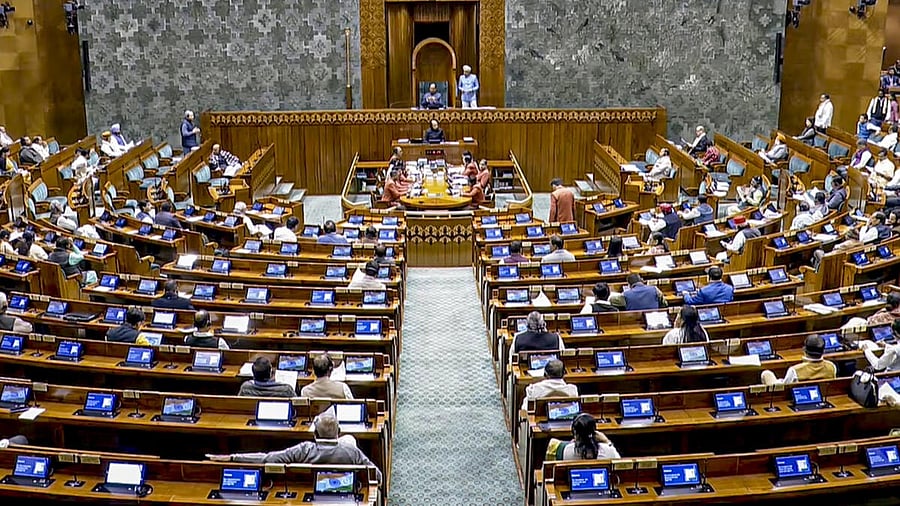
Winter Session of Parliament
Credit: Sansad TV via PTI Photo
Vande Mataram was identified with the country’s freedom struggle and has inspired generations of Indians, invoking their patriotic spirit and pride and love for the country. Bankim Chandra Chatterjee’s composition has played a historic role in the expression of the national spirit. It was rightly chosen as the national song after Independence, and still moves minds and hearts with its text, melody, and mood. It unified the country and its regions, races, religions, and other diversities into one invocation for the motherland. Unfortunately, it is now being sought to be used as a divisive tool for political ends. The debate in the two Houses of Parliament, proposed by the government, to mark the completion of 150 years of the song, was used as an occasion to blame Congress leaders, particularly Jawaharlal Nehru, for “fragmenting” the song. The decision to leave out some stanzas of the original song, which did not agree with the sensitivities of non-Hindus, particularly Muslims, was taken by the Congress Working Committee in 1937 on the recommendation of a committee headed by Rabindranath Tagore. The working committee, which included Subhas Chandra Bose and Sardar Patel, agreed with the recommendation, and Gandhiji endorsed it.
Prime Minister Narendra Modi, who faulted the Congress and Nehru for the decision, saw appeasement of Muslims and even the seeds of Partition in the decision. While he praised Vande Mataram as a unifier, his speech was political and even polarising. The Congress was an inclusive party, and the freedom struggle involved the whole country and all people; and it was right to respect the sensitivities of all sections. By creating controversies over historical events, and interpreting them in terms of narrow political interests and communal and ideological positions, he did not promote national unity. The decision to set apart a day each in the two Houses for debate on the song arose from this narrow political outlook.
Vande Mataram carries an emotional resonance in West Bengal, where the song was born, and where it has more political appeal than elsewhere. Assembly elections are to be held in the state next year, and the BJP has high hopes about them. The focus on the song and a polarising take on it could be part of the party’s electoral narrative in the state. A debate that could have underlined the country’s unity, by harking back to a symbol of the freedom struggle, was used to score political and electoral points. The Opposition pointed out that there are more urgent matters in India that need discussion and debate in Parliament, but the government chose to send out a political message with a display of poor national and parliamentary priorities. Symbols of unity should not be used to divide people.