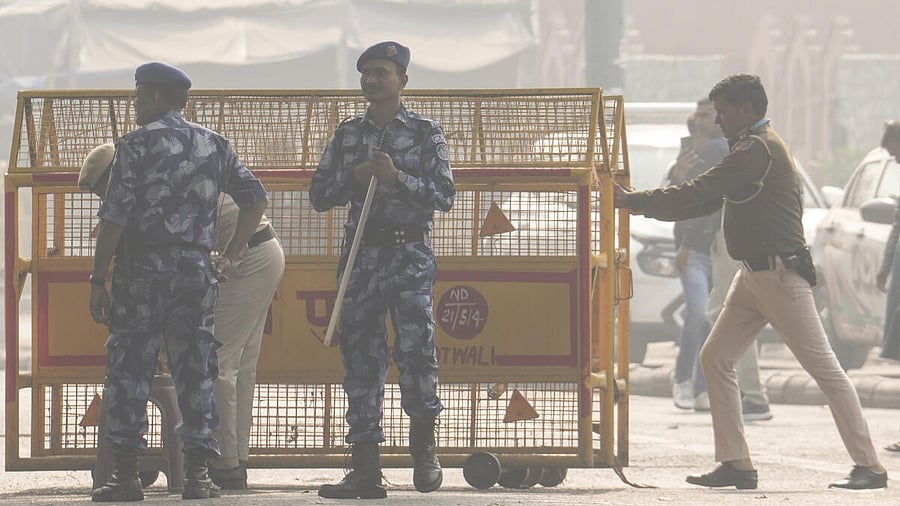
Security personnel keep vigil in a cordon off area near Red Fort after a blast in New Delhi.
Credit: PTI Photo
The Pahalgam terror attack and the November 10 Red Fort blast are going international. Extremist political Islamism, which has been on the decline since the embers of the Arab Spring died on the banks of River Nile and piracy was defeated in the Gulf of Aden, is on the rise again. Sudan is on the boil. An Indian national, radicalised by Islamic State (IS) ideology, massacred Jews observing Hanukkah on an Australian beach last weekend.
The need to defeat Islamist extremism aside, Sudan is one of India’s oldest political projects in Africa, and an important economic initiative with ramifications in energy. Despite Mahatma Gandhi’s commitments back home in the fight for Independence, Sudan was important enough for him to make an unusual foreign visit there in 1935. The first Indian to reach Sudan was a Gujarati, Luvchand Amarchand Shah, in 1856. He was known to Gandhi. Shah persuaded thousands of enterprising businessmen and farmers from Saurashtra to emigrate to fertile and potentially prosperous Sudan. A thriving Gujarati community made Sudan their home until the latest, ongoing civil war engulfed Sudan two and a half years ago. About 4,100 of them had to be evacuated in ‘Operation Kaveri’ by the Indian Air Force and Indian Navy. A few thousand chose to remain. The evacuees need to go back because they have assets in land and commercial interests in Sudan. As Prime Minister Narendra Modi is fond of saying in the context of other conflicts in the world, ‘India is on the side of peace’ in Sudan too. But in the Indian public consciousness, Sudan is a forgotten conflict. That needs to change.
A century and a half after the first Indian settled in Sudan, India played an important role in that country’s destiny as president of the United Nations Security Council (UNSC). Following a Comprehensive Peace Agreement (CPA) which led to the partition of Sudan in 2011, Hardeep Singh Puri was part of a rare visit to Khartoum and Juba — the new capital of independent South Sudan — by the entire 15-member UNSC to pave the way for a peaceful transition. When the transition was in jeopardy, Puri told the UNSC as its rotational president: “Any attempt to put artificial deadlines and preconceived ideas will not be helpful to enhance mutual trust between the parties (in Sudan), nor for the long-term resolution of the pending issues.” The UNSC accepted his advice, and India played its part in bringing peace to Sudan after half a century of civil war.
For a conflict which does not influence domestic public opinion, the Indian government takes a keen interest in developments within Sudan, in part because they intersect New Delhi’s relations with partner nations, in part because they infringe the sanctity of diplomatic conventions. In October 2024, Ministry of External Affairs (MEA) Spokesperson Randhir Jaiswal expressed “serious concern” over an attack on the residence of the United Arab Emirates Ambassador in Khartoum. “We are following the security situation in Sudan. Inviolability of diplomatic premises in any conflict must be respected and reports of attack on the residence of UAE Ambassador in Khartoum is of serious concern.” The UAE foreign ministry “confirmed that the attack by the Sudanese army…constitutes a blatant violation of the fundamental principle of diplomatic premises' inviolability.” If the UAE’s diplomatic premises were the target of a deliberate bombardment, India has suffered collateral damage in the civil war. A fortnight after the current civil war began 32 months ago, the MEA “decided that the Indian Embassy in Khartoum will be temporarily relocated to Port Sudan.” It is still there.
There are no angels on the Sudanese political chessboard. To guarantee its own interests, India’s best bet is to go along with peace proposals worked out by the Quartet — Egypt, Saudi Arabia, the UAE, and the United States. These peace proposals are obdurately opposed by General Abdel Fattah Al Burhan. He is the commander of the Sudanese Armed Forces (SAF) faction and is credited with ties to the Muslim Brotherhood as well as Islamists in Sudan’s army, once loyal to former dictator Omar Al Bashir. The rival faction, the Rapid Support Forces (RSF) led by General Mohamed Hamdan Dagalo, popularly known as Hemedti, has accepted the Quartet’s peace proposals, conveyed through US President Donald Trump’s Special Envoy for Peace in Sudan, Massad Boulos. Burhan is on a regional tour this week, which took him first to Riyadh, and now to Cairo. If these meetings give legitimacy to Burhan, it will be a shot in the arm for political Islam.
ONGC Videsh Limited (OVL) invested $2.3 billion in undivided Sudan’s oil industry. It is now spread over the two Sudans, and is affected by the civil war. A further risk spilling over from the conflict is to Indian personnel deployed in two UN Peacekeeping Missions. The UN Mission in the Republic of South Sudan (UNMISS) has 2,396 Indian troops. The UN Interim Security Force for Abyei (UNISFA), an area disputed between Sudan and South Sudan, has 596 Indian blue helmets. As these lines are being written, a Troika of stakeholders — Norway, the United Kingdom and the US — demanded that the “obstruction of departure as well as in-country movements of UN peacekeepers must stop immediately.”
K P Nayar has extensively covered West Asia and reported from Washington as a foreign correspondent for 15 years.
(Disclaimer: The views expressed above are the author's own. They do not necessarily reflect the views of DH)