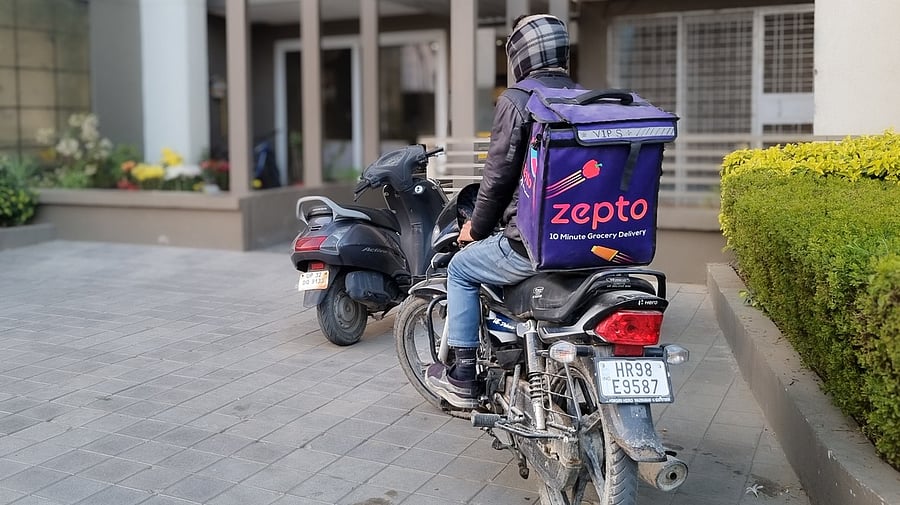
Delivery boy from Zepto standing outside a residential building
Credit: iStock Photo
By Andy Mukherjee
India’s booming quick-commerce industry is on notice. In a New Year’s Eve flash strike, more than 200,000 riders refused to ferry food, grocery and other orders nationwide. While gig workers’ demands for fair pay, safety, and dignity can be addressed to some extent by the platforms that use their services, the union leading the protest also wants a more fundamental change: an end to 10-minute deliveries. That would be a showstopper.
Like everywhere else, the Indian consumer’s fascination for everything to arrive in under half an hour began during the pandemic lockdowns — with daily essentials. But while the likes of Fridge No More, Buyk, Jokr, and Getir died or faded away in the US once shopping habits normalized, the Indian industry just kept getting bigger by shortening delivery times and adding more items — from pillows to prescription drugs — to the list of things available for instant gratification.
Apps like Blinkit, Swiggy Instamart, and Zepto have liberally poured money into so-called dark stores, strategically located warehouses dedicated to fulfilling online orders. Traditional retailers, led by tycoon Mukesh Ambani, and e-commerce heavyweights like Amazon.com Inc. and Walmart Inc.’s Flipkart, were late to the party. But now they’re also investing feverishly. Real-estate broker Savills Plc expects a threefold growth in dark stores by 2030 — to 7,500 from 2,500 — as the craze for everything arriving in 10 minutes spills over into smaller Indian cities.
The strike has sparked a debate about the cost of this addiction. Apps claim that they don’t put drivers on the clock. But delays do show up as bad ratings, angry calls by supervisors and monetary penalties, forcing riders to engage in risky behavior on narrow, congested, potholed roads that are already notorious for a death every third minute. In the capital New Delhi, being out on the streets means constant exposure to hazardous air.
Even before the recent disruption, investors were getting rattled by calls for better social security for gig workers under India’s new labor codes. Since mid-October, shares of Swiggy Ltd. and Eternal Ltd., which owns food-delivery service Zomato and quick-commerce app Blinkit, have fallen around 20%, even though the benchmark Nifty 50 Index has been broadly stable.
The flash strike has complicated matters. If regulatory diktats nudge consumers to be a little more patient — or force labor to be a little less desperate — the business model breaks down before it turns profitable. The new czars of quick commerce are trying to prevent such an outcome. In a flurry of posts on X, Eternal’s Chief Executive Officer Deepinder Goyal blamed a “small number of miscreants” for obstructing non-striking agents. With order volumes hitting an all-time high of 7.5 million on Dec. 31, the strike had failed to affect operations, he said.
But even while dismissing the strike, Goyal has gone to great lengths to address the rising social concerns. The 10-minute mandate, he says, isn’t leading to unsafe driving — Blinkit riders cover an average distance of 2 kilometers (1.2 miles) at a speed of 16 kilometers per hour. The company pays the premiums for drivers’ insurance. Finally, the average worker earns 102 rupees ($1.13) every hour they’re logged in. (Tips are extra, but meager.) For someone working 10 hours, 26 days a month, that translates into 21,000 rupees monthly, net of fuel and vehicle maintenance. “Now tell me, is this unfair? Especially for an unskilled job, which is largely part time, and has zero barriers to entry?” he asked on X.
Well, the problem with the model is revealed by Goyal’s own data. Very few people are actually putting in the effort needed to earn the 21,000 rupees a month in his hypothetical example. In a year, the average Zomato delivery worker put in 38 days, seven hours per working day. Only 2.3% worked more than 250 days. If gig work is a decent halfway house between abject urban poverty and a formal sector that has few jobs to offer, surely more people will try to maximize their earnings from the platform?
A possible explanation is that India’s massive reservoir of surplus labor makes it hard for gig workers to hit their earnings targets on a steady basis, a failing that quick commerce can’t rectify. Millions of riders voluntarily move out of platforms each year, millions of others join in, but the consumer gets his order picked up and delivered. The slack in the system makes sure that there are always enough drivers available, no matter how unhappy any individual worker may be by the remuneration or the risks.
To cheerleaders of Indian e-commerce, however, delivery partners are embarking on a great capitalist adventure. Even if they don’t join the ranks of middle-income earners, their children will. Disturb the apps now by imposing new obligations, and there will be only poverty to distribute. The trouble with this story is that only the consumer-facing side of platforms is capitalistic. The delivery part is pre-capitalistic. The rider brings his own two-wheeler to work, and buys his own fuel. Even a sharecropper in a feudalistic setup who bought his bullocks and paid for seeds could aspire to an assured tenancy. Where’s the permanence in an app that can arbitrarily suspend a worker’s login ID?
India will have 23.5 million people in its gig economy by 2030, a threefold growth over a decade. In China, where there are many more such workers despite faster job creation historically, things are cutthroat. As my colleague Juliana Liu points out, even bathroom breaks can get in the way of a parcel deliverer’s $1,000-a-month target earnings in Beijing. In both countries, the key to a fairer deal lies with the government. Otherwise, an abundance of choice for customers is just the road to serfdom for workers.
Disclaimer: The views expressed above are the author's own. They do not necessarily reflect the views of DH.