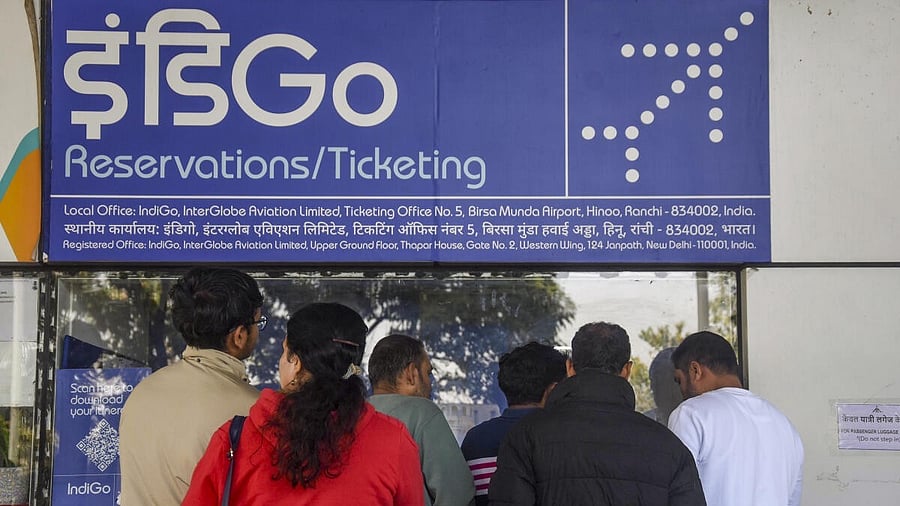
A representative image.
Credit: PTI photo
Never in India’s aviation history has an airline held passengers hostage and threatened to compromise India’s air safety credibility, as seen in the ongoing chaos involving IndiGo, the Directorate General of Civil Aviation (DGCA), and India’s travelling public.
As someone closely following the aviation sector, it was clear that the airline was not in favour of the DGCA’s revised Flight Duty Time Limitation (FDTL) in 2023; especially two key clauses: the mandatory crew rest of two days a week, and limitations on non-stop consecutive night flights.
Safety limits restrict overworking of crew and limit crew fatigue, which had some clear objectives—to improve safety, crew alertness, better cockpit decision making, and improved flight operations performance.
According to our analysis, owing to the grounding of its Pratt & Whitney-affected fleet, average fleet utilisation increased from 13 hours per aircraft to 15.5 hours on the A320 fleet. That indicates that the existing pilot pool was already being stretched to its limits.
Industry sources, which this author spoke to, confirmed that there was a hiring freeze by the airline, and if any new hires happened, it would be from existing cadet pilot programmes. If the DGCA’s FDTL regulation had been implemented, IndiGo would have needed to induct ~974 pilots (commanders and co-pilots), provide for additional reservations for hotel bookings, crew transport, and crew rest areas. Our estimates are that additional simulator checks and recurrent costs would have pushed up costs by at least 60%.
What makes its current actions appear like a ‘pressure tactic’ on the DGCA? IndiGo continues its on-time schedule with its international flights, international flight connections, and international routings. The mass cancellations and disruptions were in the domestic sector. Why is this the case?
One also understands that the FDTL regulations will affect the airline’s flight deck crew, but, the DGCA stays far away from airport staff and cabin crew. If IndiGo was really the victim in all of this, it could have deployed all its off-roster cabin crew and airport staff to support and facilitate stranded passengers while making amends. Sorrowfully, IndiGo passengers were left waiting for hours without proper information, or being able to recover
their luggage, with very little, if no, help in sight.
The current standoff boiled down to who blinked first, and frankly, none of us saw it coming when the DGCA, one of the most rigid, ruthless aviation safety enforcement and regulators, blinked. This, after the revised FDTL regulation was implemented by Air India, Akasa, and SpiceJet, by October.
The DGCA does make provisions for regulations that pertain to airworthiness for a limited time or flight hours, but never has a safety-centred regulation been retracted at the behest of pressure from an airline.
The DGCA’s retraction of its FDTL regulation is not an act to support the industry. Around the world, safety regulations are cast in stone, and can’t be bent or stretched. That’s because crew and passenger safety is sacred.
Managing airline staff fatigue has been under severe scrutiny after an IndiGo pilot collapsed and died in Nagpur shortly before he was to fly in October 2023. Given this, for the DGCA to go back on its stance sends the wrong message that air safety regulations in India are bendable, and can be distorted to suit the industry.
By going back on its safety regulations, even though it is an extension, the DGCA stands to risk unwarranted downgrades, disrespect, and prejudice from influential global aviation regulators such as the ICAO, the EASA, and the FAA.
Crew fatigue, overworking pilots, and not providing adequate rest collocated with lowering safety standards centred as the core of the new FDTL regulation. IndiGo’s answer to the DGCA’s diktat appears to focus on the airline not being willing to spend more money on crew.
IndiGo, which is the current leader of India’s domestic aviation sector, should have shown leadership and maturity by complying with the regulation and not being at loggerheads with the DGCA. In the DGCA’s temporary retraction of its FDTL regulation and the continuing airport chaos and uncertainty, IndiGo doesn’t win. On the contrary, it loses credibility, trust, and integrity, and will be perceived as unethical.
The deeper and broader impact of IndiGo’s rebuttal to safety regulations is the message that the airline is willing to compromise safety for profits. This could have a ripple effect with shareholders, banks, aircraft lessors, Airbus, ATR, and practically all OEMs and vendors connected with the airline.
The DGCA has issued a show-cause notice to IndiGo’s CEO demanding an explanation on the non-compliance with regulations. In the coming weeks and months, public distrust towards IndiGo is likely to grow, while Air India and Akasa are expected to increase flights, fly to more destinations, and enhance capacity — developments that could significantly drop IndiGo’s passenger loads.
As someone with over three decades of experience in the aviation sector and having been closely involved in the operations of five airlines, I am aghast at the stunt pulled off by the airline I once held in high esteem for its efficiency and smooth systems, now seemingly caught in an identity crisis. I often brushed aside the occasional jibes from politicians who claimed IndiGo’s market was too large and powerful, insisting that something had to be done to reduce its share. Ironically, it appears that IndiGo has done this already.
(The writer is a member of the Royal
Aeronautical Society and founder and CEO of an aviation safety firm)