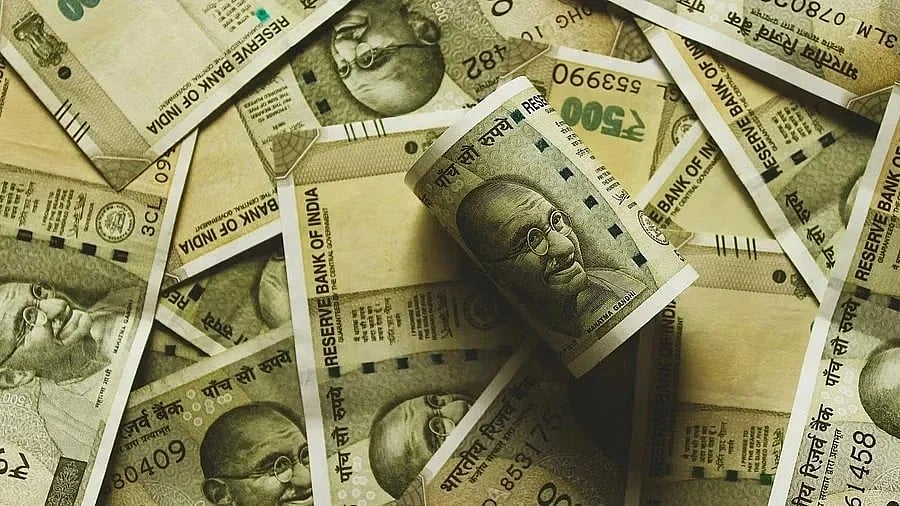
Representative image showing Indian rupees.
Credit: Pixabay Photo
This Friday’s move in the Indian Rupee was small in arithmetic but large in meaning. The currency slipped by 10 paise to 90.44 against the United States Dollar, nudged lower by persistent foreign portfolio outflows and a dollar that has regained muscle.
That this occurred despite softer crude prices and a broadly positive equity mood tells us something important: the pressures on the rupee are no longer episodic or sentimental. They are structural, global, and quietly relentless.
The immediate trigger lies far from Indian shores. The USD climbed to a six-week high after labour market data delivered a blunt message to global markets. Initial jobless claims for the week ending January 10 fell to 198,000 — the second-lowest reading in nearly two years, and far below expectations of a rise to 215,000. This data reaffirmed the resilience of the US economy.
The implication is unmistakable: the US Federal Reserve has little urgency to cut interest rates. Higher-for-longer US rates keep dollar assets attractive, capital anchored in the US, and emerging market currencies under strain. The rupee, like many of its peers, finds itself leaning against a strengthening tide.
At home, the macro picture offered little immediate relief. India’s merchandise trade deficit edged up to 25.04 billion dollars in December from 24.53 billion dollars in November as imports rose modestly.
The increase may appear marginal, but its direction matters. A wider trade gap means more dollars leaving our economy than entering it — a slow but steady drain that becomes more visible when capital inflows are hesitant. In periods when foreign investors are cautious or retreating, such imbalances translate almost mechanically into currency pressure.
This is the context in which India must learn — perhaps finally — to live with a weak rupee.
Not by resignation, and certainly not by ritualistic defence of a psychological number, but by recognising what a depreciating currency reveals, and how it can be managed. Exchange rates are signals before they are statistics. They reflect global monetary asymmetries, domestic demand patterns, and the credibility of long-term economic choices.
A weaker rupee is not, by itself, evidence of policy failure. Nor is it a free lunch. It redistributes pain and advantage unevenly. Exporters, especially in services and manufacturing segments with global pricing power, gain immediate relief as USD revenues translate into higher rupee earnings.
For them, depreciation restores competitiveness eroded by inflation and rising domestic costs. But importers of energy, capital goods, electronics, and fertilisers face higher bills. Households planning foreign education or travel feel poorer overnight. Inflation risks re-enter through the back door.
The task of policy, therefore, is not to fight depreciation as a moral evil, but to shape the ecosystem in which it operates. India’s foreign exchange reserves, now substantial by historical standards, give the Reserve Bank of India (RBI) room to smooth disorderly movements. This buffer is critical.
It allows the central bank to curb panic and one-sided speculation without committing to defend an arbitrary exchange rate. What markets fear most is not weakness, but confusion. A predictable, transparent approach to intervention preserves credibility even when the rupee trends lower.
But reserves are a shield, not a strategy.
Over time, living with a weaker currency requires reducing the economy’s structural hunger for USD. India’s import dependence, particularly in energy, electronics, defence equipment, and high-end capital goods, ensures that growth itself generates demand for foreign currency.
This is not an argument for crude protectionism, but for accelerated capability-building. Strategic domestic manufacturing, deeper integration into global value chains, and a sharper focus on high-value services exports are macroeconomic necessities, not industrial slogans or political memes.
Fiscal and monetary co-ordination becomes especially important in such phases. Currency weakness that feeds into inflation must be addressed with precision. Blanket tightening risks choking growth; excessive tolerance risks eroding purchasing power and credibility.
The distinction between temporary pass-through effects and persistent price pressures must be communicated clearly. The RBI has so far approached these trade-offs with restraint and clarity, and its judgement in navigating inflation, growth, and currency stability merits confidence rather than constant scrutiny.
Capital flows, too, deserve a more nuanced lens. The rupee’s near-term path will hinge on variables largely outside India’s control: the trajectory of US interest rates, global risk appetite, and geopolitical stability. But some factors are domestic.
Foreign portfolio investors have been net sellers in recent months, reflecting not just global conditions but relative growth expectations and regulatory clarity. A favourable outcome from a US-India trade agreement could reverse part of this sentiment by signalling stability, market access, and long-term opportunity. Such deals matter less for their immediate trade volumes than for the confidence they inject into capital markets.
Corporate behaviour also plays a role. Better hedging practices, disciplined foreign currency borrowing, and transparent balance-sheet management can reduce episodes where sudden corporate dollar demand amplifies volatility. Currency risk is a cost of doing business in a global economy and should be treated as such.
Ultimately, the rupee’s movement is a mirror. It reflects the global dominance of the USD, the strength of the US economy, and India’s own choices about growth, trade, and capital. The question is not whether the rupee will weaken at times — it will.
The real question is whether India uses these moments to strengthen its economic architecture, reduce its external vulnerabilities, and build confidence that survives beyond the next data release or deal announcement.
Learning to live with a weak rupee is not an admission of defeat. It is an act of maturity. It means accepting volatility without panic, reform without theatrics, and opportunity without illusion. India’s task is not to outmuscle the USD or mourn the rupee, but to learn how to live with a weaker currency while building an economy strong enough not to be defined by it.
Srinath Sridharan is a corporate adviser and independent director on corporate boards. (X: @ssmumbai)
(Disclaimer: The views expressed above are the author's own. They do not necessarily reflect the views of DH.)