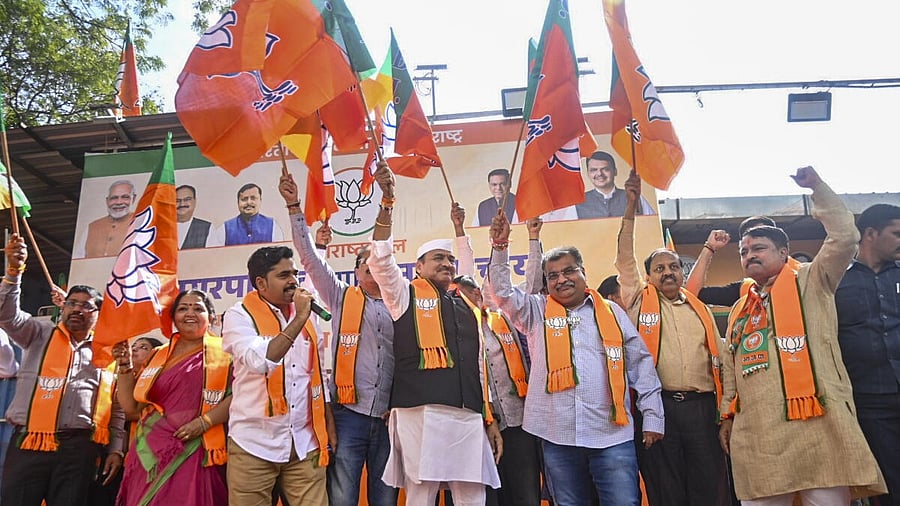
Mumbai civic polls (Image for representation)
Credit: PTI File Photo
As Maharashtra heads into high-stakes civic elections, the spotlight is firmly on the BrihanMumbai Municipal Corporation (BMC), India’s richest and most powerful urban local body that governs the country’s financial capital.
Historically hailed as Urbs Prima in Indis—the first city of India—Mumbai’s civic body, spread across the twin districts of Mumbai City and Mumbai Suburban, administers a metropolis of over 1.3 crore people with a budget larger than that of several Indian states—a whopping Rs 75,000 crore-plus. From roads, drains and public health to schools, hospitals and coastal infrastructure, the BMC shapes almost every aspect of the city’s daily life.
After a prolonged period without elected corporators, the upcoming elections are being viewed as a referendum on urban governance, accountability and political control over the institution that runs one of Asia’s most complex megacities. Yet, as nominations closed, the campaign narrative appears to be drifting away from civic issues towards a sharper political binary — Marathi pride versus Hindu identity.
At a time when Maharashtra politics is dominated by two rival alliances—the Maha Yuti and the Maha Vikas Aghadi (MVA)—the Mumbai civic contest has turned triangular, and in some pockets, even multi-cornered, making the outcome difficult to predict. In local body elections, margins are often razor-thin, adding to the uncertainty.
The last elected five-year term of the BMC, chosen in 2017, ended on March 7, 2022. For over three years, the civic body has functioned without a general body or an elected mayor. During this period, Maharashtra’s political landscape underwent a dramatic transformation—from a largely bipolar contest between the BJP–Shiv Sena alliance and the Congress–NCP Democratic Front to two new and competing formations.
Today, the Maha Yuti (NDA) comprises the BJP, the Eknath Shinde-led Shiv Sena and the Ajit Pawar-led NCP. The MVA—part of the broader I.N.D.I.A. bloc—includes the Congress, the Uddhav Thackeray-led Shiv Sena (UBT) and the Sharad Pawar-led NCP (SP). However, the BMC elections are not being fought strictly on these alliance lines, further complicating the contest.
For nearly a quarter century, the undivided Shiv Sena — first under the late Balasaheb Thackeray and later under his son Uddhav — ruled the BMC. The dominance ended after the party’s political split, which also saw Uddhav Thackeray become chief minister under the MVA before his government was toppled.
The civic polls have gained added significance following the reunion of the Thackeray cousins—Uddhav and Raj—after their acrimonious split in 2005. The Shiv Sena (UBT) and Maharashtra Navnirman Sena (MNS) have forged an alliance centred on Marathi manoos (people), asmita (pride) and bhasha (language).
Their principal challenge comes from the BJP and the Shinde-led Shiv Sena, supported by smaller allies such as the Ramdas Athawale-led Republican Party of India and Anandraj Ambedkar’s Republican Sena.
For Maharashtra Chief Minister Devendra Fadnavis, who calls the shots for the BJP, the brief is clear: secure the party’s first-ever mayor in the BMC — a long-cherished but as yet unfulfilled ambition. In the past, Prime Minister Narendra Modi and Union Home Minister Amit Shah have repeatedly stressed the need for a “triple-engine government” in Mumbai to accelerate development.
The BJP–Shiv Sena combine has foregrounded Hindutva and Hindu identity, if statements by Mumbai BJP president Ameet Satam and his predecessor, State Cultural Affairs Minister Ashish Shelar, are any indication. Their assertion that the BJP will “not allow a Khan mayor in Mumbai”, coupled with references to developments in Pakistan and Bangladesh, has sharpened the polarising pitch.
On the other hand, the Congress—after initially indicating it would go solo, citing reservations about Raj Thackeray’s stand on migrants and minorities—abruptly stitched up an alliance with the Prakash Ambedkar-led Vanchit Bahujan Aghadi (VBA), despite having earlier branded it the BJP’s “B-Team”. The Congress is also backed by Mahadev Jankar’s Rashtriya Samaj Paksha and RPI (Gavai).
Several parties are contesting independently, including the Aam Aadmi Party led by former Delhi Chief Minister Arvind Kejriwal, Akhilesh Yadav’s Samajwadi Party, and Asaduddin Owaisi’s AIMIM. The two NCP factions—NCP and NCP (SP)—are also fighting separately.
“The election is essentially between the Thackerays’ Marathi pride and the BJP’s Hindutva,” said veteran political analyst Prakash Akolkar, who authored the first biographical book on the Shiv Sena. “The key question is how many Marathis vote as Hindus and how many Hindus vote as Marathis—therein lies the answer.”
Akolkar noted that the BJP’s election machinery is working overtime in Mumbai. “The Thackerays, while they came together on the Marathi issue in June–July 2025, they were the last to announce their alliance and seat-sharing. The delay has impacted cadre morale and may have cost the Shiv Sena (UBT) a chance to replicate its Lok Sabha performance in the city,” he said.
The Thackerays have invoked their ideological lineage — from Prabodhankar Thackeray, the legendary social reformer and rationalist associated with the Samyukta Maharashtra Movement, to Balasaheb Thackeray and Shrikant Thackeray — all of whom opposed attempts to separate Mumbai from Maharashtra.
Veteran journalist and civil rights activist Jatin Desai lamented the absence of a substantive civic discourse. “Where are the manifestos? Who is talking about urban planning, public transport, roads and infrastructure? Commuting in Mumbai is becoming increasingly difficult,” he said.
Earlier this year, the BMC presented a staggering Rs 75,427 crore budget for 2025–2026, with total reserves standing at Rs 81,744.42 crore. This exceeds the annual budgets of several states, including Mizoram, Sikkim, Nagaland, Manipur, Meghalaya, Tripura and Arunachal Pradesh.
Veteran journalist Ajit Joshi summed up the stakes succinctly: “It is difficult to predict which way the election will go. The sheer size of the BMC budget is what draws every major political party into this battle.”
Disclaimer: The views expressed above are the author's own. They do not necessarily reflect the views of DH.