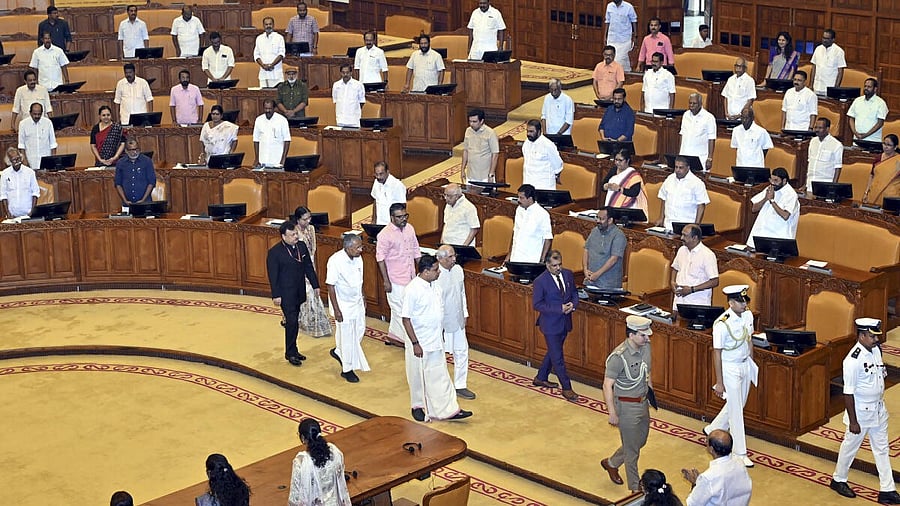
Kerala Assembly
Credit: PTI Photo
Recently, the Kerala government has doubled down its efforts to introduce a ‘Nativity Card’ — a State-issued document aimed at establishing residency and defining who qualifies as a ‘Keralite’. Following Cabinet approval on December 24, Chief Minister Pinarayi Vijayan championed the initiative as a remedy for citizens struggling to ‘prove their existence’, noting that the tahsildar-issued card would serve as an ‘authentic and legally backed’ tool for accessing government services.
The initiative’s political framing crystallised on January 20 during Governor Rajendra Arlekar’s policy address. Confirming that legislation is in its final stages, Arlekar described the card as a means to "foster a sense of pride in being a Keralite alongside being an Indian" — a formulation that effectively elevates regional sentiment into an administratively verifiable identity.
The proposal has now acquired financial teeth. On January 29, presenting the 2026-2027 State Budget, Finance Minister K N Balagopal announced an allocation of ₹20 crore for the Nativity Card.
The same day, the ruling Communist Party of India (Marxist) explicitly framed the initiative as a shield against the Centre’s Citizenship Amendment Act (CAA). In a statement on its official Facebook page, the party declared that the 'Nativity Card' is designed to ‘address the apprehensions’ of those who have lived in Kerala for generations. The post confirmed that the government will enact legislation to issue these cards to all citizens, backed by a ₹20 crore allocation.
With this, a measure initially justified as administrative convenience has begun to take the shape of a formal identity regime — one that risks redrawing lines of belonging in a state marked by high internal migration, a large inter-state workforce, and a constitutional commitment to equality before the law.
What is conspicuously missing from the government’s justification, however, is any serious engagement with the implications this move holds for Kerala’s large migrant workforce — estimated to run into several million — who live, work, pay taxes, and contribute decisively to the state’s economy, yet may never qualify as ‘natives’.
This sits uneasily with constitutional principles. Article 14 guarantees equality before the law, while Article 19 ensures the freedom to move, reside, and practice any profession anywhere in India. The Constitution does not recognise graded citizenship based on regional origin. Any State action that conditions access to public services on nativity — rather than lawful residence — invites scrutiny for violating these foundational guarantees.
The Supreme Court has repeatedly underscored this position. In National Campaign Committee for Central Legislation on Construction Labour vs Union of India and later during the COVID-19 migrant crisis, the court affirmed that migrant workers are entitled to food security, social protection, and dignity irrespective of domicile or place of origin. In its landmark 2021 orders, the court explicitly warned States against denying welfare benefits to migrants on procedural or documentation grounds, directing governments to ensure portability of entitlements and non-discriminatory access to public services.
Against this jurisprudential backdrop, the Nativity Card raises troubling questions. If access to State-run schemes, housing, education support, or employment-linked benefits begins — explicitly or implicitly — to privilege those holding a nativity document, Kerala would be moving in the opposite direction of the apex court’s emphasis on inclusion, portability, and residence-based rights.
The political symbolism is equally concerning. By invoking ‘pride in being a Keralite’ as an administrative objective, the State blurs the line between cultural identity and legal entitlement. In a state long celebrated for its social development model and progressive labour policies, embedding regional identity into bureaucratic processes risks normalising exclusion — especially of inter-state migrant workers who already face linguistic, social, and institutional barriers.
Kerala does face real governance challenges around documentation and service delivery. But the solution cannot lie in redefining belonging itself. Strengthening residence-based identification, improving Aadhaar-linked service access, and fully implementing Supreme Court directives on migrant welfare would address administrative gaps without undermining constitutional values. The Nativity Card, as currently envisioned, does the opposite: it answers a problem of governance by creating a problem of rights.
Kerala’s Nativity Card presents a profound irony: while styled as a shield against the exclusionary anxieties of the CAA, it risks becoming a tool of disenfranchisement against the State’s own vital migrant workforce. This shift threatens to replace Kerala’s celebrated progressive model with a two-tiered hierarchy of belonging.
Ultimately, the measure attempts to solve a routine administrative challenge by manufacturing a far deeper crisis of fundamental rights.
Rejimon Kuttappan is a migrant rights activist, and author of Undocumented. X: @rejitweets.
Disclaimer: The views expressed above are the author's own. They do not necessarily reflect the views of DH.