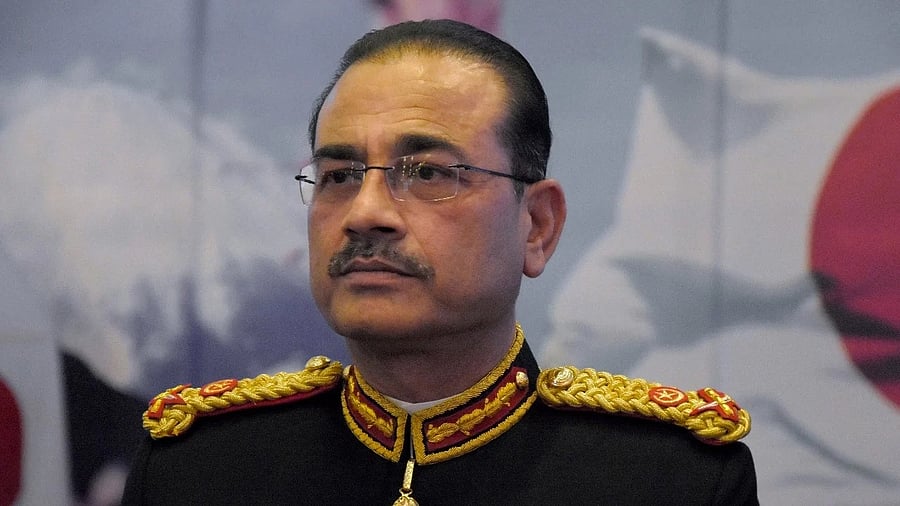
Pakistan Army Chief Asim Munir.
Credit: PTI Photo
This year, the old wisecrack about every country having an army but the Pakistan Army owning a country, will be more of a truism than ever. India’s eminently forgettable Emergency time coinage will now apply to Pakistan. Asim Munir is Pakistan, Pakistan is Asim Munir.
Throughout 2025, Pakistan’s first Chief of Defence Forces, Field Marshal Munir, successfully laboured to create the impression that he — and by extension the Pakistan Army — is the proxy for the will of the people of Pakistan. When United States President Donald Trump hosted Munir for an unprecedented lunch at the White House in June, it became a fait accompli that from then on Munir will be Pakistan, Pakistan will be Munir. It has never happened before that a US president broke bread in the White House with a chief of army staff unless he was also Pakistan’s Head of State.
When the White House stirs, can the House of Saud be far behind? History is proof that Saudi Arabia takes its cue from the US on matters of defence and security. On December 21, the Saudis awarded Munir the Kingdom’s highest civilian honour, the King Abdulaziz Medal (Excellent Class). The medal comes in five categories. The ‘Excellent Class’ is at the top. It is reserved for individuals who have rendered exceptional services to Saudi Arabia.
Last year, India missed the global signals on Pakistan. Just as it misread Trump’s attitude to India early on in his second tenure as US president. Nineteen days after Prime Minister Narendra Modi was in the White House on February 13, Trump delivered his first State of the Union address of his current term to a joint session of both Houses of the US Congress. It was completely lost in the Indian public consciousness that one of the countries Trump chose to praise in this address was Pakistan. It was the first loaded signal that Trump had decided to forget the past and forgive Islamabad for its sins of omission and commission during his previous presidency.
Unfortunately, the Indian public was still heady over Trump receiving Modi, which the Indian government’s spin doctors amplified as a great diplomatic success, pregnant with new possibilities. “I want to thank especially the government of Pakistan for helping arrest this monster,” Trump told the joint session of Congress. The ‘monster’ was a terrorist bomber at Kabul airport in 2021, when the US was trying desperately to evacuate from Afghanistan. Pakistanis know when and how to placate US presidents. This trait is lost on India to its immense disadvantage in relations with Washington, especially with those who move the levers of power in that city now.
Close on the heels of the Saudi award for Munir, President of the United Arab Emirates Sheikh Mohamed bin Zayed Al Nahyan arrived in Islamabad on an official visit. Since 2017, when Sheikh Mohamed was the chief guest at India’s Republic Day, although he was only the Crown Prince of Abu Dhabi then, he had put most of his South Asian eggs in the Indian basket. This trend intensified after he became the UAE’s president five years later. India must not miss the writing on the wall that Sheikh Mohamed last month chose to make his first presidential visit to Islamabad after keeping Pakistan more or less at arm’s length all these years. Munir was conspicuously present at the UAE president’s meetings with Prime Minister Shehbaz Sharif.
There has been much talk in India about how Munir brought Pakistan back into the good books of the White House. Leaving that aside, Munir’s next priority is the Gulf, in particular Saudi Arabia and the UAE. For the Gulf states, this is not a zero-sum game involving India. But for the Modi government, which frequently boasts of having improved relations with countries in the Muslim world, this is no time to rest on its laurels.
The Gulf is set for changes in the new year. The strong bonds between Saudi Arabia and the UAE forged by Sheikh Mohamed and Saudi Arabia’s de facto ruler, Crown Prince Mohammed bin Salman Al Saud, are unexpectedly fraying. They are now rivals in the power play in Yemen, Sudan, and Libya. If this rivalry escalates to the levels when the UAE and Saudi Arabia boycotted Qatar in 2017 — along with Bahrain and Egypt — it will be a headache for India, which has the biggest diaspora in the region in these two countries.
At any rate, India must be on its toes in the new year to ensure that its gains in the Gulf since Modi became prime minister are not eroded. Munir is waiting, ready to fish in the troubled waters of the region for the benefit of the Pakistan Army. India must not take him lightly. It has to more than match the wily field marshal.
K P Nayar has extensively covered West Asia and reported from Washington as a foreign correspondent for 15 years.
Disclaimer: The views expressed above are the author's own. They do not necessarily reflect the views of DH.