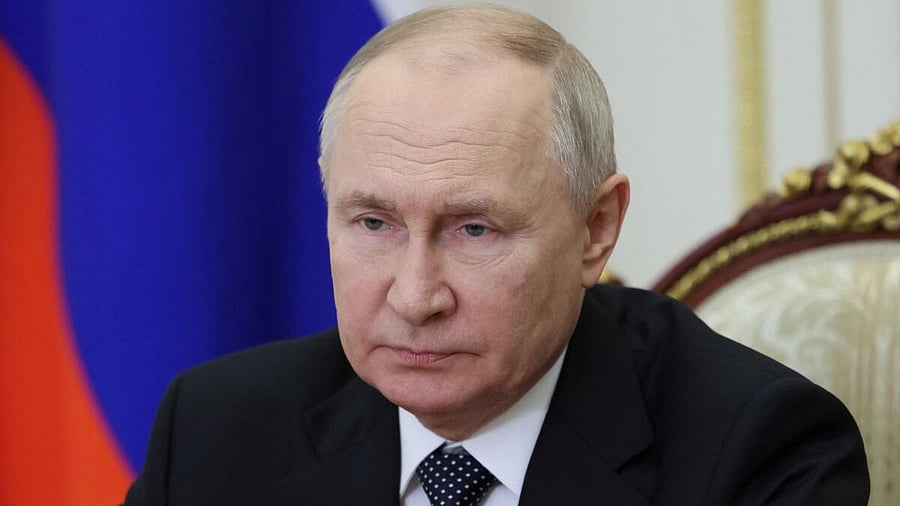
Russian President Vladimir Putin
Credit: Reuters Photo
By Marc Champion
One of the more extraordinary aspects of this turbulent start to 2026 has been the near silence over American adventurism from Russian President Vladimir Putin. This is a man never previously shy to accuse the US of being imperialist, decadent, deceitful or hypocritical, and his restraint is telling. It should concern both Ukraine and Europe.
The first opportunity came when US aircraft broke into Venezuelan airspace, dropped special forces into the heart of the capital and abducted President Nicolas Maduro, a Moscow ally, nominally protected by Russian S-300 air-defense batteries and bodyguards from another Russian ally, Cuba. The S-300s weren’t working, the Cubans were killed — and Putin said nothing.
When Donald Trump then pledged to seize Greenland from its people and Denmark, citing an alleged threat from Russia and China, again nothing was heard from the man in the Kremlin, just some jokes from his aides. Why interrupt?
Putin has been almost as quiet about Iran, as the US has encouraged protests against Supreme Leader Ayatollah Ali Khamenei and threatened military action. Even if Trump on Wednesday took his foot off that pedal, Iran is a far more important ally to Russia than Venezuela, so you’d expect something more from Putin.
Tehran has been a major supplier of long-range drones and missiles for Russia’s war on Ukraine. It’s also in a much more important region of the world for Russian interests and security than Caracas.
Finally, you may not even have noticed, but Russia’s invasion of Ukraine last weekend passed an important milestone, especially for a conflict that Putin continues to call a mere “special military operation.” This war has now continued for longer than the former Soviet Union’s participation in World War II. In Russia, that’s known as the Great Patriotic War.
The heroic and costly Soviet defeat of Nazi Germany has been integral to Putin’s narrative on Ukraine, as he’s tried — successfully — to persuade most Russians that it wasn’t they who invaded another sovereign nation on February 24, 2022, but rather Ukrainian fascists, backed by Western powers, who once again attacked the Motherland.
This gaslit framing of Russia’s attempt to conquer a neighboring country has contributed to a mind-bending revival of the cult of Stalin among many Russians, together with tolerance of ever-increasing domestic repression and loathing of the West.
It's hard to know exactly what Russians think, as reporting there is strictly limited. So, I was grateful to speak with Marzio Milan, an Italian journalist who spent a month fraught with risk to travel down the Volga River in Russia’s heartlands, posing as an historian.
He talked to everyone from beatniks who sought refuge from the war fever on one of the vast river’s islands, to Wagner troops on R&R, to nuns and priests. His book about that trip, Volga Blues, makes for disturbing reading and is to be published in English later this month.
Milan told me he was stunned by the number of teenage Russians he found wearing Stalin T-shirts, lining up to see his wartime bunker in Samara or visiting the museum of Russia’s bloody victory at Stalingrad. He was equally shocked by the general bitterness of feeling against the West and the Manichean, even apocalyptic, language of true believers in Putin’s regime.
As one otherwise thoughtful English-speaking Orthodox priest put it to him while speaking of nuclear threats, if Russians can’t have the Russia they want: “We’ll burn it all down.” A world so evil, the priest said, doesn’t deserve to exist.
The actual trip took place in 2023, so much has changed since. Domestic repression has increased, more body bags are returning home from Ukraine, with more stories of cruelty meted out by Russian officers to their own soldiers, less money and higher inflation.
A December 22 survey by the Levada Center, Russia’s least dependent polling agency, shows support for a negotiated end to the conflict rising to 67 per cent, against 25 per cent who say they want to continue it, the lowest figure since the invasion began.
That doesn’t equate to opposition to the war, let alone to Putin, but it goes a long way to explaining why he might not want to highlight the fact that it’s taken him longer to take the small eastern Ukrainian town of Pokrovsk, than it took Stalin to reach Berlin. And, unlike the more distant American adventures, it isn’t just Putin who was silent on this marker — so too were his officials and media.
My colleagues from Bloomberg News have it from sources close to the Kremlin that Venezuela just wasn’t important enough to fight for, given the much greater stakes Putin sees in Russia’s relationship with the US. The same might also be said of Iran.
An American seizure of Greenland, meanwhile, would likely destroy the North Atlantic Treaty Organization, a net win for Putin that he could only have dreamed of a year ago.
That seems to tell only half the story, though. For the rest, it’s worth asking two questions. First, how could Putin be expected to react to Trump’s imposition of a US sphere of influence in the Western Hemisphere if his goal is to build one for himself in Eastern Europe? Second, had he wanted to stand up against Trump’s America on behalf of Venezuela and Iran, what could he have done about it?
The answer to the latter is nothing — because until he ends his invasion of Ukraine, Putin’s capacity for more global action will remain sapped. Maduro and Khamenei are just the most recent allies Putin has let down.
In 2015 he could send his military to rescue President Bashar al-Assad from imminent defeat in Syria; in 2024, when Assad faced the same threat, Putin could only withdraw what Russian planes and personnel remained in the country.
As to the first question, it makes sense to stay quiet about American adventurism if Putin believes there’s a Yalta-style deal to be made with the US, one that would solve his Ukraine problem by forcing Kyiv to cede what he’s been unable to take by force.
Such an agreement would exchange a de-facto sphere of control for Moscow in Eastern Europe for Putin’s acceptance of whatever Trump wants to do elsewhere — plus, given this is Trump, some ancillary commercial benefits.
What such an accord couldn’t include is any security arrangement for Kyiv that would allow Ukraine to emerge as a genuinely sovereign nation, free to build its economy, integrated with the European Union and protected by meaningful guarantees from NATO-member states.
Nor could it block the Kremlin from establishing its sphere of influence in other areas that Putin considers part of Russia’s birthright.
This is why European plans to deploy a stabilization force in Ukraine seem unreal, even as Trump’s envoys are hosted by Moscow. It would also explain why Trump on Wednesday told Reuters — and has said again and again since taking office last year — that he sees Ukrainian President Volodymyr Zelenskyy, not Putin, as the main obstacle to peace. The implication is that Trump aims to sideline Europe and pressure Zelenskyy into a deal giving Putin what he wants. I sincerely hope to be proved wrong.