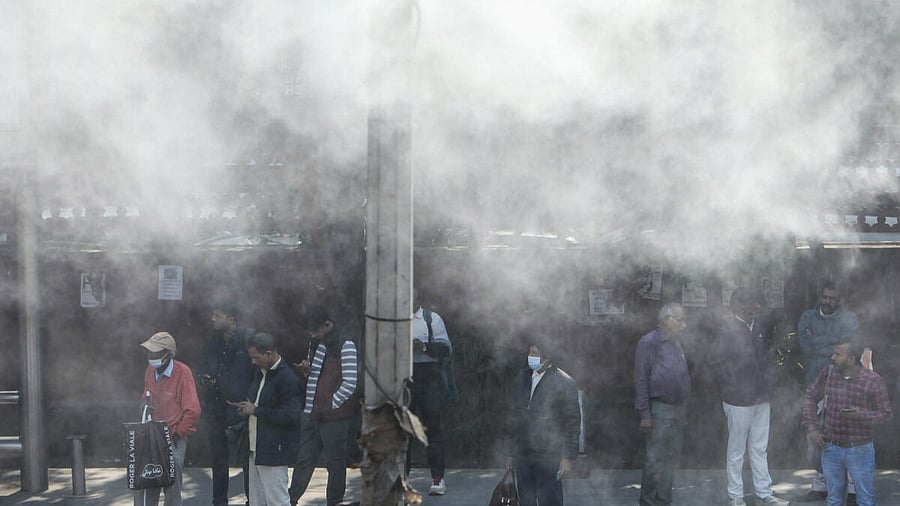
Commuters stand amidst water being sprayed to curb air pollution, in New Delhi.
Credit: PTI
The causes of air pollution in Delhi have been known for about 25 years. In 1999, a group of 200 scientists from different parts of the world, led by atmospheric scientist V Ramanathan, identified and traced the ‘Asian Brown Cloud’, a massive haze covering the Indian subcontinent between October and February, to fossil fuel consumption in industries, power houses, transport systems, and wood-burning by small businesses and households.
Recent research from the Ministry of Earth Sciences and other institutions had similar findings, underlining that biomass burning contributed to nearly 50% of PM2.5 and PM10 in Delhi during winter nights. In 2023, another study suggested that 37% of PM2.5 is caused by coal-burning in industries and power generation. Vehicular pollution is the third-largest cause of pollution. Approximately 220 crore tons of fossil fuel and biomass are burned in India annually; 85% of it is from coal and biomass, and the remaining from oil and gas.
The political tussle between the Aam Aadmi Party (AAP) and the present BJP government in Delhi has deferred temporary solutions. In the winter of 2023, the AAP government, despite assurances, failed to implement cloud-seeding, while the BJP government’s experiment in October this year failed to deliver. Though cloud-seeding has produced good results in drought-prone areas during the rainy season, nowhere has it been successful in winters, when clouds are absent.
Closing schools, suspending construction, preventing the entry of heavy vehicles, sprinkling water on roads, etc., are short-term solutions and have a negligible impact. Millions of people living around Delhi are facing health emergencies, with long-term exposure to pollution threatening damage beyond the lungs.
The situation has been worsening, even as the authorities respond with uninformed strategies. The Delhi Environment Minister’s claim that eight months are not sufficient to fix the soaring AQI levels may fit the political narrative, but it does not inspire confidence for efficient mitigation efforts on the ground.
The Beijing model
In the 1990s, Beijing faced a similar air quality emergency, pushing the Chinese government towards some tough decisions. Coal- and wood-consuming industries were directed to transition to cleaner energy. Wherever there were bottlenecks in developing solar energy at speed and scale, the industries were relocated 400 km away from the city. The government invested heavily in revamping the public transport system, significantly improving accessibility. People were encouraged to cycle. Aggressive promotion of electric vehicles was crucial in the long-term strategy. The authorities also coordinated with counterparts in the adjoining areas on measures to check regional pollution.
Delhi has the option of taking the Beijing route. The priorities and methods have to be aligned with a long-term vision – there is no alternative to stringent controls on biomass and coal burning, and the consumption of vehicular fuel. Temporary solutions will not work. China took two decades to remove its winter haze; Delhi must make a start now to ensure that the National Capital Region is in line with the Viksit Bharat agenda by 2047.
Extensive greening of the Delhi-NCR region needs to be prioritised. The capability of trees to bring relief by absorbing pollutants has largely remained under-explored in our policy statements.
A year ago, the Government of Haryana, with the support of the Union Environment Ministry, came up with a proposal to create a tree wall all along the Aravalli range, from Gujarat to Delhi. The states of Gujarat, Rajasthan, Haryana, and Delhi, during the monsoon of 2025, commenced planting an area of around 1.15 million hectares. The programme was set to be completed by 2027.
The Ministry’s elevation-based redefinition of the Aravalli hills and the Supreme Court’s initial acceptance of the move had created a stir, raising concerns that large portions of the Aravallis would be opened up for mining and real estate. The ruling, which threatened to aggravate the winter haze, stands stalled, with the apex court keeping its original order in abeyance.
Apart from checking the spread of the Thar desert towards the Delhi region, the Aravallis have protected alluvial valleys of the northern plains from the Westerlies. The degradation of these hills over a long period has also led to an extension of urban areas on Delhi’s outskirts, aggravating pollution.
Delhi’s pollution warrants coordinated, multi-pronged action to tackle biomass burning in households and industries, stubble burning in farmlands, industrial and vehicular pollution, and dust from construction sites and roads across states within a 350-km radius. The Aravalli ruling may defer greater degradation of the range, but the pause should not take the authorities’ eyes off the big picture.
(The writer is a former head of Forest Force, Karnataka)
Disclaimer: The views expressed above are the author's own. They do not necessarily reflect the views of DH.