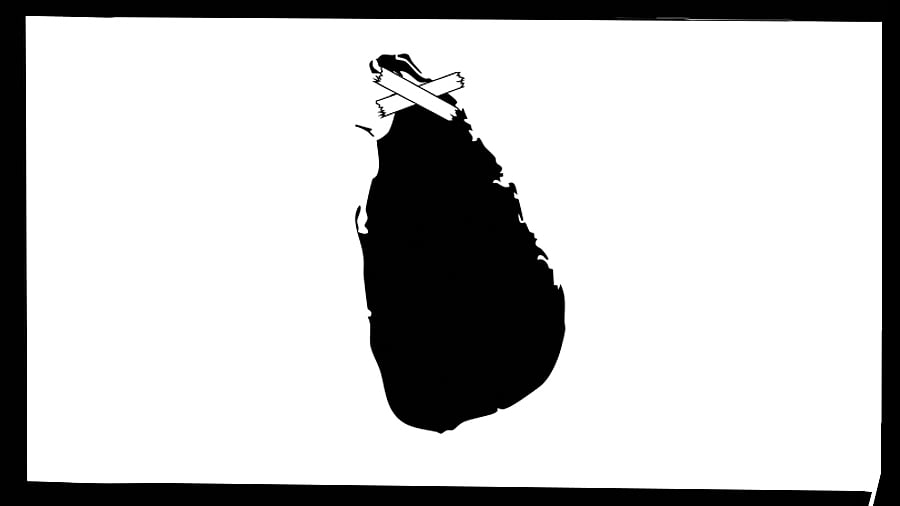
Can you imagine a woman getting chopped into pieces? Someone cutting off men’s genitals and thrusting them into women’s mouths? What will you call men who insert rods into dead women’s bodies? All of this happened when the Sri Lankan authorities gave a free hand to security forces to crush the Tamil Tigers. But even after the Liberation Tigers of Tamil Eelam (LTTE) was militarily routed in 2009, sexual violence against vulnerable Tamil women in Sri Lanka’s northeast has not stopped.
These are the sickening findings in a United Nations report that details sexual violence against combatants and civilians from 1985 (two years after a Tamil separatist campaign began) to 2024, when a centre-Left coalition led by the Marxist Janatha Vimukthi Peramuna (JVP or People’s Liberation Front) rose to power in Sri Lanka.
The report by the United Nations Human Rights Office in Geneva was released on January 13. That it does not name any of the traumatised survivors should not surprise anyone. The document exposes the lengths to which security forces went to dehumanise an entire society just because the LTTE, which claimed to speak for the Tamils, rose in armed opposition against Colombo. These acts, some of which may amount to war crimes and crimes against humanity, were used as a strategic tool to extract information, assert dominance, intimidate individuals and communities, and instil a pervasive climate of fear and humiliation.
According to the report, the incidents were part of a deliberate, widespread and systemic pattern of violence. All of it was institutionally enabled, indicating they were sanctioned by the highest in the government.
Successive Sri Lankan governments have denied much of this, dubbing them unfounded allegations. Even amid credible reports of the deaths of thousands of innocent Tamils in the final stages of the war, Colombo maintained an air of innocence and, instead, accused the LTTE of killing civilians who tried to escape from its jurisdictional custody.
Sri Lankan authorities have failed to adequately investigate or prosecute cases of sexual violence or punish the perpetrators. Many of the Tamils who spoke in confidence to the UN recounted various forms of harm and victimisation, including rape, gang rape, sexual torture, pregnancies resulting from rape, repeated assaults, forced nudity, as well as sexual extortion and sexual exploitation.
The alleged perpetrators included members of the army, navy, air force, the Criminal Investigation Department, the Terrorism Investigation Division, the Special Task Force, as well as anti-LTTE Tamil groups such as the Eelam People’s Democratic Party and the Tamil Makkal Viduthalai Pulikal.
The victims were targeted due to their Tamil ethnicity or alleged past ties to the LTTE. From the 1980s, hundreds of women fought for the LTTE as it became a feared insurgent group, controlling a third of Sri Lanka’s land area and two-thirds of its sea coast. While many joined the Tigers willingly, many underage girls of later years were forcibly recruited.
A complicit system facilitated the crimes
A reading of the report shows that when security forces cracked down on the insurgents, they made little distinction between the fighters, real or perceived sympathisers, and innocent women who had nothing to do with the conflict. Survivors told the UN that the security forces aimed to terrorise the Tamil community to the point of dehumanising them. If this were not the case, the troops would not have committed the degrading acts despite being largely from the Buddhist faith.
A survivor said military personnel cut off the genitals of men and put them in women’s mouths. One woman was chopped into pieces. A former LTTE cadre saw soldiers inserting sharp blades and rods into the bodies of female guerrillas who were dead and whose naked bodies were hanging from the trees. The report noted: “The recurrence of identical methods, environments, and perpetrators across time and locations strongly suggests a coordinated institutional policy aimed at asserting control through widespread and systematic violence.”
It added that the post-conflict State’s failure to ensure accountability for wartime abuses mirrors its continued failure to protect vulnerable groups from sexual violence in peacetime, exposing a continuum of impunity and gendered harms. The report says sexual violence was also employed when the leftist JVP unleashed urban insurrections in 1970-71 and 1988-89. Both periods saw thousands of killings, mainly of suspected Sinhalese members of the JVP, whose surviving leaders now govern Sri Lanka.
But it was during the civil war from 1983 to 2009 that sexual violence came to be used widely against civilians and actual or suspected LTTE members. Detention centres were sites of systematic torture. Both men and women recounted extreme physical abuse during interrogation, including rape, gang rape and general torture. Sex was coerced in exchange for access to visit a relative or to be granted an early release. The absence of access to justice, acknowledgement, and reparations for wartime crimes has created a legacy of impunity that continues to shape the lived realities of survivors.
The report documented a rising trend in rape and incest complaints, from 1,397 cases in 2007 – two years before the war ended – to 2,175 in 2013. Even off-duty members of the army were involved in sexual violence.
The national response to the tragedy was hampered by under-reporting, lack of trust in State institutions,
and the absence of comprehensive data collection.
Also, many survivors refrained from reporting their experiences due to a fear of retaliation, deep-rooted social stigma, and lack of trust in justice mechanisms. There were also multiple barriers within the justice system. Complaints were often trivialised or ignored. Some women complained that the same police officers recording the complaint solicited sexual favours.
The report has made a string of suggestions, including intervention by the international community, through all legal means, including extraterritorial jurisdiction, to investigate and prosecute perpetrators of sexual violence due to the prolonged lack of accountability in Sri Lanka.
The writer is a long-time observer of Sri Lanka and the author of four books on the ethnic conflict.
(Disclaimer: The views expressed above are the author's own. They do not necessarily reflect the views of DH.)