
RAJAT PANDIT
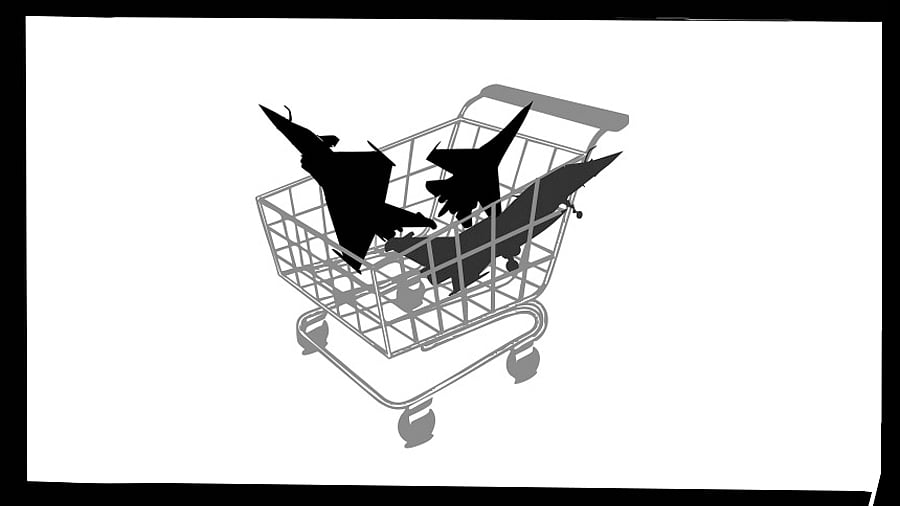
India’s systemic inability to formulate and then execute long-term plans to assiduously build military capabilities to tackle its two-front collusive threat from China and Pakistan is evident once again. The defence ministry’s ongoing move to finalise the acquisition of 114 French-origin Rafale fighters under the multi-role fighter aircraft (MRFA) project, with the bulk of them to be built domestically, is a stark reminder of the country’s lack of strategic planning over the years.
A similar plan to induct 126 fighters under the medium multi-role combat aircraft (MMRCA) project was scrapped in 2015 after a long-drawn competition, in which the Rafale was eventually selected over the F/A-18 and F-16 (US), Gripen (Sweden), MiG-35 (Russia), and Eurofighter
Typhoon jets.
The Indian Air Force (IAF) had first projected the requirement for 126 MMRCA way back in 2000, for which the global tender was finally floated in 2007 by the UPA-2 government. After the other contenders were ejected following technical evaluation, the Rafale had then edged out the Eurofighter in the ensuing commercial evaluation. The final negotiations, however, deadlocked over French aviation major Dassault’s refusal to stand full guarantee for 108 of the 126 jets which were to be built by defence PSU Hindustan Aeronautics (HAL) as well as their huge production costs.
The NDA government, in office by then, finally junked the stalled MMRCA project and went in for the direct acquisition of 36 Rafales, without any transfer of technology or ‘Make in India’ component, under the Rs-59,000 crore inter-governmental contract with France, in September 2016.
Now, it is back to square one. Though the final contours of the MRFA project and price negotiations are still far from being finalised, it is estimated that it could now cost around Rs 3.25 lakh crore – this is almost double the MMRCA project. The IAF, meanwhile, is
in a precarious position, down to
just 29 fighter squadrons (each has 16-18 jets) against an authorised strength of 42.5. In contrast, Pakistan already has 25 squadrons and is looking to acquire 40 J-35A fifth-generation Chinese stealth jets in the near future. With
an air force more than four times the size of the IAF, China is now
even developing sixth-generation fighters such as Chengdu J-36 and Shenyang J-50.
China continues to steadily arm Pakistan to keep India bogged down in South Asia, with Bangladesh also being wooed now as a potential ally in the grand design. During the cross-border hostilities with India in May last year, Pakistan used a wide array of Chinese weapons and sensor-shooter networks, ranging from J-10 fighters armed with over 200-km range PL-15 air-to-air missiles to HQ-9 air defence missile batteries. Beijing even provided Islamabad with real-time satellite feeds on Indian military deployments.
Faced with this collusive challenge in the backdrop of India’s persistent failure to build its own jet engines, the continuing huge delays in production of the fourth-generation Tejas jets and their advanced versions, and the indigenous fifth-generation jet called AMCA (advanced medium combat aircraft) not expected to enter production before 2035, the IAF contends that the 4.5-generation Rafale is the only viable option available to shore up its depleting numbers.
Preparedness is the casualty
The situation on other fronts is equally dismal. Take conventional or diesel-electric submarines. India’s major underwater combat edge over Pakistan also faces erosion now, with the latter slated to induct eight advanced Chinese Hangor-class submarines, with air-independent propulsion (AIP) for greater underwater endurance, from this year onwards.
While India’s mega project to construct six new German-origin submarines with AIP at Mazagon Docks for around Rs 90,000 crore may finally be inked soon, the first boat will roll out only after seven to eight years. This project, incidentally, was granted the initial nod or “acceptance of necessity” way back in 2007.
This lack of proactive planning and execution across multiple fronts, ranging from fighters, submarines, and helicopters to anti-tank guided missiles, air defence weapons, and night-fighting capabilities, rudely jolts India whenever it faces a crisis. Be it the Chinese incursions into eastern Ladakh in April-May 2020 or Operation Sindoor last year, India has to scramble for emergency procurements (EP) of even smaller weapons and arms to plug its critical operational gaps in a piecemeal manner.
The sixth EP tranche, approved after Operation Sindoor, incidentally, ended on January 15. Under it, the armed forces were empowered to build and replenish their stockpiles, with an outer combined limit of around Rs 40,000 crore for capital and revenue procurements from the existing 2025-26 defence budget.
For larger projects, the defence ministry had promulgated the much-touted strategic partnership (SP) model in May 2017 to boost indigenous defence production through tie-ups with foreign armament majors. But this has not taken off due to some inherent problems, including the pricing methodology. The defence offsets policy, too, has largely failed to deliver the goods.
India needs well-crafted concrete long-term capability development plans to ensure the domestic defence-industrial base becomes robust, with greater private sector participation, the armed forces get the requisite capabilities to deter threats, and the country gets the biggest bang for its buck. Amid the ongoing geopolitical volatility, being upended by US President Donald Trump in no small measure, it is a strategic necessity.
(The writer is a senior journalist who writes on strategic/defence issues)
Disclaimer: The views expressed above are the author's own. They do not necessarily reflect the views of DH.