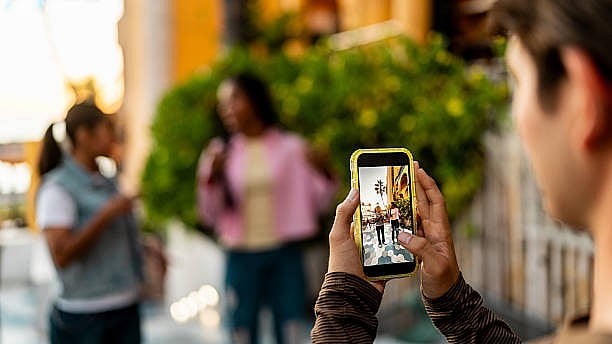
Streets as studios and the missing consent.
Credit: iStock photo
Public spaces—footpaths, restaurants, parks, buses, and trains—once places of practical obscurity and shared anonymity are now open studios for social media content creators chasing virality. Incentives for going viral on short-form video platforms such as Instagram and YouTube have attracted thousands of individuals to the streets to record strangers. A stranger’s reaction, a passer-by’s expression, or a person’s quotidian conduct in public space is edited and uploaded on the internet within minutes. Consent is rarely sought, and strangers are often recorded without their knowledge. Stepping out onto a public street is accepting the possibility of becoming the subject of someone else’s video and remaining on the Internet forever.
While it is easier to spot someone recording in public using a mobile phone or digital camera, wearable recording devices, especially camera-embedded spectacles, make it almost impossible to detect a person recording people in public spaces; a few are being aggressively marketed on social media in India and abroad. These technologies mark the shift from open recording to ‘ambient recording’, where individuals are filmed in public spaces secretly, continuously and pervasively by other individuals. What is recorded is not merely stored for safety or security purposes but is made into social media content for views, comments, sensationalism, and money.
Public spaces are becoming Orwellian. Not because the State is watching, but because social media is watching. The issue of secret non-consensual recording of private individuals in public spaces is not just a social concern but also constitutional. The Supreme Court in K S Puttaswamy v. Union of India (2017) affirmed that the right to privacy is a fundamental facet of the right to life and personal liberty under Article 21 of the Constitution. Privacy is grounded in dignity, autonomy and personal choice. Justice D Y Chandrachud writes in his opinion, “The extent to which an individual expects privacy in a public street may be different from that which she expects in the sanctity of the home. Yet if dignity is the underlying feature, the basis of recognising the right to privacy is not denuded in public spaces.” While the decision of the Supreme Court is a robust precedent against violation of privacy by the State and its instrumentalities, the Indian privacy jurisprudence is underdeveloped to provide remedy against an individual content creator who records videos in public space without consent. Advancement in technology is making people on the streets into digital artefacts.
India’s Digital Personal Data Protection (DPDP) Act 2023 and recently notified DPDP Rules are significant steps towards protecting personal data. However, their application to prevent non-consensual public recording of people in public spaces is limited. In principle, any video (data) in which a person is identifiable constitutes personal data (Section 2(s), DPDP Act). Further, recording, editing and uploading such a video amount to processing personal data under the Act, requiring consent to be taken by the person who is processing the video (personal data). Yet, the Act’s structure and compliance architecture are inadequate to prevent non-consensual recording of strangers in public spaces. The consent and notice requirements under the Act presuppose structured data flows, purpose specification and grievance mechanisms. Even the illustrations given in the Act indicate this. These obligations cannot be practically operationalised by or be enforced on a teenager recording a passer-by on a metro platform or an influencer recording public reaction in a busy mall.
The Act excludes “personal or domestic use” from its scope. However, it is unclear whether content created with the intention of uploading it on the internet (monetised or not) falls within the meaning of “personal or domestic use”. Hence, even though, technically, the Act should apply to individuals filming in public, the compliance requirements and structure might make it impractical. The result is a significant regulatory vacuum.
Addressing this challenge requires legal and ethical thinking about privacy in public space. Even though the expectation of privacy is limited in public spaces, streets, metros, buses, and malls cannot become a stage for content creators to shoot videos of strangers. The European Union, Japan, South Korea and the United Kingdom have started to regulate public filming through data privacy laws, criminal laws, and disclosure guidelines. India lacks a comparable framework for visual privacy in public spaces. Democracy grounded in
the value of dignity, autonomy and self-determination must ensure protection of every individual’s right to decide how they are seen online.
(The writer is an Assistant Professor at Alliance School of Law, Alliance University)
Disclaimer: The views expressed above are the author's own. They do not necessarily reflect the views of DH.