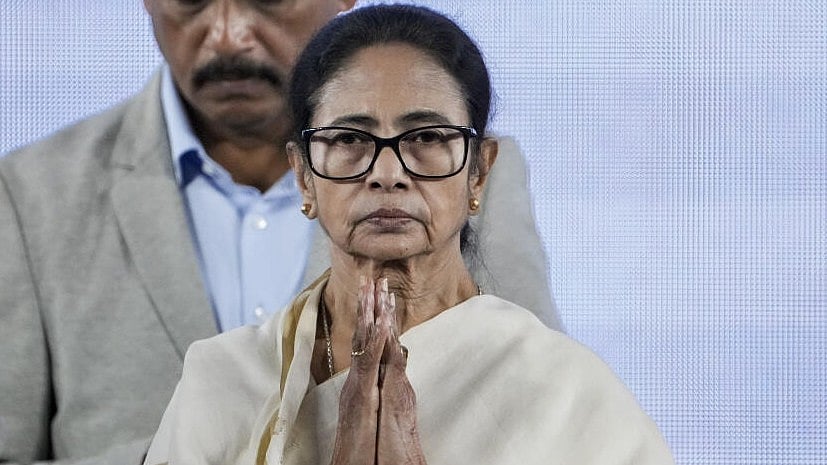
West Bengal Chief Minister Mamata Banerjee.
Credit: PTI Photo
With the West Bengal Assembly elections barely a couple of months away, the contest has sharpened into a familiar yet deeply layered battle between Mamata Banerjee’s TMC and an aggressive BJP determined to breach what has long remained one of its most difficult political frontiers. At stake is not merely the continuation of a government but the ideological direction of a state where identity, history, and political memory carry unusual weight.
Mamata Banerjee enters the election as a seasoned campaigner who has repeatedly demonstrated an ability to defy predictions of her political decline. Over the past decade and a half, she has embedded her party deeply into the social and administrative fabric of Bengal. Welfare schemes targeted at women, rural households, students and the urban poor have created an ecosystem of dependence and loyalty that is not easily dismantled. For large sections of the electorate, especially in rural Bengal, elections are increasingly judged less on abstract governance metrics and more on the continuity of tangible benefits. This structural advantage gives the TMC a head start that no opposition force can afford to underestimate.
Yet this election is not taking place in a vacuum. The BJP has dramatically raised the pitch by foregrounding the issue of illegal infiltration from Bangladesh, seeking to turn border security into a central electoral concern. Citing official figures of thousands of infiltrators being pushed back by the Border Security Force in recent months, the BJP argues that demographic imbalance and administrative complacency have become defining features of Trinamool rule. The party’s leadership believes this narrative has the potential to resonate beyond border districts and strike a chord with voters anxious about jobs, land, and cultural identity.
Whether this argument will travel far beyond politically receptive constituencies remains uncertain. Bengal’s electorate has historically shown a strong resistance to narratives that appear externally imposed or overly nationalistic in tone. For many voters, infiltration remains a distant abstraction rather than an everyday lived concern. Moreover, there is a widespread perception that border management is primarily a central responsibility, making the BJP’s attempt to attribute the problem solely to the state government less persuasive to undecided voters. The party’s challenge, therefore, lies in translating a security discourse into a credible governance alternative at the local level.
The situation in Bangladesh, marked by political volatility and reports of insecurity among Hindu minorities, adds another layer of complexity. While this development has undeniably generated anxiety in certain pockets of Bengal, particularly among refugee-origin communities, its broader electoral impact is ambiguous. Sympathy and concern do not automatically convert into votes, especially when economic stability, welfare delivery, and local leadership remain dominant electoral considerations. The TMC has been quick to counter the BJP’s narrative by portraying itself as a protector of social harmony and accusing its rival of stoking fear for political gain.
Crucially, Mamata Banerjee continues to position herself as the custodian of Bengali identity. Her emphasis on language, culture, and regional pride is not merely rhetorical but deeply strategic. In past elections, this appeal has successfully consolidated minority voters while retaining a significant share of secular and regionalist Hindu voters who are uncomfortable with overt communal polarisation. The support of Muslim voters for the Trinamool Congress remains largely intact and may even have strengthened amid recent debates on citizenship, voter verification and infiltration. This consolidation limits the BJP’s ability to expand its support base and makes the road to power in West Bengal much steeper.
For the BJP, the task is further complicated by organisational limitations and leadership perception within the state. While the party has expanded its footprint since 2019 and commands a sizeable vote share, it still struggles to project a chief ministerial face who can match Mamata Banerjee’s street-level connect and emotional appeal. Central leaders may draw large crowds, but Bengal elections have consistently shown that local credibility matters more than national stature.
That said, anti-incumbency is not entirely absent. Allegations of corruption, local strong-arm tactics, and fatigue with prolonged rule have created pockets of resentment, particularly in urban and semi-urban areas. The BJP is likely to capitalise on these sentiments and could improve its seat tally, especially if it succeeds in consolidating Hindu votes in select regions. However, converting incremental gains into a decisive statewide victory remains a formidable challenge.
At this juncture, the balance of probabilities still favours Mamata Banerjee retaining power, though perhaps with a reduced margin. The TMC’s entrenched welfare network, cultural positioning, and minority consolidation provide it with a resilient electoral shield. The BJP’s infiltration narrative may influence discourse and mobilise its core supporters, but whether it can decisively reshape voter priorities across Bengal is far from certain.
(The writer is a Delhi-based journalist)
(Disclaimer: The views expressed above are the author's own. They do not necessarily reflect the views of DH.)