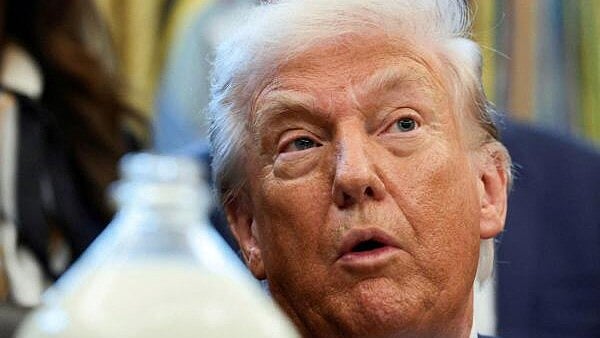
US President Donald Trump.
Credit: Reuters Photo
The blatant flouting of all international norms by America, in entering Venezuela by stealth and taking prisoner its President Maduro and his wife as prisoners to the US, the first worldwide reaction would have been, “There goes Donald Trump’s Peace Prize.”
But if something is a magnificent obsession, as is the Nobel Peace Prize for Trump, nothing can stop him from trying for it. Not one to stay and wait for the Nobel, this POTUS ensured he managed the first Peace Prize instituted by FIFA, which he collected in person. When awarding the prize, FIFA’s President Gianni Infantino (Trump’s friend) said that it had been instituted to honour individuals who had striven hard and made exceptional contributions towards peace.
Many saw this laurel as some kind of a consolation prize for Trump, who had actively campaigned for the 2025 Nobel Peace Prize – among the exorbitant claims were diplomatic efforts in brokering a historic peace treaty between Congo DR and Rwanda, peace initiatives between Israel and Palestine and also efforts to end the attacks on Ukraine by Russia. Also, both on and off social media, Trump repeated ad nauseum his role in ending the India-Pakistan war. Pakistan was quick to follow in formally recommending Trump for the prize by citing his “decisive diplomatic intervention”, whilst India was hardly forthcoming in giving the US President credit.
Despite the FIFA award backlash resulting from the abduction of the President of Venezuela, the football governing body says that they are not reconsidering the Peace Award. They are probably justified in their decision if one were to consider the number of questionable Nobel Peace Prizes.
Probably the most controversial was the 1973 one, given to then US Secretary of State Henry Kissinger, who was named along with North Vietnamese leader Le Duc Tho for a temporary Vietnamese ceasefire through the Paris Peace Accords, which quickly unravelled. The New York Times scathingly termed it the “Nobel War Prize”, while Harvard professors petitioned the Norwegian Parliament, saying the choice was “more than a person with a normal sense of justice can take.”
Interestingly, the Vietnamese Le Duc refused the award, making him the truly noble laureate in history and the only one to decline the Nobel Peace Prize. Kissinger accepted, though he did not attend the Oslo ceremony, offering the implausible explanation of a schedule clash. Two years later when the Vietnam War officially ended, Kissinger attempted to return the award, saying, “The peace we sought through negotiations has been overturned by force.” But the Nobel Committee declined to take back the award, despite two of its members resigning in protest over the selection of Kissinger, breaking the claim of unanimity that the committee chairman had tried to project. Protests continued over Kissinger as an awardee on account of his expanding the Vietnam War into Cambodia and Laos. His support for authoritarian regimes around the world included his role in the 1973 coup in Chile that overthrew the democratically elected presidency of Salvador Allende, not to mention his tacit approval of Indonesia’s invasion of East Timor in 1975.
President Barack Obama winning the Nobel Peace Prize in 2009, with no efforts at conflict resolution, also stirred up a huge controversy, as his opponents claimed that the prize had lost its credibility to “whatever prizes they are putting in Cracker Jacks these days.”
Aung San Suu Kyi, who was awarded the Nobel Peace Prize in 1991 for her peaceful resistance against the military junta, turned out to be another disappointment. After her party’s landslide victory in 2015, Suu Kyi completely changed her approach. Those who saw her as an international symbol of courage watched the betrayal as she personally defended Myanmar and its allegations of genocide against the Rohingya Muslims at the International Criminal Court of Justice. Ironically, Suu Kyi is now under the detention of the same generals whom she first fought against and then defended, in a complete travesty of what the Nobel Peace Prize is meant to stand for.
The actions of her 2025 successor, Maria Corina Machado, are no less questionable, as she dedicated her Peace Prize to Donald Trump, who confirmed CIA covert operations in her country and now took its president as prisoner. After this assault on Venezuela, Machado is believed to have moved from wanting to share her peace prize with Trump to now wanting to hand it to him. The Nobel Peace Committee was quick to issue a “no transfer of prize” statement.
The Nobel Peace Prize in present times seems to have moved in its notion of what a peace prize entails, probably in keeping with geopolitical realities. Hence, it might be possible to see Donald Trump as a future awardee. Even if that were not to be, Trump could probably console himself by saying that he is in good company. The greatest apostle of peace and non-violence, Mahatma Gandhi, was denied the Nobel Peace Prize, despite being nominated five times.
(The author is an independent writer and a keen observer of politics)