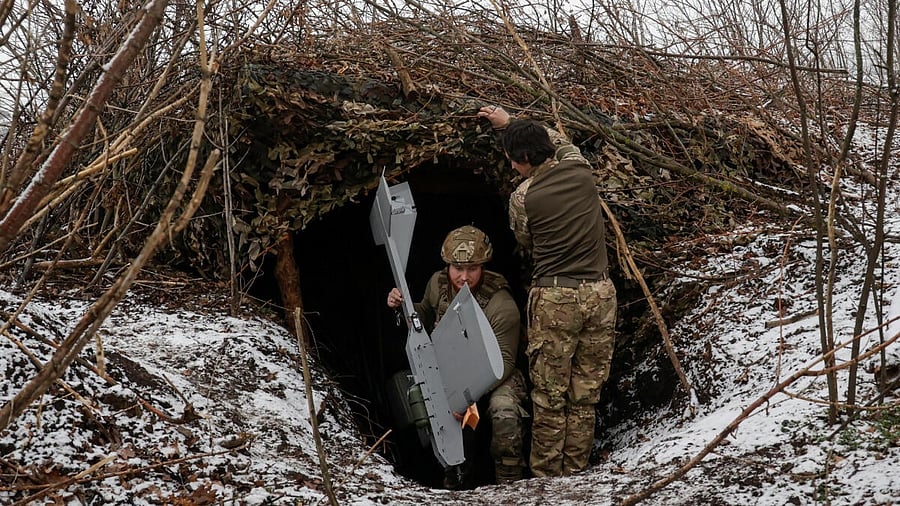
Ukrainian servicemen operate a Darts strike drone at their position near a front line in Donetsk region
Credit: Reuters photo
By Marc Champion
Of the two main sticking points in getting a deal to end Russia’s invasion of Ukraine that Kyiv, if not Moscow, can accept, there seems to have been a breakthrough on security guarantees. Territorial concessions are proving more difficult and it’s reasonable to ask why.
For promoters of the original 28-point ceasefire deal that US negotiators drafted with the Kremlin, the answer is straightforward: It shouldn’t be that big a deal. Russia already occupies about 20% of its neighbor, and to add what remains in Ukrainian hands of Donetsk Province would expand that by about a percentage point.
Take a big step back, and that looks a small price to pay for a genuinely independent Ukraine, after centuries of struggle. Besides, the argument goes, if the war goes on Ukraine will soon lose the territory anyhow.
There are several problems with this view, because this isn’t a real-estate deal. The best-known complication is the military value of the piece of territory that Vladimir Putin wants — the so-called fortress belt of cities his forces have been trying and failing to take since 2014. Hand that over and Russia would be in a dramatically better position to restart the invasion if it chose, with no natural defenses until the major industrial city of Dnipro. And, no, Ukraine is not doomed to lose this territory soon anyway, as I’ve written before.
Just as difficult for Ukraine are the concerns of hundreds of thousands of people who still live in this part of the Donbas or have fled to safety. They would face a choice: Live under Russian occupation, with all the brutality and repression that brings, or sacrifice their homes and livelihoods. As president, Volodymyr Zelenskiy must also consider his dead soldiers. What will have been the purpose? Morale would be devastated and a deep sense of betrayal would define Ukraine’s political future.
All of this would create military and political weaknesses that Putin would be tempted to exploit, but it still doesn’t cover the full impact of giving up land. For Donetsk is not unique. There are, sadly, many places in Ukraine that show what shifting the front line by a few miles can mean. I visited one, Ochakiv, at the mouth of the Bug River on the Black Sea coast, in late September.
From a high point overlooking the sea, you can see where Russian forces are stationed just four or five kilometers (2.5 or 3 miles) away on what’s known as the Kinburn Spit (or to locals who had summer cabins or “dachas” on this overgrown sand bar, “the Ukrainian Maldives”). The Russians, however, can see you as well. They fly drones over Ochakiv every day. Most houses on the long, exposed escarpment that sweeps down from the church to the sea have holes blasted in their roofs.
Kids go to class underground in the local high school’s converted basement. Local authorities installed ventilation systems and renovated the space to make it bright and habitable. The hospital has largely moved underground, too.
Ochakiv has a program to repair roofs for free, where houses aren’t abandoned, because the town hall is determined to keep the place alive. “It’s a circular problem,” Deputy Mayor Oleksiy Vaskov said as he showed me around a granary destroyed by a sea-launched Kalibr missile. “If we don’t renovate, people won’t stay or come back, and if they aren’t here we don’t have money to renovate.” He used to have 10 crews repairing roofs. Now he has one.
But if Russian drone operators have targeted civilians on bicycles here, harassing the town isn’t their main goal. That’s blocking Mykolaiv, a larger city a short distance upriver that had the country’s most modernized port before the war, shifting most of Ukraine’s grain exports from its terminals.
Mykolaiv came nail-bitingly close to capture in the first days of Putin’s February 2022 invasion. It and the Bug River are to the strategically critical port city of Odesa what the fortress belt is to Dnipro: A last natural line of defense. Moscow’s troops and tanks made it to Mykolaiv’s suburbs, before getting pushed back by 10-15 km.
From those positions, they lobbed up to 32 short-range missiles per day for the next 321 days in a row, Mykolaiv’s regional governor Vitaliy Kim recalled when I visited his new offices a few hundred meters from the destroyed regional administration. More than 6,000 buildings were damaged during those months, and much of the city’s energy and water infrastructure destroyed. The pipeline that brought fresh water was hit in multiple places. Almost 300,000 of the city’s 470,000 population fled.
All that ended when a Ukrainian counteroffensive pushed Russian forces back by about 60 km, just beyond Kherson, the next city east, in November 2022. Mykolaiv has been rebuilding for the three years since, with the help of €317 million ($372 million) in foreign aid. Today there are more cafes and restaurants, more bustle in the streets than I remember when visiting before the war and the population is almost back to 2021 levels. Kim says more than 580 new businesses have opened.
The water treatment plant has fresh water again, even if it arrives as a foaming sludge that is still undrinkable after filtering. Filthy tile linings were being replaced, chamber by chamber, in preparation for the arrival of a new pipeline that will bring much cleaner water from 60 km away. Across the city, roads were being torn up to replace 200 km of steel mains-water pipes, corroded by the emergency salt-water supply.
So, what if Ukraine were forced to give back the Kherson region that Putin still claims as annexed Russian territory, as he does Donetsk?
“I don’t think it’s possible, it would be like asking the US to give up Alaska,” Kim said. “But if it happened, we’d be a frontline city again, with the same problems we had before. The risks would be too high for businesses to come back and invest.”
Even now, the future is bleak. The port remains idle. More than 100 ships and grain barges have been trapped there for four years. When a few tried to sail out, Russian forces opened fire, sinking one.
This, writ large, explains why the details of any territorial bargain matter so much. Ukraine’s biggest postwar challenge will be demographic. It can’t be met so long as Russia uses the proximity of its forces to destabilize its neighbor — something it has been attempting by commercial, covert and military means since the day Ukraine became independent.
I spoke about this with Andriy Rozov, director of Odesa’s department of economic development and a numbers guy who went to business school in Chicago. From a population of 45 million in 2013, Ukraine now has about 28 million residents. A little more than 10 million are pensioners and between 5 million and 7 million are too young to work. That leaves at best 11 million people to rebuild Ukraine, given that many who return from the front will be missing limbs or too traumatized to work.
That’s millions short of what it will take. Ukraine needs its 6 to 7 million refugees to come home, and for that it needs the war to end definitively, with the security guarantees and territorial arrangements that make it possible for Ukrainian mothers to bring their children home from safe schools and jobs in Western Europe.
Kim and his Danish backers are doing what they can for Mykolaiv, building schools with bomb shelters, bringing in clean water and even having outdoor musical festivals to show there’s life to return to. But ultimately the port has to open in insurable safety, which means there cannot be Russian drone operators and howitzers on the Kinburn Spit.
I sincerely doubt Putin would sign up to any deal that provides this kind of assurance. As he so often says, it would not deal with the “root causes” of the conflict, which are that he wants control over all of Ukraine and a sphere of influence beyond. And that is precisely why his willingness to accept terms that prevent him from either restarting the war, or continuing it in a hybrid form dressed as peace, should be the litmus test by which any settlement is judged.