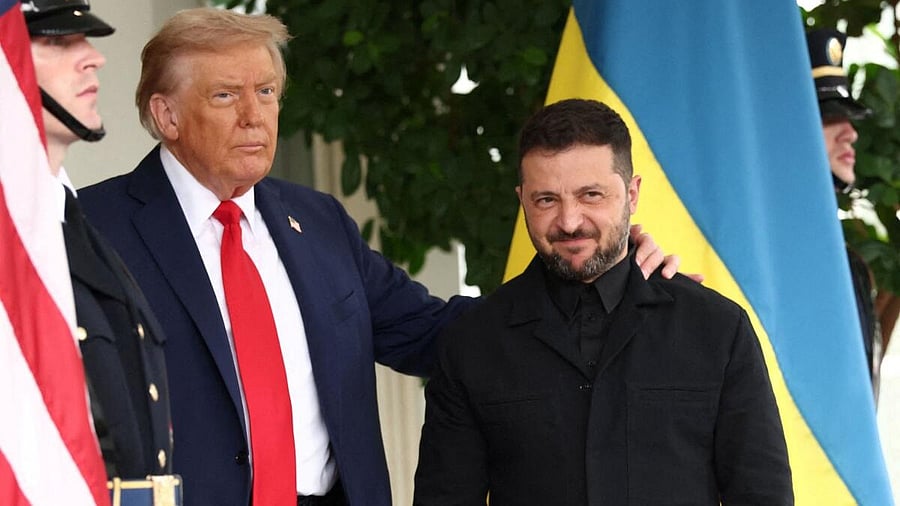
US President Donald Trump with Ukrainian President Volodymyr Zelenskiy at the White House.
Credit: Reuters Photo
A pivotal week in diplomacy is at hand, as the Ukraine peace process struggles to gain traction and in Kyiv, the dismissal of Andrii Yermak, chief of staff to President Volodymyr Zelenskyy, last Friday phenomenally changes the calculus of political power, in turn galvanising United States President Donald Trump’s peace plan.
There is no question that Washington forced Zelenskyy’s hands to dismiss Yermak after the Specialised Anti-Corruption Bureau (NABU) investigators raided his home in Kyiv. Yermak was no run-of-the-mill bureaucrat. He wielded enormous power at the top of the government, and was even trusted to negotiate on Ukraine's behalf at peace talks with the US.
Yermak and Zelenskyy go back a long way since they first met in 2011 when the former was an intellectual property lawyer and the latter a TV comedian and producer. In a profile of Yermak published in July, Christopher Miller of the Financial Times wrote that the two men even slept near each other in the president’s bunker, often after a night playing table tennis or watching classic movies. In the early mornings, they lifted weights together.
“There’s no path to Zelenskyy that bypasses Yermak,” one former chief of staff to a Ukrainian president told Miller. “And that’s the problem.” As Zelenskyy concentrated his power over time, Yermak became the second most powerful person in Ukraine. He navigated foreign and security policy, ousted political rivals, and even made battlefield decisions.
Some say it was Yermak who pushed for Zelenskyy’s famous White House meeting in February — the disastrous shouting match with Trump and Vice-President J D Vance, known as the ‘blowup’ in the Oval Office. A more recent meeting with Trump, which degenerated into another shouting match behind closed doors, was further evidence that Yermak misread DC and gave poor advice to Zelenskyy on how to manage the White House.
Politico has reported on US elites’ bipartisan disdain for Yermak — that he was “uninformed about US politics, abrasive and overly demanding with US officials.” That said, Yermak was also a savvy political operator, after all, he and Zelenskyy got much of what they wanted from their trips to DC.
Washington holds the patent for the NABU, which was designed in the mould of the Federal Bureau of Investigation (FBI), to roll back the tidal wave of corruption and venality that began eating into the vitals of the Zelenskyy regime. NABU investigators are trained in the pattern of the FBI and function as an independent unit of the prosecutor general of Ukraine who oversees criminal investigations.
Needless to say, the NABU, which is funded by the EU, has been a thorn in the flesh for the Kiev regime. Recently, the security service arrested and searched several officials at the NABU, alleging they were Russian spies or had ties to Russia. Zelenskyy followed up by ordering the shutdown of the NABU. But under pressure from Washington and the EU, he backtracked within the week.
That being the state of play, quite obviously, without White House green lighting, the NABU wouldn’t have dared to confront and expose Yermak. Equally, it is highly improbable that Zelenskyy dismissed Yermak out of self-volition. Therefore, the big question here is, as Lenin would have asked, ‘Who stands to gain?’
There can be only one answer — Trump. Simply put, this event, potentially leading to a ‘regime change’ in Kiev by other means, is a landmark in Ukraine’s unceremonious transition from war to peace. Russia stubbornly refuses to sign any peace agreement with Zelenskyy. In an insightful analysis, Andrew Day, senior editor of the American Conservative, wrote, “Yermak’s departure from the negotiating team increases the chances that Kiev will take a more concessive approach to negotiations, closing the gap between the Ukrainian and Russian positions…
“Back in America, the DC political class has found rare bipartisan agreement in deeming Yermak an irritant and political malefactor, and the Trump administration has certainly been no exception to that consensus. When Vice President JD Vance’s office phoned Ukraine’s ex-army chief and ambassador in London (Valerii) Zaluzhny in March to probe whether he’d be a worthy successor to Zelenskyy, whose term officially had ended one year prior, Yermak intervened, convincing him to reject the calls. Now that Yermak is out, the Trump team will find fewer obstacles to their geopolitical maneuvering around Ukraine.”
Interestingly, according to grapevine, the charismatic ex-general is already packing his bags to return to Kyiv. Nonetheless, Yermak’s ouster does not necessarily mean that peace is at hand, or that Ukraine’s democracy will bloom again. The point is, the ceremony of innocence was lost in Ukraine’s democracy a long time ago, even before the 2014 CIA coup which turned Ukraine into a classic vassal state and proxy of the collective West.
Much will now depend on Zelenskyy having a change of heart to seize the chance to reverse course and embrace Trump’s peace plan. In immediate terms, it also involves Zelenskyy truly taking Ukraine beyond the sordid Yermak era and choosing a credible successor to the ousted chief of staff, someone hailing from outside the orbit of the discredited regime. Perhaps, that is all a bit too much to expect.
Miller reported for FT in a riveting dispatch from Kyiv, ‘Yermak’s exit could signal a shift away from the concentration of authority that has characterised much of Ukraine’s post-Soviet politics and especially the Zelenskyy-Yermak era. In the near term this is likely to be difficult, as Zelenskyy navigates internal divisions and the corruption scandal.’
The bottom line is that Zelenskyy himself is a diminished figure, having lost control over the vertical of power, unable to protect even those closest to him. And Ukrainian politics, as in many former Soviet republics, is shaped by big characters. Don’t think the bell tolls only for Yermak, it tolls for Zelenskyy, too.
(M K Bhadrakumar is a former diplomat.)
Disclaimer: The views expressed above are the author's own. They do not necessarily reflect the views of DH.