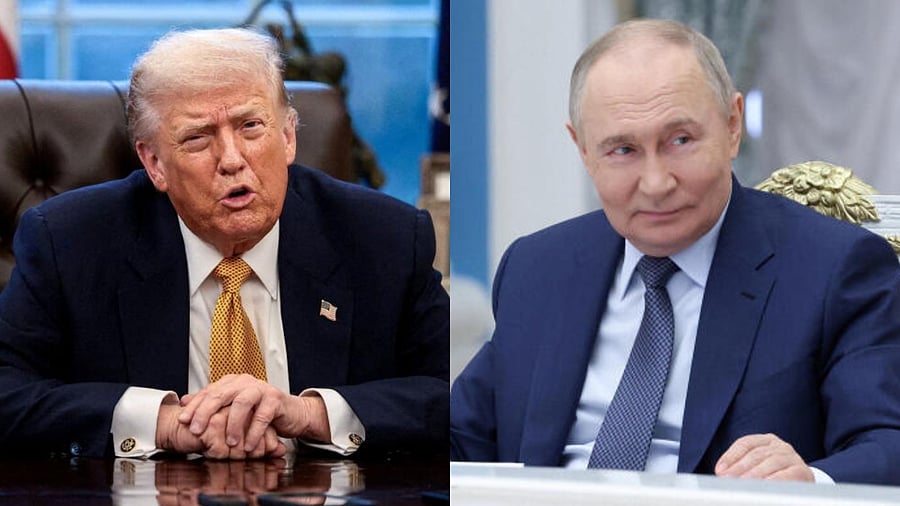
US President Donald Trump (L) and Russian President Vladimir Putin.
Credit: Reuters Photos
Russian President Vladimir Putin has brought to the centre stage the criticality of creating a European security architecture as the only framework within which a negotiated and durable peace settlement in Ukraine can be achieved.
Putin chose the solemn occasion of the presentation of credentials at the St Alexander Hall of the Grand Kremlin Palace in Moscow on January 15 — attended by 32 newly-appointed envoys from all over the world, including eight from NATO member states — to effectively define Russia’s foreign policy priorities in its relations with Europe.
An extraordinary backdrop was provided by a welter of events lately that brought home the contradictions accruing around the Ukraine conflict — NATO’s defeat in the Ukraine conflict, and the collapse of the Western narrative, exposing the fault lines within the transatlantic system; US aggression in Venezuela, one of Russia’s close partners in Latin America; mounting US threats against Cuba, one of Russia’s oldest and closest allies; and most importantly, the drone attack on Putin’s residence in the Novgorod Region on the night of December 28.
While the CIA denied the incident, Russia insisted it occurred and provided evidence to support it. The attack, shortly after a phone call from US President Donald Trump, was followed by a fierce Russian retaliation with a hypersonic Oreshnik missile attack on western Ukraine. Indeed, it was a jam-packed fortnight that ushered in the new year.
There was a lot of public criticism in Russia, including among known supporters of Putin, demanding that the time has come for the Kremlin to play up to Trump’s doublespeak.
The most significant part of Putin’s speech was that he talked back to his 2021 December address to the West, just before the special military operations began in Ukraine, where he offered to have a collective security architecture for Europe and Russia pegged on a rollback of Nato's eastern border to where it existed when the Cold War ended.
Putin recalled the assurance given to Mikhail Gorbachev by then US Secretary of State James Baker at a meeting in Moscow on February 9, 1990, that NATO's jurisdiction would not move ‘not one inch eastward’ if the Kremlin allowed German unification, as a security guarantee for Russia.
Putin chose his words very carefully when he said, “security must be truly comprehensive and, therefore, equal and indivisible.”
He flagged the crisis around Ukraine as “a direct consequence of years of ignoring Russia’s legitimate interests and a deliberate policy of creating threats to our security, including the advancement of the NATO bloc towards Russia’s borders — contrary to the public promises made to us. I want to emphasise this: contrary to the public promises made to us.”
Putin stressed the need for “a substantive discussion” to build a new, reliable, and fair architecture of European and global security “under which a peaceful settlement of the conflict in Ukraine could be achieved.” He declared, “Until then, Russia will continue to consistently pursue its objectives.”
The salience is that Russia is winning in Ukraine, but is willing for a compromise if there’s a rollback by NATO from Russia’s border regions. Indeed, recent events testify that NATO is no longer up to the task of providing collective security to its members, and Trump is undermining NATO and is even planning to annex Greenland, the territory of a NATO member country.
In these fraught times, Putin’s message to the European capitals is that Russia will not accept some sort of ceasefire that Europeans want that will bring Western troops to the borders of Russia or, partial solutions devolving upon some sort of demarcation line marking a ‘frozen conflict’ in Ukraine that will only reinstate the CIA and MI6 in the driving seat eventually.
Russia can do without palliatives and crutches as the West lacks the capability anymore to counter Russia militarily, which was the message from the Oreshnik attack on January 8-9 — that if Russia wants to, military targets anywhere in Europe can be destroyed within minutes.
Equally, there is a geo-economic dimension to all this, namely, Russia is also open to co-operation to address the economic crisis in Europe, especially in Germany. Putin offered restoration of trade ties and resumption of energy supplies (possibly, at a discounted price as in the past), which used to be the lifeblood of the German export industry.
During his recent visit to India, German Chancellor Friedrich Merz pointedly ruled out pressuring India to reduce its energy imports from Russia.
This is smart thinking by Putin, now that the chances of the US interfering to undermine Russia's ties with Europe (or, conversely, of Europe paying heed to US diktats) have significantly receded during the past year, which in turn would, hopefully, give Moscow a level playing field, and create space for its European interlocutors to revive mutually beneficial energy co-operation.
The most intriguing part of Putin’s message concerned Trump’s so-called peace proposals on Ukraine. Putin signalled politely that Americans are unreliable, and that Trump is uninterested in Europe’s future and is obsessed with his grand design of annexation of territories.
Most importantly, Putin conveyed that he is not interested in Trump’s partial solutions in Ukraine, such as which oblasts Kiev can or cannot keep in a settlement, etc. It comes as no surprise that Putin is pretty much tired of Trump’s zigzagging approach — speaking to Moscow, Kiev, and European capitals in different languages, lacking consistency.
All in all, Putin conveyed a rather stiff message of lack of trust. At the core of it must have been the shocking realisation that the CIA used Trump’s phone call to Putin via satellite on the evening of December 28 for the geo-positioning of its ‘target’ to mount a deadly attack within the next few hours with 91 long-range drones.
At a special briefing at the defence ministry in Moscow on December 31, the head of Russian Aerospace Forces’ air defence missile troops General Alexander Romanenkov stated that Ukraine carried out the drone assault “along several routes toward the Russian president’s residence, passing over the Bryansk, Smolensk, Tver and Novgorod regions” and it was “deliberate, carefully planned and conducted in a layered manner.”
It is a moot point whether CIA director John Ratcliffe, a close associate of Trump, green-lighted such an attack by the Ukrainian military without the prior knowledge of the president. Of course, the assassination plot floundered, but, in the event, it may also have put to sudden death Putin’s pointless dalliance with the business associates of America’s ‘peacemaking president’.
Interestingly, Putin never once referred to Trump in his speech. But he did have a meaningful message for the Western Hemisphere, which goes into the heart of Trump's security strategy, as Putin went out of his way to warmly greet the newly-appointed ambassador from Cuba.
Putin spoke at some length, underscoring, inter alia, that Russia and Cuba enjoy “genuinely strong and friendly relations. We have consistently provided assistance and support to our Cuban friends. Russia stands in solidarity with Cuba’s firm determination to defend its sovereignty and independence. The Russian-Cuban alliance has withstood the test of time and is rooted in the sincere mutual goodwill of our peoples.”
Suffice to say, the Oreshnik attack has sent a stark message to the West that a ‘new normal’ has appeared in Eurasian security, which it must come to terms with, as the kaleidoscope will now on represent with its ever-changing hues and new shapes, the seamless prospects and opportunities the Kremlin wields today for the release of blocked creativity to bring the Ukraine war to an end.
M K Bhadrakumar is a former diplomat.
(Disclaimer: The views expressed above are the author's own. They do not necessarily reflect the views of DH)