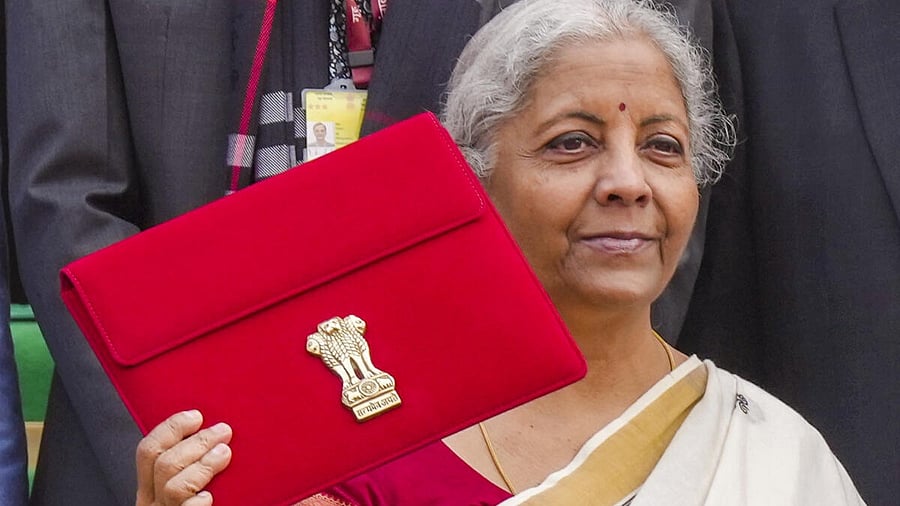
File photo: Union Finance Minister Nirmala Sitharaman at the Union Budget 2025-26.
Credit: PTI Photo
The preparation of the Union Budget 2026–2027 will be a formidable challenge for Finance Minister Nirmala Sitharaman, given the global tariff wars, heightened geopolitical tensions and a potential revenue shortfall in FY26. The Budget must sustain growth, rein in the fiscal deficit to 4.2-4.4% of GDP in FY27, maintain higher capital expenditure outlays, and deliver a strong supply-side push to revive private investment.
Simultaneously, it must provide for a higher defence budget to modernise the armed forces in an increasingly high-tech and volatile geopolitical environment; support merchandise exports amid an adverse global trade climate; continue PLI-type programmes to raise manufacturing's share of GDP; attract foreign direct investments through tax reforms and deregulation; and strengthen social sector support for the four priority groups—gareeb (poor), yuva (youth), annadata (farmers) and naari (women)—termed GYAN segments. Balancing these often competing priorities will be a tightrope walk few would envy.
Former Finance and Economic Affairs Secretary Subhash Chandra Garg has warned that the Centre faces severe headwinds on the tax revenue front. He estimates a shortfall of nearly Rs 3 trillion in gross tax collections in FY26 (the official estimates are much smaller at Rs 48,000 crore), driven by income tax relief on incomes up to Rs 12 lakh and large GST rate cuts following the prime minister's ‘double Diwali GST bonanza’ announcement in his Independence Day speech. These cuts, however, have not meaningfully boosted consumption to offset revenue losses.
The scope for raising additional taxes is limited. Any increase in import duties risks retaliatory tariffs from other countries. Personal income tax and GST rates have recently been pruned, capital market taxes were raised in the 2025-2026 Budget, and higher corporate tax rates would invite strong resistance from industry.
The Finance Minister may be able to increase the Centre's capital expenditure by a modest 6-7% year-on-year. Higher capital expenditure outlays are expected in the Union Budget for infrastructure projects in sectors like railways, highways, urban infrastructure and transfers to states —together accounting for nearly 80% of the Centre's capex— are expected to continue. However, the budget should enhance capex allocation for agri-infrastructure such as cold storage, irrigation projects, and greenfield fertiliser plants, while moderating the capex allocation for transport infrastructure. Capital expenditure in the defence sector focussed on modernisation and expansion of the indigenous manufacturing capacity deserves special attention. Increased allocations for clean water supply, underground drainage, and flood control are equally critical to ensuring dignified living conditions in both urban and rural India.
Strategic sectors such as semiconductors, electronics, renewable energy and artificial intelligence are also likely to feature prominently. The recent rollout of the India Semiconductor Mission 2.0, with an enhanced financial outlay of Rs 1.8 trillion, points to the priority accorded by the government for the emerging and strategic sectors. The budget may prioritise chip design and capital equipment for domestic manufacturing. Semiconductor manufacturing relies on a specialised ecosystem of capital goods and tools, from advanced lithography systems to precise etching tools.
Raising manufacturing's share of GDP remains an urgent imperative. Budgetary support for research and development can help Indian firms move up the value chain. Expanding PLI schemes, offering long-term tax incentives for greenfield investments, improving access to credit, and creating sector-specific industrial ecosystems will aid this effort. Deregulation, reduction in compliance burden and decriminalisation of minor lapses will empower entrepreneurship and start-ups. While the government has announced the new labour codes, land reforms remain a critical unresolved challenge.
The World Bank's Logistics Performance Index (LPI) is an interactive benchmarking tool created to help countries track their performance in trade logistics and identify challenges and opportunities to improve their performance. The LPI is based on two components: First, a worldwide survey of international logistics operators on the ground (global freight forwarders and express carriers), providing feedback on the logistics “friendliness” of the countries with which they trade. The second component of the LPI is based on granular high-frequency information on maritime shipping and container tracking. Though India has improved its ranking in LPI 2023 by jumping six places to rank 38 among 139 countries, further investments and improvements in these areas are needed to enhance supply-side investments and international trade.
Finally, to contain the fiscal deficit within 4.2-4.4% of GDP while expanding capex and to reduce the Centre's debt-to-GDP ratio to 50% by FY31 from the current 56.1% of GDP, revenue expenditure must be reduced. This requires rationalising non-military manpower costs, pensions, interest payments, non-essential publicity and ceremonial spending. "Minimum government, maximum governance" must move from slogan to practice.
(The writer is a retired corporate professional)
Disclaimer: The views expressed above are the author's own. They do not necessarily reflect the views of DH.