
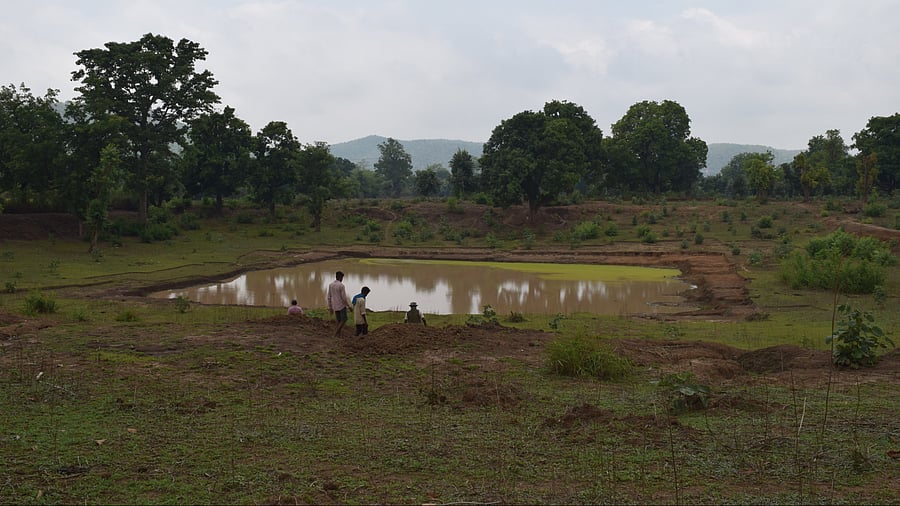
Ancient pollens hidden beneath a lake in Chhattisgarh have helped unearth 3,000 years of India’s climatic history and the summer monsoon’s changing pattern in the core monsoon zone — a discovery that may provide more clues on how the monsoon will behave in the future.
Scientists at Birbal Sahni Institute of Palaeosciences, Lucknow, have found evidence of unusually strong Indian summer monsoon in lake sediment pollen records preserved in the Raja Rani Lake in Korba district, right in the heart of India’s core monsoon zone. Using an unusual technique, they extracted a 40-centimetre-long sediment core. The mud records revealed environmental changes, as indicated by microscopic pollen grains shed by plants that once grew around the lake.
By identifying and counting these pollen grains, a science known as palynology, the researchers reconstructed past vegetation and, in turn, past climate. Forest-loving plants indicated warm, humid conditions, while grasses and herbs suggested drier phases.
“We chose the lake because there was no mixing of the sediments due to minimal human influence, as we are looking for lake sediments in forested areas. The sediment chronology was determined by accelerator mass spectrometry. We also did carbon dating of a part of the core,” BISP scientist Mohammad Firoze Quamar, corresponding author of the paper, told DH.
Quamar and his team found that the savannah vegetation between 1610-910 BCE first transformed into wooded grassland and subsequently into forest, as the area first experienced low rainfall and then increased and intensified rainfall.
They also found the signature of a global weather event known as the medieval climate anomaly (MCA). The pollen record showed a clear dominance of moist and dry tropical deciduous forest species, indicating strong monsoon rainfall and a warm, humid climate in central India. Crucially, the study found no evidence of contrasting dry conditions within the core monsoon zone during this period.
The scientists traced this strong monsoon to a global warm phase known as the MCA, roughly between 1,060 and 1,725 CE. The study attributes the enhanced monsoon to a combination of global and regional factors, including La Niña–like conditions, which are typically associated with stronger Indian monsoons.
According to the scientists, understanding monsoon behaviour and Holocene climate change variability would help strengthen current understanding of present climatic conditions and possible future trends. Also, the high-resolution palaeoclimatic records generated in the study could help develop paleoclimatic models to simulate future climatic trends and rainfall patterns. The study has appeared in the Review of Palaeobotany and Palynology.