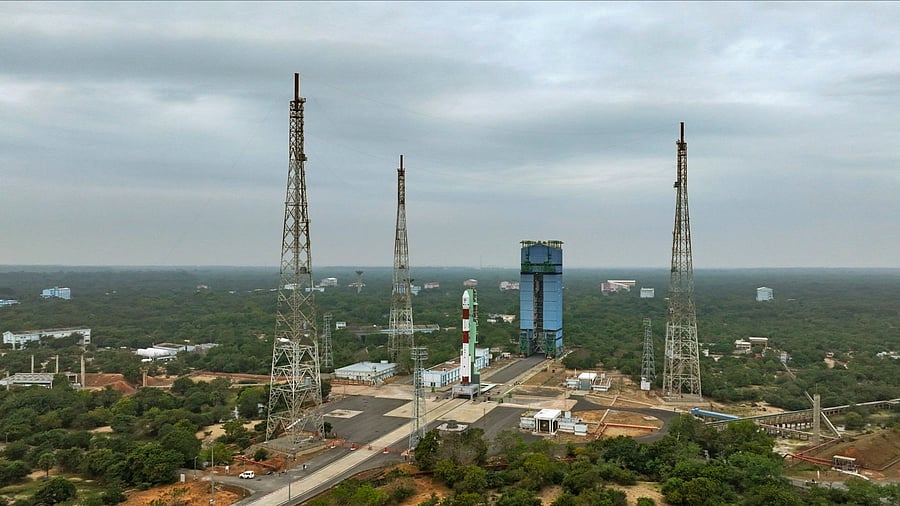
PSLV-C62 rocket, carrying an earth observation satellite along with 14 other co-passenger satellites into orbit, at the launch pad
Credit: PTI photo
Chennai: In the first mission in 2026, the Indian Space Research Organisation (ISRO) on Monday successfully launched earth observation satellite, EOS-N1, and 15 co-passenger satellites from the Satish Dhawan Space Centre (SDSC) in Sriharikota near here.
PSLV-C62, the ninth dedicated commercial mission undertaken by NewSpace India Limited (NSIL), took off from the first launchpad of the SDSC at 10.17 am. The mission is also a boost to the burgeoning private space sector in the country with Hyderabad-based Dhruva Space, alone contributing five satellites. Indian companies Laxman Gyanpith and OrbitAid have one satellite each.
Of the remaining eight, five are from Brazil’s AltoSpace, one each satellite from UK’s SSTL, one from Antharkshya Pratishtan of Nepal and the Ministry of External Affairs, India, and Orbital Paradigm (Spain) and RIDE (France).
The launch used the PSLV-DL variant with two solid strap-on motors and
the mission demonstrated KID or Kestrel Initial Technology Demonstrator from a Spanish startup, which is a small-scale prototype of a re-entry vehicle being developed by the startup.
“The KID will be the last co-passenger to be injected, after which it is slated to re-enter the earth’s atmosphere towards splashdown in the South Pacific Ocean,” the ISRO said.
PSLV is the workhorse launch vehicle of ISRO that has completed 63 flights including notable missions like Chandrayaan-1, Mars Orbiter Mission, Aditya-L1 and Astrosat Mission. In 2017, PSLV set a world record by launching 104 satellites in a single mission.
After injection of EOS-N1 and 14 satellites, PS4 stage will be re-started to de-boost and enter a re-entry trajectory, followed by KID Capsule separation. Both PS4 stage and KID capsule will re-enter into Earth’s Atmosphere and impact will be in the South Pacific Ocean.
Developed by Defence Research and Development Organisation (DRDO), the EOS-1 or Anvesha satellite is designed to provide cutting-edge imaging capabilities, enabling India to map enemy positions with pinpoint accuracy.