
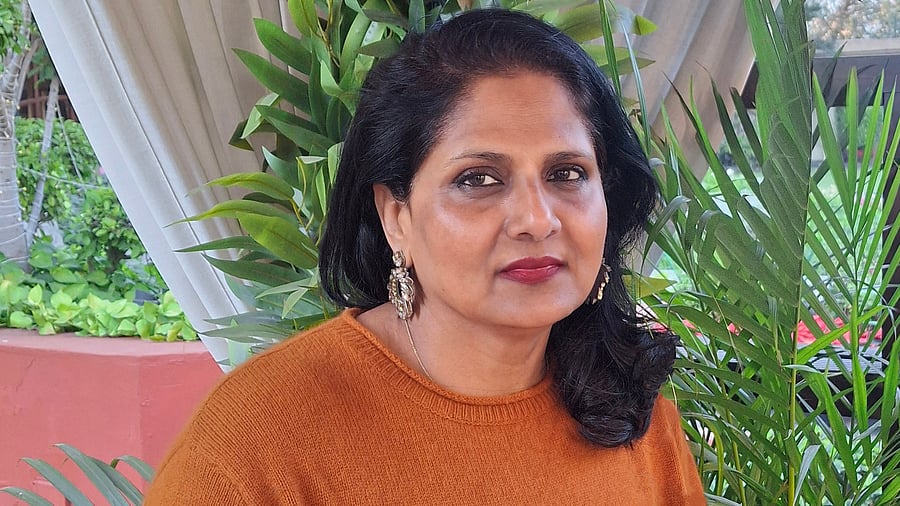
Priyamvada Natarajan
Credit: Kalyan Ray
Last year, Yale University astrophysicist Priyamvada Natarajan became only the second scientist of Asian origin in 45 years to win the prestigious Dannie Heineman Prize, awarded jointly by the American Institute of Physics and the American Astronomical Society. Originally from Coimbatore and raised in New Delhi, Natarajan was at Ashoka University recently. She also participated in an open house discussion in Delhi and spoke to DH. Excerpts:
lWhy do black holes remain an enigma in cosmology?
For a long time black holes were believed to be a mathematical curiosity derived from Einstein’s General Theory of Relativity. Later Karl Schwarzschild provided the black hole solution as space around a very concentrated point mass known as a singularity, where all known laws of physics break down. It has a special boundary called the event horizon with peculiar properties. Even light
can’t escape such a boundary. The space beyond the event horizon is
the black hole.
The physics and astronomy community never imagined the mathematical solution would correspond to real objects in the universe. But in the 1960s they first found evidence for its existence from X-ray observations.
lWhere do black holes come from?
Thanks to Subramanian Chandrasekhar’s work, we know if a star starts life with a birth mass that is quite heavy, maybe 10 times as massive as our sun, it will end its life inevitably as a black hole. But those are very small black holes. The ones that we see at the centres of galaxies are a million and a billion times the mass of the sun.
For the last 25-30 years, people have been trying to understand how they form. We now find these black holes farther and farther back in time. This means they are assembling really early in the universe.
lThis brings me to your research about cosmic dawn and heavy-seeded black holes. Can you elaborate?
Around 10 years ago, we started finding these black holes that are a billion times the mass of the sun. They were already in place when the universe was a fraction of its current age of 13.8 billion years. There wasn’t enough time to start from a little seed. One of the first projects I worked on with my team was to see if there are any ways to have a black hole that will start life much more massive as a heavy seed. Can it be born with 1,000, 10,000 or even 100,000 times the mass of the sun? I discovered that such heavy-seeded black holes can form in the very early universe under very special conditions that we described as direct collapse formation of black holes. We had predicted in 2017 there should be a class of galaxies that would carry the imprint of such heavy-seeded black holes, and the James Webb Space Telescope should be able to see such imprints. We just did not know when.
lWhat was the nature of your prediction?
Since the black hole is dominant, such a galaxy, even if it is very, very far away, should be visible both in the X-ray by the Chandra Space Telescope and by the James Webb. These objects were probably formed when the universe was just 500 million years old, after the Big Bang. That’s really far away, and they have to be really bright to be detected. But there is another thing called gravitational lensing. We thought if we are lucky, we have one of these guys behind the lens, which will then magnify it and allow James Webb to detect it.
lAnd did it happen like that?
Yes, James Webb detected it in 2023. This object is called UHZ1. It was magnified about four times. Had it not been magnified, we wouldn’t have seen it. This object, as we had predicted, was simultaneously detected by Chandra and by James Webb. I felt it was a gift from the universe.
lIs there only one sighting by James Webb?
We made a case that this particular object is a very compelling example for direct collapse formation of black holes. Later on we also showed that such direct collapse can happen under different conditions. Now there is growing evidence that direct collapse is happening at later times. There is a class of objects called little red dots that James Webb is seeing. Many of them look like they could be explained by direct collapse, but they are not as heavy.
lHow do you see the future of astronomy?
While black holes and galaxies grow simultaneously, black holes can also grow by crashing into each other, and their signature is gravitational waves. We have seen gravitational waves from stellar-mass black holes but not from supermassive black We expect to see such gravitational waves with LISA satellites, which the Europeans are going to launch in the 2030s.
Moreover, James Webb is likely to throw in many more surprises. The old telescopes like the Hubble and Chandra are still working. And we have the ground-based Vera Rubin Observatory that is going to survey the sky every night. We are going to discover new kinds of events and new kinds of explosions that we missed all these years.
Disclaimer: The views expressed above are the author's own. They do not necessarily reflect the views of DH.