
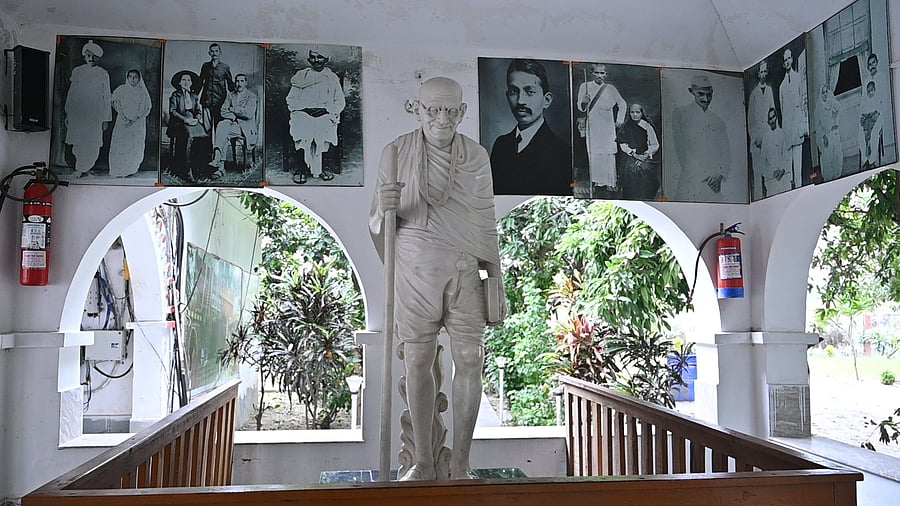
Mahatma Gandhi’s statue at the Bhitiharwa Ashram, where he stayed and spearheaded the Champaran campaign in 1917.
Credit: Ashish Pandey
The single-lane road from Narkatiaganj to Bhitiharwa feels like a corridor through time. Once walked by Mahatma Gandhi in 1917, the 16 km stretch is now paved with bitumen and is marked by rural bustle.
In October and November, lush fields of sugarcane and paddy dot the route. I was in north Bihar during the Assembly elections and took the opportunity to visit the less-known Gandhi Ashram in Bhitiharwa, a village in West Champaran district. The approach to the ashram is still marked by the wilderness Gandhi first encountered.
It would not be an exaggeration to say that Mohandas Karamchand Gandhi, a barrister who returned to India from South Africa in 1915, began his journey towards becoming the Mahatma during his stay in Champaran. It was here that he led a landmark rebellion in India’s struggle for independence, rooted in non-violence and civil disobedience.
Letter to Gandhi
In 1917, as nations across the world were locked in World War I, two men from Champaran were setting the stage to challenge British atrocities through non-violence. They wrote to Gandhi, urging him to lead the movement. They were Rajkumar Shukla, an indigo farmer, and Pir Muhammed Munis, a schoolteacher-turned-journalist.
One of the letters, titled ‘Sad Tale’ and written on February 27, 1917, compared the struggle of Bihar’s farmers to Gandhi’s own struggle in South Africa. “Our sad tale is much worse than what you and your comrades have suffered in South Africa... 19 lakh people of Champaran are waiting to see you. They have full hope that they will be liberated as soon as your feet touch the soil of Champaran,” reads an excerpt. The letter was reproduced in the 2014 book ‘Champaran: Satyagraha Ke Sutradhar, Rajkumar Shukla ki Diary’ (Maharajadhiraja Kameshwar Singh Kalyani Foundation).
Later, in his autobiography, ‘My Experiments With Truth’, Gandhi would describe Shukla as a man who would not take ‘no’ for an answer. “Rajkumar Shukla was one of these (the oppressed). He was filled with a passion to wash away the stain of indigo... He followed me to Cawnpore (Kanpur) and then to Ahmedabad. ‘Appoint a day,’ he pleaded. At last I promised him.”
While history often highlights Shukla’s ‘resolute’ pursuit of Gandhi, it was Munis’ intellectual “nationalisation” of the peasant struggle in his ‘Sad Tale’ letter that truly drew the Mahatma to Champaran. Munis was dubbed a ‘rogue journalist’ by the British for his scathing writing.
Through their collective efforts, Gandhi learned how indigo factory owners (British planters) were imposing the Tinkathiya rule on farmers. Under this arrangement, peasants were required to cultivate indigo on three kathas of every bigha of land and sell it at fixed, low prices to the planters. Since a bigha comprises 20 kathas, this amounted to 15% of their landholdings. The exploitative practice led to widespread debt and hardship.
Indigo, a deep blue dye, was in high demand in Europe in the 18th and 19th centuries, before synthetic dyes became common. To meet this demand, British planters forced Indian peasants to grow indigo, often without any legal basis. In 1813, the first indigo factory was established in Champaran. By 1850, it had become the region’s dominant crop.
Bold experiment
Gandhi finally arrived in Champaran in April 1917. He first stayed in the town of Motihari, where he documented the farmers’ plight. It was here that the British served him a notice to leave Champaran by the “first available train”. He defied the notice in his own style of civil disobedience. He famously told a court that he would not contest the notice but instead plead “guilty”. He argued he would rather listen to the “voice of his conscience” and face imprisonment for it than leave Champaran. The trial eventually went against the local administration, and Gandhi was allowed to proceed with his inquiry of exploitation.
In ‘My Experiments with Truth’, Gandhi described the Champaran uprising as “a bold experiment with Truth and Ahimsa”. He wrote about his daily meetings with ryots (peasants), listening to their grievances, and crafting responses that would force the British administration to first acknowledge injustice and then rectify it.
Gandhi first lived at his ashram in Motihari and later at Bhitiharwa, about 100 km apart. These ashrams served as both his home and office, where he interacted with locals and corresponded with British officials. They were also the first sites where he put his philosophy of non-violent resistance, Satyagraha, into practice on Indian soil.
A well, a school, a bronze bell and a wheat grinder from Mahatma Gandhi and his wife Kasturba Gandhi’s time at the ashram are key attractions.
Credit: Ashish Pandey
Ashram of big ideas
Walking past the iron gate and modest walls of the Bhitiharwa Gandhi Ashram feels like stepping into a quiet yet important chapter of India’s freedom struggle. The ashram embodies simplicity of the highest order, one that Gandhi himself would have approved of. Its courtyard exudes serene stillness, broken only by leaves drifting to the ground in the wind and the distant calls of birds perched in the trees across the campus.
The afternoon I visited the ashram, I saw children playing cricket in what must once have been its open grounds. In a corner, a few fishermen sat knitting their nets. Though they had no formal education, they were well aware of the ashram’s unique place in history. One of them said, “Is jagah Gandhi baba ki aatma rehti hai (Gandhi’s soul rests here).” Another added, “Gandhiji ka saara planning yahi se shuru hua.” He meant that this was the very site where Gandhi began his peaceful resistance against the British Raj, a movement that would spread across the country in the years to come.
At the centre of the ashram stands a statue of Gandhi, hands by his side and draped in a crumpled shawl. He holds a book in one hand, a reminder of the school he started here during his stay.
The small room where Gandhi stayed during his Champaran sojourn immediately caught my attention. The walls are plain, the floor rough, and the lone wooden cot stands firm, as if still carrying Gandhi’s will that was second to none. The chakki (wheat grinder) used by his wife Kasturba rests in a corner, carefully preserved inside a glass box. It was a simple household tool in those days but it also represented self-reliance, the heart of Gandhian thought.
My eyes then fell on a wooden table, plain and unpolished — it was on this table that important letters and notes were written. It was also a witness to countless conversations about justice and reform among those who sat across from each other. Next to the table hangs an old school bell, rusted by time, yet dignified in its stillness. The bell symbolises how Gandhi not only taught children to read and write but also to live by the values of honesty and truth that he espoused.
All of Gandhi’s belongings in the ashram carry one common message: to live a simple life and think of the larger good.
The ashram serves as a reminder that big movements are built on small acts: visiting a ryot’s hut, exercising patience in a meeting, spending a day recording grievances, and publicly refusing to accept arbitrary power. It was heartening to see schoolchildren being given a guided tour by local volunteers. I learnt that such tours are a regular feature at the ashram, with schools from across Bihar visiting frequently.
Turning point
When Gandhi arrived at Bhitiharwa on November 20, 1917, he was already a well-known figure because of his success in South Africa, and his legal battles in Motihari. However, he was yet to emerge as a national political icon.
Gandhi came as a reformer determined to probe the roots of rural misery. Though he came almost alone, he was soon joined by educators and doctors from all around. These volunteers became catalysts in the fight against the British indigo planters.
The movement called for social uplift along with legal battles. It was in Bhitiharwa that Gandhi famously remarked that “the way to Swaraj is through the door of the village school”. He urged locals to donate land to start a school, and in response to his call, Baba Ramnaren Das, a priest, offered his land. The school was managed by Kasturba and other volunteers. It had nearly 80 students in its first year and continues to function to this day.
The ashram Gandhi established was born out of necessity and haste, but it soon became a symbol of quiet defiance, transforming the entire village into a laboratory for revolution. He divided his time between recording the harrowing testimonies of oppressed farmers and teaching villagers basic sanitation.
Defiance through letters
During his stay at Bhitiharwa, Gandhi’s correspondence with British officials became a testament to the power of Satyagraha. On the surface, these letters appeared to be complaints, but they were far more than that. They were legal and moral challenges that stripped away the administrative veneer of the British Raj.
When the local planters’ henchmen burned down the makeshift hut in which he stayed, Gandhi wrote to the administration not to demand police protection, but to inform them that the villagers would rebuild it themselves with “better materials”. Later, under the supervision of Kasturba and volunteers, a permanent structure of brick and clay was raised. This became a powerful way to highlight the British administration’s inability to maintain law and order against the planters, a point Gandhi later used effectively during the Champaran Agrarian Committee hearings.
From the humble confines of the ashram, Gandhi addressed high-ranking officials such as the district magistrate of Champaran, W B Heycock, and the commissioner of the Tirhut division, L F Morshead. One of his most famous assertions of his right to remain in Champaran was written to the district magistrate: “I have entered the villages with the object of surveying the condition of the ryots and understanding their grievances... I am unable to leave this district until my inquiry is finished.” (Collected Works of Mahatma Gandhi, Vol. 13)
Between April and November 1917, Gandhi’s relentless pursuit of the cause made the seemingly impossible happen with the enactment of the Champaran Agrarian Act in 1918. It brought an end to the oppressive Tinkathiya system and liberated peasants from forced indigo cultivation. The Tinkathiya system, which began in the 1860s and reached its peak of exploitation in the 1910s, was abolished through a combination of letters, civil disobedience, and some legal hearings. And all this in less than a year.
Photographs and illustrations depicting indigo cultivation and peasant uprising are also on display.
Credit: Ashish Pandey
Lasting legacy
Today, the village of Bhitiharwa has modern amenities such as cellular connectivity, electricity, and good roads. Yet, amid these changes, stories of Gandhi continue to echo in some families. For Rajendra Sharma, who hails from the nearby Gonaha block, stories of Gandhi were part of his childhood. “It’s a matter of pride for us that such a great man came here and gave this place its own identity,” he says.
Echoing the sentiment, Vijay Kant, a retired schoolteacher born in independent India, says, “This place gained recognition not only on India’s map, but globally, because of Gandhi and his work here.” But much has changed now. “Earlier, when I travelled outside Bihar and said I was from Champaran, people would immediately say, ‘Oh! Champaran, Gandhi wala Champaran’. Now they say, ‘Oh! Champaran mutton’. The story of Gandhi’s connection with this place should not fade away. It needs to be told and retold,” he says.
Some initiatives honour the region’s historical legacy. A train now connects Motihari to Porbandar in Gujarat, symbolically linking Gandhi’s karmabhoomi to his janmabhoomi. Meanwhile, the train running from Raxaul in Champaran to Delhi has been fittingly named the Satyagraha Express.
The place also holds political relevance. Almost every leading politician from Bihar has visited the ashram at some point. Nitish Kumar visited it as chief minister during the centenary celebrations of the Champaran Satyagraha in 2017. More recently, Prashant Kishor of Jan Suraj began his political journey here by launching his first ‘pad yatra’.
When I left Bhitiharwa, dusk was folding over the fields. The most striking aspect of my visit was that I had learnt more about a movement that shaped India’s freedom struggle, and got a glimpse of how extraordinary change was brought about by common people. Bhitiharwa, in that sense, is not just a place to be visited, it is a place to be listened to — it makes a persuasive call to continue working for dignity and justice.