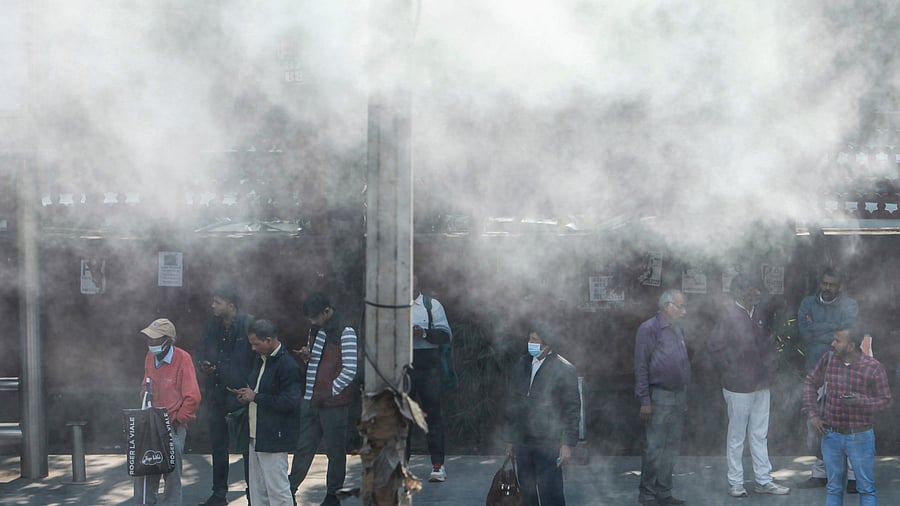
Commuters stand amidst water being sprayed to curb air pollution, in New Delhi.
Credit: PTI
The unhealthy air in Delhi hides another unseen threat. Researchers at Jawaharlal Nehru University (JNU) have mapped a “biological smog” that carries antibiotic-resistant bacteria—often referred to as “superbugs” and a part of the growing global crisis of antimicrobial resistance (AMR).
The study sampled air at four key locations: the Vasant Vihar urban slum in South West Delhi, Munirka market complex in South Delhi, Munirka Apartment in Dwarka Sector 9, South Delhi and a local sewage treatment plant within the JNU campus.
The findings show that at its peak, the load of a particular airborne bacteria strain, ‘staphylococcus’ reached 16,000 CFU/m³— sixteen times higher than 1,000 CFU/m³ — a level recommended by global health experts for microbial presence in the air, including all bacteria.
Out of the sampled airborne load, 20% were Methicillin-Resistant Staphylococci (MRS), 73% of which were resistant to drugs/antibiotics, including common antibiotics such as azithromycin and erythromycin.
Repeatedly exposed to antibiotics, the microbes evolve to survive them. The study suggests heavy antibiotic use during the COVID-19 pandemic may be a contributing factor.
However, Pune-based pulmonologist Dr Aparna Birajdar notes that antibiotic use in India requires regulation. “If there is repeated and unnecessary usage of antibiotics for wrong durations or wrong dosages, it will lead to mutation of AMR microbes,” says Aparna. “These drug-resistant strains will then spread from person to person and in the environment, making them dominant.”
According to the Institute for Health Metrics and Evaluation (IHME) data, more than 3,00,000 lives have been lost in India annually since 1990 due to AMR. In India, an estimated 267,000 attributable deaths in 2021 were directly caused by antimicrobial resistance, while nearly 987,000 deaths were linked to AMR-related infections, according to IHME data estimates.
Poor air quality and AMR
Microbial contamination in the air could impact public health by increasing infections, says Dr Raksha K, Consultant Microbiologist and Infection Control Officer at Manipal Hospitals, Bengaluru. “Fine particulate matter (PM2.5 and PM10) and organic pollutants in the air create protective surfaces that help microbes spread more widely and survive longer,” she adds.
While one could assume that the pollutants are mostly inorganic, carbon particles make up 20-45% of particulate matter in the air. And vehicular, industrial, and biomass-burning emissions contribute to this. “Any particle in the air can carry microbes if there is even a little bit of humidity,” says Dr Maneesh Paul, a clinical microbiologist with an expertise in antimicrobial resistance (AMR). A thick haze is nothing but air filled with countless particles, each a potential vehicle for microbes to survive and travel.
The study confirms this. “The microbial load was very high during the winter season, both in indoor and outdoor settings,” said Madhuri Singh, one of the researchers. “This could be because of the usual rise in Particulate Matter (PM) levels during winter.” Cold air is denser and gets trapped under a layer of warmer air above. This prevents particulate matter from rising and dispersing, resulting in higher pollution levels during the winter.
A study published in the International Society for Microbial Ecology found that in “polluted” areas where the air quality index (AQI) was more than 100, the number of unique Antibiotic Resistance Genes (ARG) subtypes and their absolute abundance were significantly higher than in “clean” or “good” sites where the AQI was less than 50. In highly polluted air, there was a strong correlation between ARGs and integrons that facilitate the transfer of resistance genes between bacteria, thereby enabling horizontal gene transfer.
ARGs enter the atmosphere adsorbed on biological aerosols from anthropogenic sources such as sewage, hospitals, livestock farms and biomass burning. Experts say that it is important to act in accordance with the One Health Approach, a collaborative, multidisciplinary strategy that recognises the deep interconnectedness of human, animal, plant, and environmental health.
Another intriguing aspect of the study is ‘gene silencing’. Some bacteria carried genes for antibiotic resistance but did not actually behave as resistant in lab tests, responding to antibiotics. “This is critical because routine lab sensitivity tests, which check whether bacteria are killed or inhibited by an antibiotic, may not detect hidden resistance genes,” Madhuri said. “Even if bacteria appear responsive in these tests, mutations can later activate those genes and make the bacteria fully resistant.”
The microbes studied are known to cause skin, lung, urinary tract, bloodstream, and medical device-related infections. People with immunosuppressive conditions or undergoing immunosuppressive therapies, populations with chronic lung conditions, and age groups that may lack immunity are at high risk of infection with these bacteria and AMR.
Prevention methods
Mere presence of bacteria doesn’t cause infection, but a concentration 16 times the safety limit is critical, says Maneesh. Experts report that physical barriers, such as wearing N95 masks, can protect people from microbes. Lifestyle changes that can enhance immunity may protect against AMR.
To ensure proper use of antibiotics in the judicial system, sensitivity testing is significant. “But, in primary healthcare setups and in clinics in small towns, there are neither facilities nor cost-bearing capacity for the patient to do the drug sensitivity testing,” said Aparna. However, this requires regulation, experts noted.
Experts warn that antibiotic use must be controlled, and the sale of antibiotics over the counter must be avoided. Even improper disposal of antibiotics could increase AMR in the environment.
The precautionary principle requires that we treat urban air as a vector of resistance. “The failure to address this problem will cause the global health crisis of AMR, which already exists, to become more severe,” Raksha said.
“Just like how pollution is monitored, there needs to be surveillance of AMR as well. While surveillance is carried out at clinical setups, surveillance of ambient AMR should also be strengthened,” adds Madhuri. Experts and the State Action Plan to Combat Antimicrobial Resistance (SAP–CAR) suggest sterilising the air when a particular locality is found to have a critical mass concentration of AMR.
(The author is a freelance journalist based in Bengaluru)