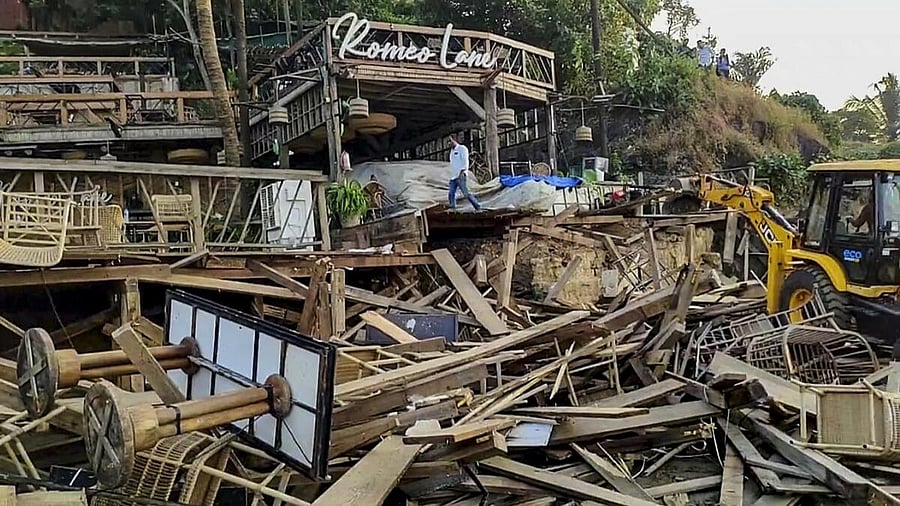
Goa begins demolition of Romeo Lane after nightclub fire
Credit: PTI photo
On a cold December night, a nightclub named Birch by Romeo Lane, situated in the village of Arpora, some 25 kilometers north of Panaji, the capital of Goa, went up in flames, taking the lives of 25 people and leaving scores of others injured. It being a Saturday evening and the peak of tourist season, the nightclub was full to capacity with revelers from all across.
Just 15 minutes short of the stroke of midnight, while a dance performance was ongoing, people noticed sparks flying behind the dancers which soon got converted into a blaze, and engulfed the entire establishment.
This incident is considered to be one of the worst fire disasters in recent history. However, this is not the first such accident and possibly not the last.
Police and forensic personnel inspect the site where a fire killed 25 people at the Birch by Romeo Lane nightclub, in Arpora, Goa.
Credit: PTI
If one were to analyse the nitty-gritty of this disaster or any such previous incident, one would realise that these catastrophic incidents don’t occur in isolation, rather they are the result of concurrent failure of various systems which are designed to prevent such accidents if allowed to function without hindrance.
Thus, disasters occur not from a single lapse but from cascade of breakdowns in multiple layers of protection, all happening in conjunction---The Swiss Cheese Model.
This very theory was postulated by James Reason in his book Human Error. He introduced the Swiss Cheese Model to showcase how a catastrophe unfolds.
Reason argued that in order to 'prepare for an accident', multiple layers of defences are created to minimise the impact as you can never altogether prevent it. An accident, as and when it occurs, can always be contained. It only turns into a disaster when these defences fail across all levels paving way for a crisis.
This and some other similar unfortunate incidents in the past are stark examples of the Swiss Cheese Model. The most tragic one being Uphaar Cinema Tragedy.
A man shows charred remains after a fire at Uphaar Cinema, which has been shut since 1997 following a blaze that killed 59 people, in New Delhi.
Credit: PTI photo
Way back in 1997, on a summer afternoon in Delhi—the now much beloved film—Border was being screened at a theatre in the upscale and affluent neighbourhood of Green Park. More than 700 people from across the capital had flocked to the theatre for its 3:15 pm show.
It was just hours later when the capital descended into a state of chaos as families of moviegoers suddenly found themselves frantically rushing from hospital-to-hospital in order to find what had happened to their loved ones. The popular theatre had become a victim of a massive fire which extinguished the lives of 59 people and caused injuries to multiple others.
Smoke and flames billow after a fire broke out at a nightclub, in North Goa, after midnight on Sunday.
Credit: PTI Photo
This incident, which later came to be known as the Uphaar Cinema Tragedy, is considered a watershed moment in the recent past, as it exposed blatant violation of the existing directives, lax implementation of law of the land compounded with bureaucratic indulgence and unhindered corruption.
The tragedy lay in the fact that this incident could have been avoided and is further exacerbated by the fact that we refused to learn from this incident and repeated the same mistakes decades later, this time in Goa.
Goa nightclub inferno
This establishment in Goa was a disaster waiting to happen by design. A fire-show organised at the club created the first spark which was soon amplified by the wooden panels as well as the décor of the place. As the fire spread, the people discovered there was no fire safety equipment present nor a proper route to evacuate.
Those working in the basement got trapped as there was no emergency exit provided—this incident finds an echo in Uphaar wherein adding extra seats in the balcony blocked crucial exits and narrowed their paths.
The combination of these factors led to the loss of 25 precious souls that dreadful night in Goa as it had consumed 59 lives in Uphaar, decades earlier.
Once again, the tragedy lay in the fact that even this incident could have been avoided.
Both Uphaar and Goa nightclub aren’t anomalies, rather the very existence of these establishments is a recipe for disaster. These two incidents are best understood through Reason’s Swiss Cheese Theory.
What is Swiss Cheese Model and how it explains the reasons behind such tragedies
As aforementioned, the theory posits that accidents don’t occur in isolation or due to a single failure; rather they occur when there is a complete breakdown of ‘defences’ across all layers of the system.
Each layer of defence is represented using slices of Swiss cheese. Each cheese slice has ‘holes’ in them that symbolises weakness. Usually when one stacks up layers of Swiss cheese, the ‘holes’ won’t always align—this would mean the defences on all layers are in working order.
However, according to Reason, a disaster occurs when all the holes or failures momentarily align creating space for a catastrophe.
In the case of both Uphaar and Goa nightclub tragedies, the seeds of destruction were sowed long before the fire began, rather both tragedies were the result of management and structural failures.
The terms “latent” and “active failure” were used by Reason to showcase how a tragedy unfolds. In layman’s terms, ‘active failures’ are triggers behind an accident. In both Uphaar and Goa nightclub, the spark from the transformer and the decision to hold a live fire-show—respectively— were the major culprits.
However, it is the latent failures— the ones that lie dormant within the system, which aggravate an already bad situation.
It is a universal truth that all have reluctantly acknowledged that accidents can occur at any time. While it is difficult to stop that particular tide altogether, having safeguards can minimise its impact. Unfortunately for both Uphaar and Goa nightclub, every defence that could have combated the fires failed on that fateful day.
Not isolated incidents
Wang Fuk Court housing complex during a deadly fire in Tai Po, Hong Kong.
Credit: Reuters Photo
These two aren’t isolated incidents, similar incidents have been a recurring phenomena both in our country and abroad, like the Kurnool bus fire accident which claimed more than 15 lives and the disasters occurring in the fireworks industry at regular intervals.
The recent fire incident in Hong Kong is also no exception where more than 100 lives were extinguished in the deadly blaze which erupted in an apartment complex.
Reports reveal that the blaze was amplified because a construction firm was using unsafe materials. There was a green mesh that was wrapped around bamboo scaffolding on the buildings at the time of the blaze, which did not meet the fire norms.
These recurring tragedies paint a grim picture of the current administrative machinery and reveal the deep-seated corruption which has now become the bedrock of the system. When political greed, bureaucratic convenience and systemic apathy becomes the norm, enforcement of the law becomes an exception, paving the way for disasters to occur.
Therefore, in order to dismantle this ’recipe of disaster’, one needs to overhaul the system and weed out the corrupt in order to steer towards a fundamental shift that prioritises safety of citizens and restores the value of a common man’s life.