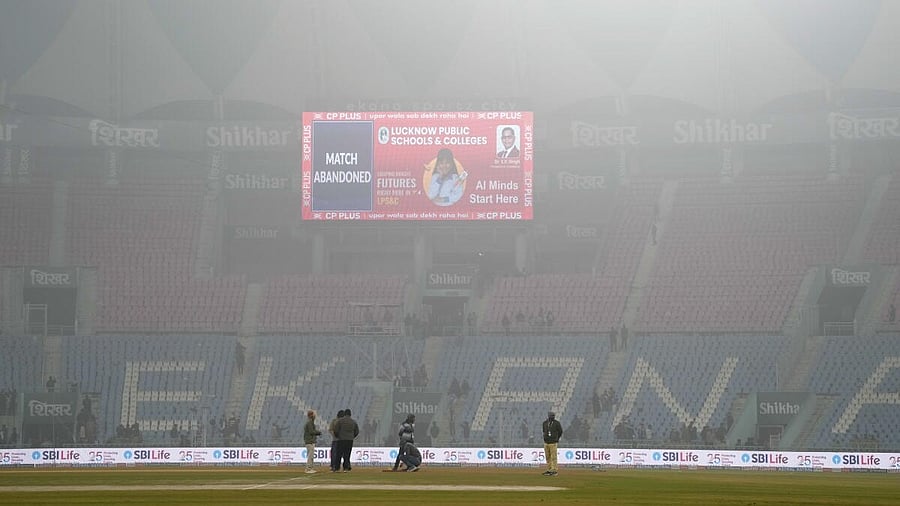
A display with "Match Abandoned" written on it at Lucknow.
Credit: PTI Photo
Bengaluru: On Wednesday (December 17) evening, the fourth T20I between India and South Africa in Lucknow was called off after a dense layer of smog enveloped the ground.
Match officials waited for conditions to improve and conducted multiple inspections before eventually calling it a day, as a disappointed crowd disappeared into the haze.
While this was the first time an international match in India has been abandoned because of smog, several fixtures -- both international and domestic -- have previously been affected by similar conditions.
You don’t have to be a meteorologist to understand the weather pattern in northern India at this time of year. It is generally foggy, but increasingly “chillingly” smoggy. As visibility drops rapidly towards the evening, the Air Quality Index (AQI) rises to alarming levels, making even a morning stroll hazardous, let alone playing a cricket match.
In November 2017, the third Test between India and Sri Lanka in Delhi was interrupted on multiple occasions after some visiting players suffered respiratory issues, with a couple of them even vomiting on the field. In 2019, India and Bangladesh played a T20I in similarly hazardous conditions, again in Delhi. Ahead of the 2023 World Cup match between Bangladesh and Sri Lanka on November 6, both teams cancelled their practice sessions on medical advice as the AQI rose to dangerous levels in -- where else? -- Delhi.
Yet the Board of Control for Cricket in India (BCCI), for all its expertise in marketing the game and making cricket the country’s undisputed No.1 sport, refuses to learn from experience when it comes to scheduling. For the eight limited-overs matches (three ODIs and five T20Is) against South Africa, the four venues chosen -- Raipur, New Chandigarh, Dharamsala and Lucknow -- are all in northern India. These venues not only endure harsh winter conditions but are also forced to contend with dangerously deteriorating air quality.
While this raises doubts about the BCCI’s ability to produce a viable schedule, it also prompts serious questions about its commitment to player welfare. The influence the BCCI wields may compel visiting teams to play without complaint, but abandonments like the one in Lucknow expose an unreasonable rigidity. It hardly reflects well on the country when cricketers, who typically train and play in moderate to good air quality with AQIs ranging from 50 to 60, are forced to compete in conditions where AQI levels hover between 350 and 400.
What makes this even more perplexing is that the BCCI has previously demonstrated foresight by shifting the opening Test between India and South Africa from Delhi to Kolkata, citing peak pollution levels in the capital during November.
The BCCI also claims to follow a rotational policy when allotting international matches, although it is evident that some venues are rotated far more frequently than others. That, however, is a discussion for another day. Even accepting the BCCI’s claim at face value, it beggars belief that basic common sense cannot be applied. New Zealand will tour India in January for three ODIs and five T20Is, with most matches scheduled in the western, central and southern parts of the country. With even minimal foresight, the BCCI could have swapped some venues in the South Africa series with grounds in the west or south, where winters are milder and air quality significantly better.
Granted, venues in Bengaluru and Chennai are currently unavailable due to government restrictions and renovation work respectively, but India is vast and boasts no shortage of world-class cricket grounds. There is simply no justification for an embarrassment like the one witnessed in Lucknow. All it requires is political will from the “elected” members of the BCCI and not the politics that so often dictate its decisions.
Internationals affected by smog
* Fourth T20I between India and South Africa in Lucknow on December 17, 2025 was abandoned without a ball being bowled due to "excessive fog."
* Third Test between India and Sri Lanka in Delhi in December 2017 was several stoppages as players suffered from vomiting and respiratory issues.
* On the eve of the 2023 World Cup match between Bangladesh and Sri Lanka in early November, both teams cancelled training sessions due to "severe" air quality on medical advice.
Domestic & Age-group matches
* Two Ranji Trophy matches in Delhi in November 2016 (Gujarat vs Bengal and Hyderabad vs Tripura) were cancelled without a ball being bowled because of poor visibility caused by smog.
* The knockout stage of the men’s U-23 one-day tournament in November this year was shifted from Delhi to Mumbai due to "severe" air quality levels.