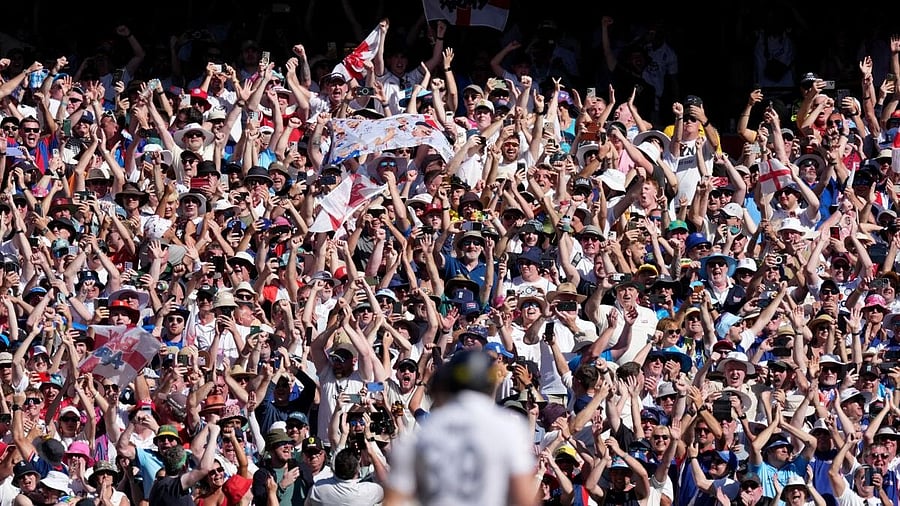
England fans celebrate after the match.
Credit: Reuters Photo
Bengaluru: As an astonishing 20 wickets tumbled on the opening day of the Boxing Day Test in Melbourne, former England skipper Kevin Pietersen made a pointed observation.
“India ALWAYS gets hammered when wickets fall like crazy on day one of a Test, so I hope that Australia gets the same scrutiny. Fair is fair!” he posted on X on Friday.
A maverick batter during his playing days, Pietersen offered an even more pertinent point on the second day, when Australia were dismissed inside two sessions in their second innings.
“Utter shambles and complete disrespect to the greatest form of the game.”
In total, 36 wickets fell and the Test concluded with almost 22 overs remaining on the second day.
If Test cricket were to be compared to Formula One, the pitch would be the car in the ultimate motorsport race. The better the car, the higher the chances of winning, as driving skills become less significant. Likewise, over-prepared or undercooked pitch to aid home team reduces the contest to farce. It becomes a game of luck rather than skill, a disservice to the traditional format that begins to resemble an extended one-day match.
Whether in Mumbai or Melbourne, it is Test cricket that ultimately suffers.
Beyond the financial fallout, the deeper loss is the erosion of Test cricket’s true character: a flow of calm passages and chaotic phases, momentum swings created by changing weather or a deteriorating surface and a cat-and-mouse battle where control shifts from one side to the other, making it compelling viewing.
One major reason for the rise in shortened Tests is the structure of the World Test Championship, where the top two teams by points percentage contest the final at the end of a two-year cycle. To stay ahead, home boards often prepare pitches tailored to their bowling strengths, but the strategy can backfire when surfaces offer too much assistance and leave batters on a wing and a prayer as even average bowlers look unplayable.
The numbers reflect the trend. Since the start of the WTC cycle in June 2021 (after the inaugural final between India and New Zealand), 38 Tests have ended in under three days. Seventeen of those came in cycle between the second and third finals. The current cycle, which began with the Australia–West Indies series in June, has already seen seven Tests finish before a fourth day.
The pressure to maximise home advantage is clear, but it carries risk: surfaces that help bowlers too much — whether pace or spin — can level the playing field for touring sides. It happened to India in Kolkata against South Africa last month, and to Australia in Melbourne against England on Saturday.
It’s an absolute travesty that a championship that was introduced to provide some context to Test cricket should hurt its cause.
Test cricket is unique because it avoids the monotony of white-ball cricket. Same Kookaburra ball across all countries, little difference in the nature of pitches and the pattern of matches. On the other hand, five-day cricket offers a variety of challenges in different regions: Turn and reverse swing in the sub-continent, conventional swing and seam in England and pace and bounce in Australia test cricketers’ ability to adapt and succeed out of their comfort zone. Even the choice of ball -- SG in India, Dukes in England, Kookaburra in Australia -- adds another layer of complexity to the format.
Home teams are entitled to use familiar conditions to their advantage, but that edge should not be stretched to the point where it strips the soul from Test cricket.