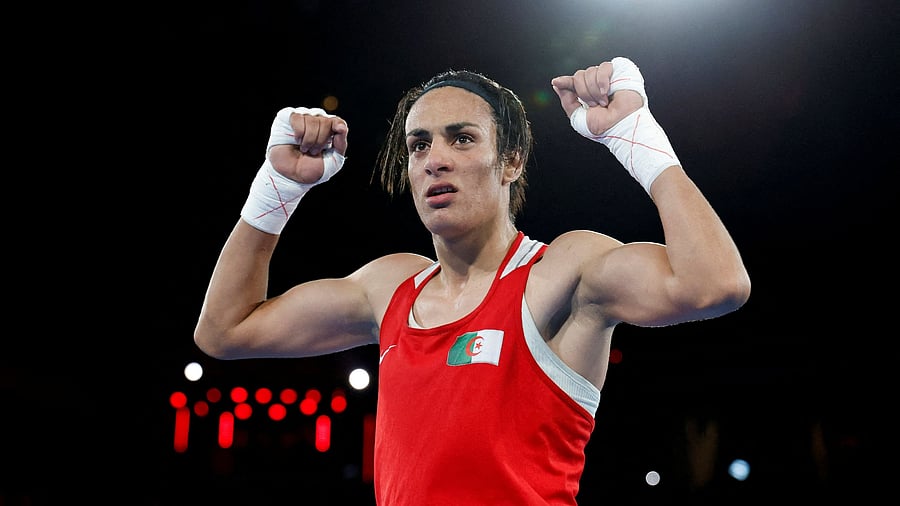
Imane Khelif of Algeria.
Credit: REUTERS
Bengaluru: In a largely smooth and successful Paris Olympics last year, a major controversy erupted in the boxing ring. When Algerian Imane Khelif and Taiwanese Lin Yu-ting -- both of whom had been disqualified at the 2023 World Championships by the now-banned International Boxing Association (IBA) for failing gender eligibility tests that reportedly showed elevated testosterone or chromosomal findings -- were cleared by the International Olympic Committee (IOC), one knew the global spotlight would be on the North Paris Arena. And that’s exactly what happened when Khelif walked out for her opening 66kg bout against Italian Angela Carin. The tension and anticipation were similar to a sold-out heavyweight battle at the MGM Grand Arena in Las Vegas or Madison Square Garden in New York with media gaze at its peak.
All it took was 46 seconds for the IBA to feel somewhat vindicated and cast the IOC in poor light, which personally oversaw the boxing programme in Paris. Khelif, completely oblivious to the spotlight on her, walked in with a swagger and in two clean heavy punches, knocked the stuffing out of Carin. The Italian, who is the daughter of two police officers, then did something unthinkable. After getting her headgear checked, Carin thought for a few seconds before removing her mouthguard and conceding the bout. The visuals instantly went viral across the world, the bout yet again highlighting the issue of whether women with elevated testosterone or chromosomal findings should be allowed to compete in the women’s category. For the record, both Khelif and Lin (57kg) went on to win gold in their respective categories, the former dominating most of her bouts in ruthless fashion.
The next Olympics in Los Angeles is about two and a half years away, but the IOC, now under the new leadership of Kirsty Coventry, is determined to avoid such mishaps. More importantly, in line with Olympic values that advocate fair play as well as protecting the dignity of athletes, the world body has set a target of early 2026 to detail a new policy on eligibility in female sports that could see transgender athletes excluded from the Olympic Games.
“I am really hopeful that in the next couple of months, and definitely within the first quarter of next year, we will have a very clear decision and way forward. It’s not going to be the easiest thing to do. But we are going to try our best to ensure that when we are talking about the female category, we are protecting the female category and we are doing that in the most fair way,” Coventry, a two-time Olympic champion swimmer, said early this month after a meeting of the executive board she chairs.
The decision on barring transgender athletes or athletes with differences in sexual development (DSD) from competing in women’s categories could possibly come during the Milan Cortina Winter Games that opens on February 6. In essence, athletes who went through male puberty will be barred from competing alongside women, something that World Athletics, World Aquatics, and the US Olympic & Paralympic Committee have implemented, albeit not without controversy, with critics questioning the tests conducted to differentiate a male from a female. Women have XX chromosomes while men have XY, which is what the governing bodies consider.
Although it’s still unclear what the IOC committee intends to do, judging by Coventry’s comments, it appears as if the world body will bar transgender athletes from competing in women's categories. In fact, all seven candidates, including Coventry, in the run-up to the IOC presidential election, promised a stronger policy on gender eligibility.
While it may seem unfair to transgender athletes because what chromosomes they have or how much testosterone their bodies produce or what physiological changes their bodies undergo during puberty — some of it can have long-lasting psychological effects — is not entirely in their control, it’s a no-brainer that females are physically weaker sex and every effort needs to be made to protect their interests. Testosterone is an anabolic hormone and that’s the primary reason why men can run faster and throw longer than women. Although they may not be injecting it and is naturally produced in their bodies, excess amount of testosterone gives an advantage to transgender athletes over women.
“The reason why doping is considered an offence is because it breaks the concept of a level playing field,” Anju Bobby George, India’s first World Championships bronze medallist, told DH. “So, when a third gender comes into the women’s category, they already have an advantage. So, as a woman, I feel this is not fair. I'm so sorry for the third gender athletes, because it's not their fault. But, when they compete in the women’s category, I feel sorry for women athletes. A solution would be to have competition for the third gender. Anyone who takes drugs has an advantage because they will be ahead of normal athletes. We are not against the third gender, but their bodies will be having an excess amount of banned substances naturally.”
Dr PSM Chandran, former Director of Sports Medicine at the Sports Authority of India, however, felt barring transgender athletes is extremely unfair. “I commend the IOC for protecting women athletes. Similarly, the IOC should also protect transgender athletes because sport is not limited to just males and females. It’s for all. Transgender athletes have the equal right to participate. It is a difficult process because it is difficult to define transgender completely. There is a difference of opinion among the medical community on defining a gender.”
Former Athletics Federation of India president Adille Sumariwalla, who has been a council member of World Athletics for a decade that pioneered the move to ban transgender athletes from competing alongside women, differed with Chandran, saying there’s enough scientific evidence available. “Women have to compete against women. As simple as that. You saw what happened in boxing (Khelif bout), that girl (Carin) had to throw in the towel else she would have gotten killed.
“I’m proud to say World Athletics has done all the heavy lifting. A lot of cases were filed at CAS (Court of Arbitration for Sport), but the ruling came in favour of us (regarding Female Eligibility Regulations). All our regulations are backed by science. Hardcore scientific data was presented before the courts. In the beginning, World Athletics was criticised. Now the rest of the world is following, and I feel it’s about time," opined Sumariwalla.
Not just Sumariwalla and Anju, but World No. 1 tennis player Aryna Sabalenka and a whole bunch of elite athletes oppose transgenders from lining alongside women. US President Donald Trump signed an executive order titled “Keeping Men Out of Women's Sports” this February.
The sporting world now waits with bated breath for the IOC’s game-changing decision next February.
Anju Bobby George.