
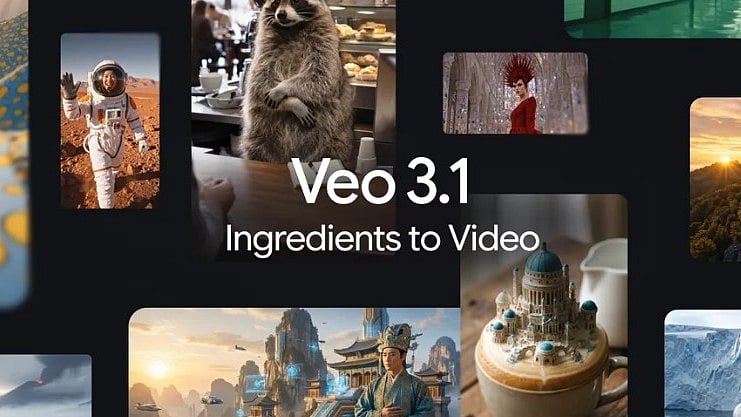
Veo 3.1 app update.
Credit: Google
Google has announced a new Veo 3.1 update bringing several value-added features to the AI video editing model.
It brings a new 'Ingredients to Video' (ItV) feature. It allows users to add reference images from the photo gallery, and with prompts, the Veo 3.1 model can create a fun and lively video clip.
It also offers more control over the scene to maintain the integrity of the setting and the objects within it. Users can also reuse objects, backgrounds, or textures across scenes.
It also supports native 9:16 aspect ratio (portrait orientation), which can be shared on apps such as YouTube Shorts, Instagram or any other mobile-first social media applications.
The Veo 3.1 update also introduces a new upscaling feature that enables users to upgrade any regular video to 1080p (full HD) or even 4K resolution, which is particularly useful for high-fidelity production workflows.
At start, Veo 3.1 Ingredients to Video feature is now available inthe YouTube Shorts app and the YouTube Create app for the first time. Users can find the same feature and portrait mode for Veo in the Gemini app as well.
Veo 3.1 app update.
Credit: Google
Google also noted that all the videos generated through the Veo model on YouTube, YouTube Shorts and Gemini will come with SynthID.
For the uninitiated, SynthID is developed by Google's DeepMind division. As noted earlier, it works on gen AI language models for Gemini AI. It comes with several nuanced technologies to ensure the artificial images are aesthetically good and not marred with noticeable marks that compromise visual beauty.
The SynthID tool will ensure that even if the AI-generated image is edited with more layers of filters using other applications, will still not get erased or hide the digital watermark. The SynthID is deeply ingrained with the metadata of the photo, and it cannot be erased.
Also, users can upload any video to Gemini and simply ask if it was generated with Google AI. It will help clear doubts of whether the multimedia content is an AI generated or not.
Google's SynthID tool
If the content is created from non-Google AI sources, Gemini will only be able to provide general observations about common AI attributes such as unusual lighting, repetitive patterns, and errors in small details. With such results, users can make an educated guess on whether the image or a video is a deepfake or not.
Get the latest news on new launches, gadget reviews, apps, cybersecurity, and more on personal technology only on DH Tech.