
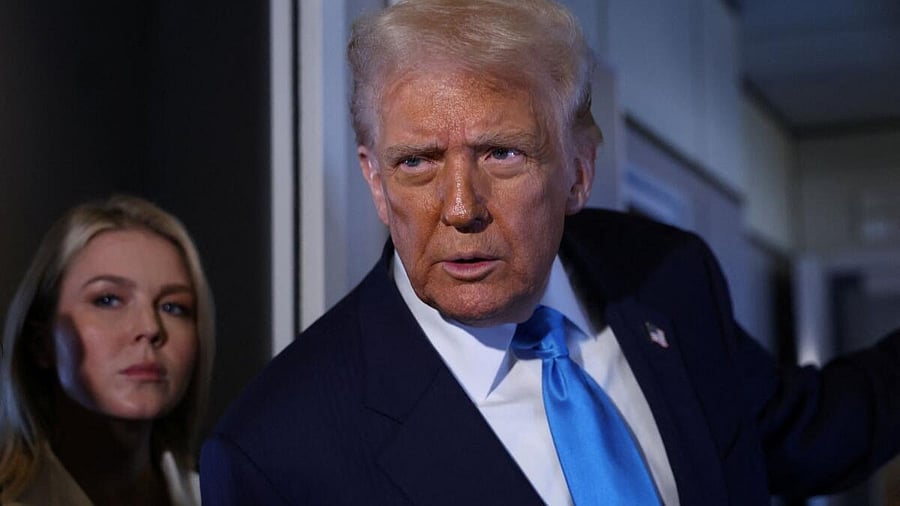
US President Donald Trump
Credit: Reuters Photo
New Delhi: After months of asserting that he persuaded Prime Minister Narendra Modi’s government into slashing energy imports from Russia, President Donald Trump has now claimed that Washington, DC, and New Delhi already had a deal for India to buy oil from Venezuela, now under the control of the United States, instead of purchasing from Iran.
New Delhi refrained from officially commenting on the US president’s claim, although officials said that energy import policies of the Government of India included broad-basing and diversifying sources in accordance with market conditions, and were guided by the objective of safeguarding the interests of consumers in the country.
Trump made the claim about India purchasing oil from Venezuela just a day after Modi had a phone call with Delcy Eloína Rodríguez Gómez, who had taken over as the acting president of the South American nation after the US had carried out a military operation in Caracas and ‘captured’ the country’s President Nicolás Maduro and his wife Cilia Flores on January 3.
“China is welcome to come in and would make a great deal on (sourcing) oil (from Venezuela),” Trump said while speaking to journalists while flying to Palm Beach, Florida, on Saturday. China had been the biggest buyer of oil from Venezuela before Nicolás Maduro’s detention by the US military personnel. A journalist aboard Air Force One had asked the US president if China would continue to source energy from Venezuela. “We welcome China,” said Trump.
He then made the claim about the deal for India to buy oil from Venezuela instead of Iran.
“We've already made a deal. India is coming in, and they're going to be buying Venezuelan oil as opposed to buying it from Iran. So, we've already made that deal, the concept of the deal,” said the US president.
India’s crude intake from Venezuela had hit its high point in 2015, when shipments touched about 441,000 barrels per day, accounting for roughly 12 per cent of the country’s total oil imports that year. The import volumes remained substantial in the following years, with nearly 108 million barrels in 2019, before procurement dwindled sharply.
Unlike Brazil, Russia, China, South Africa and several other nations, India avoided directly criticising the US for carrying out the military operation in Venezuela and capturing the president of the South American nation and his wife. With its own relations with Washington, DC, under stress due to the 50 per cent tariffs imposed by Trump on India’s exports to the US and both sides trying to ease the wrinkles in ties, New Delhi chose to tread cautiously and just called upon all concerned to address issues peacefully through dialogue, ensuring peace and stability of the region.
Venezuela, under Acting President Delcy Rodríguez, has loosened state dominance over its oil industry in a bid to restart exports after prolonged sanctions. The Trump Administration eased some of the restrictions earlier imposed on Venezuela, permitting sales of oil under US oversight. Trump’s claims about US ‘control’ over Venezuela are described by his aides as influence over revenue flows and buyers, not formal ownership.
After Modi and Delcy Rodríguez spoke over the phone on Friday, both sides confirmed that they discussed the energy cooperation between India and Venezuela, along with the prospects of trade and investment, and cooperation in digital technology, health, agriculture and people-to-people ties.
Trump had announced on August 6, 2025, an additional 25 per cent tariff – on top of the 25 per cent levied earlier – on India’s exports to the US, in a move to dissuade the South Asian nation from buying oil from Russia. He had accused India of funding Putin’s war in Ukraine by buying oil from Russia, defying the sanctions the US and the European Union had imposed on the former Soviet Union nation.
Russia’s share in India’s total crude oil imports rose from less than 2 per cent before the launch of its war in Ukraine in 2022 to around 40 per cent by 2023–24.
But imports from Russia came down from over 2 million barrels per day in June 2025 to 1.6 million barrels per day in September 2025. The imports saw a rebound in October and the first half of November, but fell by nearly 30 per cent after the stringent US sanctions on Rosneft and Lukoil of Russia came into effect on November 21.
Trump has been claiming that he could persuade India to slash its oil imports from Russia.
India was a major buyer of crude oil from Iran. But after Trump, during his first term as the US president, reimposed US sanctions on Iran, India had to stop buying oil from the Persian Gulf nation.