
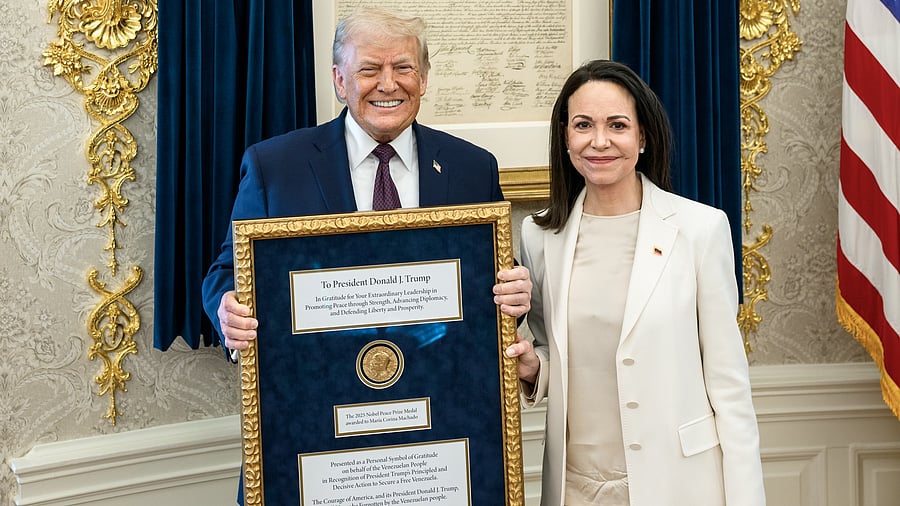
Maria Corina Machado 'presents' her Nobel Peace Prize medal to Donald Trump.
Credit: X@WhiteHouse
Venezuelan Opposition leader Maria Corina Machado ceremonially 'presenting' her Nobel Peace Prize medal to US President Donald Trump has triggered a question: once the Nobel Prize is awarded, who really “owns” it? Can it be shared, handed over, returned or even revoked?
The short answer, according to the institutions that administer the Nobel legacy, is: no. But the longer story reveals why such gestures, while symbolic, sit uneasily with the strict rules governing the world’s most celebrated honour.
What the Nobel Peace Prize represents
Among the six Nobel Prizes awarded annually — physics, chemistry, medicine, literature, peace and economics, the Peace Prize occupies a distinct moral and political space.
Conceived by Alfred Nobel, the Swedish inventor of dynamite, the award was intended to recognise those who work to advance peace, international fraternity and the reduction of armed conflict.
Unlike the scientific prizes decided in Stockholm, the Peace Prize is awarded by a committee appointed by the Norwegian Parliament. Laureates receive three things: a gold medal, a diploma and a monetary award, which currently stands at 11 million Swedish krona.
Members of the Norwegian Nobel Committee have repeatedly stressed that the Peace Prize is not about intellectual brilliance in a narrow sense but about ethical action and tangible contributions to peace. It is this moral weight that makes any public handling of the prize — including symbolic gifting — a matter of global attention.
Can a Nobel Prize be shared or transferred?
Despite the optics of Machado’s gesture, the Nobel institutions are unequivocal: a Nobel Prize cannot be passed on to someone else, split, or reassigned in any form. Once announced, the decision is final.
The statutes of the Nobel Foundation, which govern all prizes, leave no room for reinterpretation. There is no provision for transferring ownership, altering the list of laureates or retroactively sharing an award. Nor is there a mechanism for revocation, regardless of later controversies surrounding a winner.
“Once a Nobel Prize is announced, it cannot be revoked, shared, or transferred to others. The decision is final and stands for all time." the Nobel Peace Center reiterated on Thursday, January 15.
Officials of the Norwegian Nobel Institute have clarified that Alfred Nobel’s Will itself does not contemplate any such flexibility. In fact, the rules explicitly bar appeals against the decision of any prize-awarding body. The award, once conferred, stands “for all time”.
What a laureate chooses to do with the physical medal, however, falls in a grey area. The medal is personal property, and gifting or displaying it elsewhere is legally possible. But such an act has no bearing on the formal status of the prize or its recipient.
Machado is not the first Nobel laureate to give away a medal. Ernest Hemingway, who won the Literature Prize in 1954, donated his medal to Cuba, a country deeply connected to his life and work. Such gestures are symbolic and personal, not institutional.