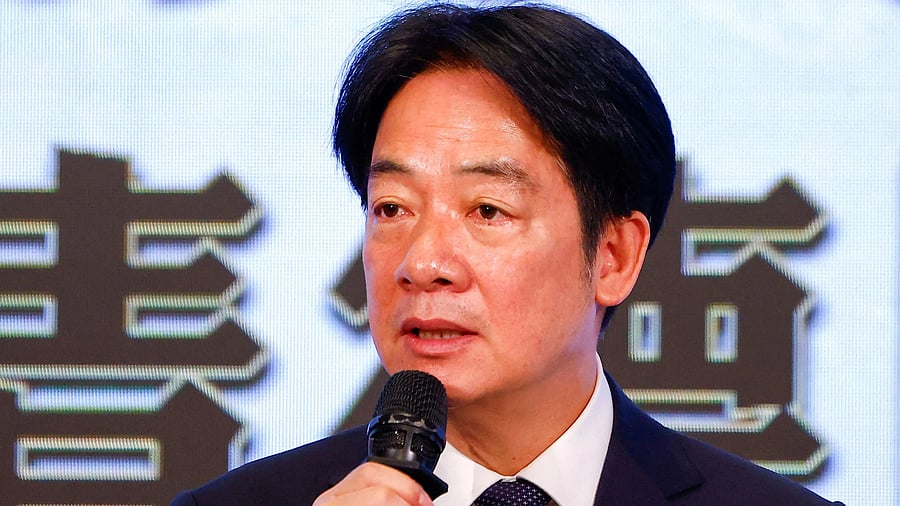
Taiwan President Lai Ching-te.
Credit: Reuters photo
Taipei: Taiwan is in a political deadlock over the government refusing to enact amendments to a local government spending law passed by the opposition-controlled parliament, saying the plan is fiscally unsound and has been done without proper consultation.
The opposition now wants to impeach President Lai Ching-te, calling him a "dictator" for refusing to respect the will of the democratically elected legislature, though they lack the numbers to do so. They could instead pass a no-confidence vote in Premier Cho Jung-tai that might result in new elections.
Here is what is happening and how the process could play out.
WHAT HAPPENED AT THE LAST ELECTIONS?
In January 2024, Lai, from the Democratic Progressive Party (DPP), won the presidential election. But the party lost its majority in parliament to the Kuomintang (KMT) and its much smaller ally the Taiwan People's Party.
Given the DPP controls the presidency, it also runs the government in Taiwan's system.
Since the 2024 election, the opposition has used its majority to block or stymie major government proposals, such as the budget, and push their own legislation.
Both sides have accused the other of breaching the constitution in the current spending dispute. In July and in August, two recall votes pushed by civic groups but supported by the DPP and taking aim at a swathe of KMT lawmakers, failed.
CAN THE OPPOSITION OUST THE PRESIDENT AND THE PREMIER?
Impeaching Lai would require the vote of two-thirds of lawmakers, and the opposition lacks the numbers to do that.
Were it to pass, which is unlikely, the Constitutional Court would need to issue a ruling. The court is not currently functioning due to a separate dispute between the government and opposition on appointing new judges.
To remove Cho, the opposition could pass a vote of no confidence in him. If that passes, the president has the right to dissolve parliament within 10 days with new legislative elections having to take place within 60 days. That would be unprecedented. The DPP says the opposition is welcome to try and force Cho from office, but KMT lawmakers have signalled they don't intend to do that as they do not want new elections to take place.
WHAT IS AT STAKE?
The stand-off is happening against a backdrop of continued Chinese military and political pressure against Lai and his government. China views Taiwan as its own territory, which Lai rejects saying only the island's people can decide their future.
China says Lai is a "separatist" and has rebuffed his repeated offers of talks. The government and opposition are also at loggerheads over defence spending, after Lai unveiled a $40 billion supplementary budget. The opposition has so far blocked that from being discussed at parliament.
WHEN ARE TAIWAN'S NEXT ELECTIONS CURRENTLY PLANNED? The next major vote in Taiwan will be in November, 2026, for city mayors and county chiefs. While these mostly focus on local issues, they are an important sign of party support ahead of the next scheduled presidential and parliamentary election in early 2028.
At the last local election, in 2022, the KMT won 14 cities and counties to the DPP's five.