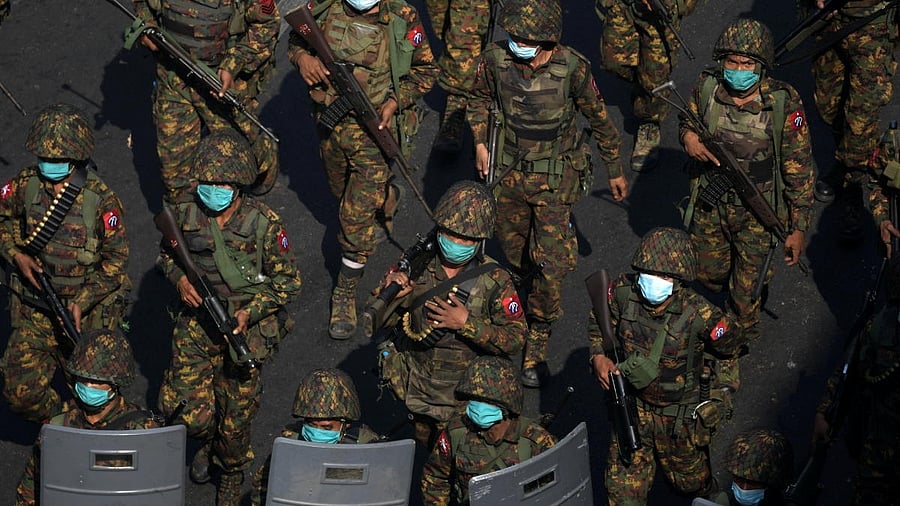
Myanmar soldiers from the 77th light infantry division walk along a street during a protest against the military coup in Yangon, Myanmar, February 28, 2021.
Credit: Reuters Photo
Myanmar's military-led government is holding a phased general election amid a civil war convulsing large areas of the Southeast Asian nation.
Why is Myanmar holding an election?
The military ousted the elected government of Nobel laureate Aung San Suu Kyi in a February 2021 coup, just as it was preparing for a second term in office following a landslide election win months before.
The generals promised to restore the democratic system and accused Suu Kyi and her National League for Democracy party of electoral fraud, a charge that she rejected. International election monitors reported no irregularities.
Suu Kyi and much of the NLD were detained along with thousands of junta opponents.
Most analysts see the election as a way for the military, which has governed Myanmar for much of the past six decades, to entrench its rule via proxies in the absence of a viable political opposition, and earn legitimacy at home and abroad.
The military pledged an election by August 2023 but pushed back the date as it lost control of swathes of the country in battles with ethnic minority rebels and anti-junta militias.
The NLD was among dozens of parties dissolved for failing to register for the election and rebels refused to take part.
How is the election being held?
Voting is set for three phases, on December 28, January 11 and January 25, in 265 of Myanmar's 330 townships, including areas where the junta does not have full control. Polls are not nationwide because of the conflict.
It is not clear when final results will be announced but electronic voting machines are being used to speed counting. Seats are determined by first-past-the-post, proportional representation and mixed-member proportional systems.
Previous elections used a plurality system in which candidates with the most votes won seats.
In line with an army-drafted 2008 constitution, 25 per cent of upper and lower house seats are reserved for serving military officials selected by the armed forces chief.
Who is taking part?
With many parties that contested the past two elections disbanded, just six are competing on a national level, with 51 contesting within a single region or state.
That has left only junta-approved parties, including the military's proxy Union Solidarity and Development Party, which won the last election held by a junta in 2010. The USDP is fielding 1,018 candidates, a fifth of the total registered.
The USDP, led by former generals, was routed by the NLD in landslides in 2015 and 2020 elections, the latter annulled after the coup.
As in 2010, with the armed forces controlling 25 per cent of the legislature and its USDP allies likely to win many seats, the military can influence the choice of president and formation of a government.
What has happened so far?
The USDP won 90 of the 102 lower house seats contested in the first round, or 88.2 per cent, and 13 more in walkovers. It won 21 of 31 upper house seats announced. Second-round results have yet to be released.
Authorities said first-phase voter turnout was 52.13 per cent. That compares to about 70 per cent in the last two elections.
The junta has sought to gloss over the low turnout, with spokesperson Zaw Min Tun pointing to "great enthusiasm" among voters in the second round.
"This is not just a victory for the government, but a victory for the people, an achievement for those who desire democracy and peace," he said.
How is a president chosen?
Parliament must gather within 90 days of the start of the election, likely in March, the junta says. Speakers will be elected and then a president.
To choose a president, three electoral colleges are formed comprising members of the upper and lower houses, which each nominate one candidate, while the third consists exclusively of military-appointed lawmakers.
To choose a president, three electoral colleges are formed comprising members of the upper and lower houses, which each nominate one candidate for president. Two of the colleges are elected lawmakers while the third is exclusively comprised of military-appointed lawmakers.
The candidate securing the most votes in a plenary election by the combined houses becomes president, with the runners-up as vice presidents. The president then appoints a cabinet. The junta has said a government should be in place in April.
Min Aung Hlaing recently sidestepped a reporter's question on whether he hoped to become president.
What's the international reaction?
The United Nations, many Western countries and human rights groups call the election a sham, aimed at perpetrating military rule, saying the contest is not free, fair or credible in the absence of a meaningful opposition.
The Association of Southeast Asian Nations grouping, of which Myanmar is a member, has called for a fair and inclusive election and may find it difficult to re-engage even after the polls.
Min Aung Hlaing, however, has made a major diplomatic push to win support for the polls, with two trips each to key allies China and Russia, which back the election, as does India, state media say.
The military rejects international criticism, saying there has been no coercion and the election has public support.
Its spokesperson said he expected greater engagement and international recognition of the new administration, as well as an easing of sanctions.