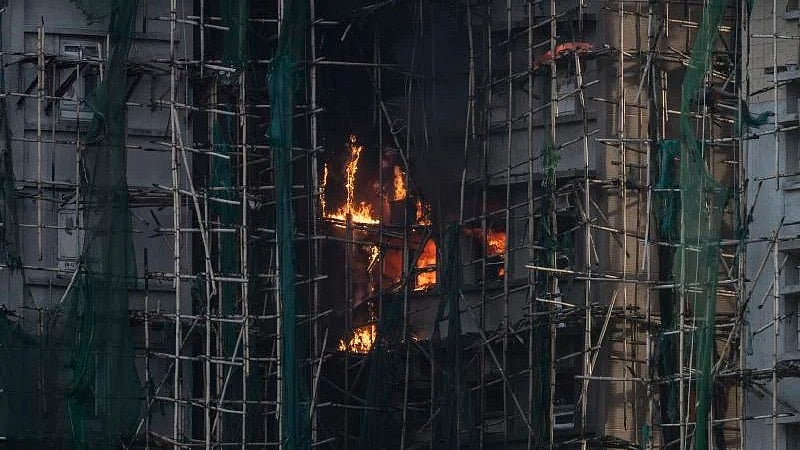
Hong Kong: Hong Kong officials said on Monday that contractors at the ill-fated housing estate where a fire killed more than 150 people had blanketed buildings with substandard scaffolding netting, and then tried to conceal the unsafe material.
The Independent Commission Against Corruption said that after a summer typhoon, some of the scaffolding netting used at the Wang Fuk Court housing estate in northern Hong Kong was replaced with cheaper material that did not meet fire-safety standards.
To fool inspectors, netting that met the standards was installed at the base of the scaffolding, where samples are usually taken.
The findings emerged as the death toll from Wednesday's blaze rose to 151, with police still combing the towers for bodies and evidence of identification. More than 40 people were still missing. The work of locating and identifying remains would take another three weeks, officials said.
In a sign of how intensely the fires had raged, police said that some bodies were so severely burned that they had been reduced to ashes, and they acknowledged that they might not be able to recover the remains of all the missing people.
The latest findings about what contributed to Hong Kong's worst fire in decades have raised sharp questions about the city's construction industry and the government's ability to police it. The probe has exposed gaps in oversight that allowed unsafe material to be installed across multiple buildings -- not just the substandard netting, but also flammable polystyrene foam boards that officials said caused the fire to spread rapidly.
The revelations could further stoke public anger over the disaster, especially because residents had tried for more than a year to warn officials about hazards at the site, including the netting.
Authorities had said last week that the protective netting at Wang Fuk Court met fire-safety standards, citing preliminary testing. The security secretary, Chris Tang, said on Monday that earlier samples had been taken from the ground floor of a building that had been unaffected by the fire. He acknowledged that the results of their tests differed widely from "the observations of our colleagues on-site and from numerous experts and citizens afterward."
The police and anti-corruption agency said that 14 people so far have been arrested, including engineering consultants, contractors and scaffolding subcontractors. They also described in the greatest detail yet how contractors acquired and installed unsafe netting.
Danny Woo Ying-ming, commissioner of the anti-corruption agency, said that after a typhoon damaged the Wang Fuk Court scaffolding in July, individuals whom he did not name bought 2,300 rolls of netting from a local supplier at 54 Hong Kong dollars, or about $7, per roll. That material did not meet fire-safety standards.
But, in October, after a separate fire involving scaffolding netting in the Central district set off official scrutiny, those individuals grew worried that the unsafe netting would be found in random inspections, Woo said.
They then bought 115 rolls of netting that complied with the standards and installed it at the base of each building's scaffolding in what investigators believe was an attempt to disguise the inferior material above. This netting was 100 Hong Kong dollars, or $13, nearly twice as expensive as the noncompliant netting.
Seven of the 20 samples that officials took from Wang Fuk Court failed to meet fire-safety standards, said Tang, the security secretary. These 20 samples were taken from areas near windows, from less-accessible spots, "even requiring firefighters to climb out to obtain samples," he said.
Hong Kong's Buildings Department last week ordered all contractors to review the safety of scaffolding protective netting and other materials at their sites and submit their reports, along with quality certificates and test results, within seven days. On Monday, the department said it had inspected 359 buildings undergoing external maintenance and has taken samples of netting for tests.
In recent days, as inspections ramped up, some contractors appeared to be moving quickly to remove netting used at sites. "You can see the mesh being removed in Hong Kong because they are avoiding punishment," said Jason Poon Chuk-hung, a civil engineer-turned-activist who lobbied the government to address fire safety of scaffolding netting for more than a year.
"If you remove it," he added, "you can escape from the requirements."
Even as authorities sought to show that they were doing their utmost to recover bodies and investigate the disaster, they were also cracking down on expression, in a sign of how anxious officials are about the potential political fallout of this disaster.
Over the weekend, officials invoked a new national security law to warn citizens not to use the tragedy to fuel discontent. The Office for Safeguarding National Security in Hong Kong issued a statement to warn that it would take action against "those with ulterior motives" who tried to use the tragedy to destabilize national security.
The South China Morning Post reported that authorities had arrested a man who had called for the establishment of an independent inquiry on the blaze and holding government officials responsible. The police did not respond to requests for comment.
It was notable that the government has focused on suppressing critical views rather than on trying to reassure the population that a disaster like this would not happen in other high-rises in the city, said Steve Tsang, director of the SOAS China Institute in London.
"It shows the lack of credibility that the government has with the local population," he said.