
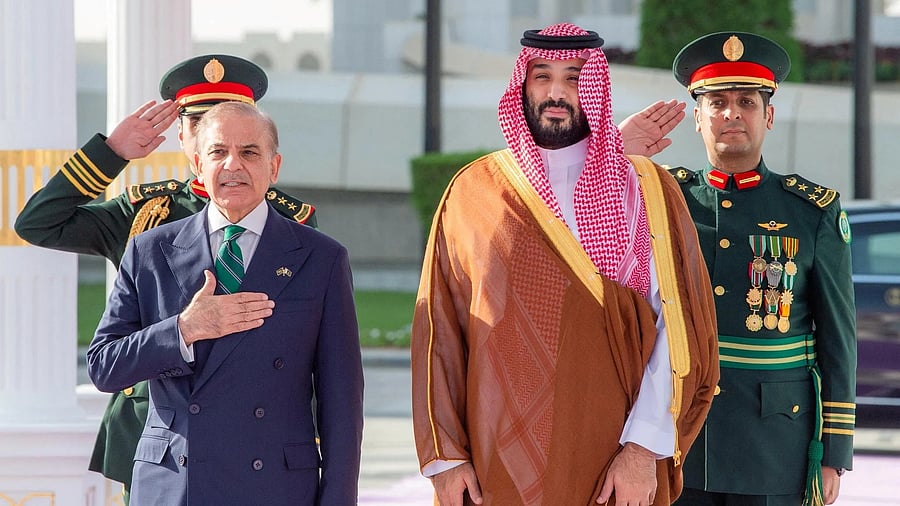
Saudi Crown Prince Mohammed bin Salman and Pakistan Prime Minister Shehbaz Sharif meet in Riyadh, Saudi Arabia, September 17, 2025.
Credit: Reuters Photo
In a development with far-reaching implications for both South and West Asia, Pakistan and Saudi Arabia on September 17, signed a Strategic Mutual Defence Agreement (SMDA), one of their most significant military pact in decades. The agreement, signed in Riyadh by Pakistan Prime Minister Shehbaz Sharif and Saudi Crown Prince Mohammed bin Salman, has sparked intense debate about whether it could alter the balance of power in the region, particularly for India.
The clause in the Saudi-Pakistan deal that drew global attention is that: “Any aggression against either country shall be considered an aggression against both". While the details remain sparse, the symbolism of the pact is undeniable — a nuclear-armed Pakistan pledging joint defence with the Arab world’s most influential power.
The Saudi-Pakistan military relationship: Old wine in a new bottle
Pakistan and Saudi Arabia have shared military ties since the 1960s. Pakistani troops were first deployed in the Kingdom during the Yemen crisis, and in 1979, its special forces helped quell the armed takeover of the Grand Mosque in Mecca. Over the years, Islamabad has trained Saudi pilots, stationed troops on Saudi soil, and sold arms to Riyadh.
These ties were institutionalised in 1982 through a bilateral security cooperation agreement, ensuring continuous Pakistani military presence in Saudi Arabia. Even in recent years, around 1,200–2,000 Pakistani soldiers remain deployed in the Kingdom.
The new SMDA, however, is qualitatively different. It transforms decades of informal security cooperation into a formal commitment resembling NATO’s collective defence clause. Analysts like Husain Haqqani, Pakistan’s former ambassador to the US, argue that the pact could allow Pakistan to acquire American weapons using Saudi funds – a potentially game-changing dynamic.
Why Saudi Arabia signed the deal now
The timing is crucial. The agreement comes after Israel’s recent strikes in Doha, amid growing concerns in the Arab world about Tel Aviv’s regional ambitions. Riyadh’s reliance on the US security umbrella is also weakening, especially after Washington’s perceived retreat from West Asia.
Saudi Arabia’s concerns are layered:
The threat from Iran and its proxies, particularly Yemen’s Houthis.
The uncertainty caused by Israel’s belligerence and stalled peace talks.
The need to diversify its security partners beyond the US.
As various observers have pointed out, Saudi motivations are less about South Asia and more about fortifying Middle Eastern stability. For Riyadh, Pakistan offers both manpower and, more importantly, the shadow of a nuclear deterrent.
Pakistan’s motivations: Money and prestige
For Islamabad, the agreement is a lifeline. Facing economic distress and mounting debt, Pakistan stands to gain billions in Saudi investments and defence-related funding. This is not new — Riyadh has poured over $30 billion into Pakistan’s economy since the 1980s. But the SMDA allows Islamabad to reinforce its image as the protector of the Islamic world, a role it claimed after its nuclear tests in 1998.
As the Eurasian Times pointed out, the deal raises unsettling questions: Has Saudi Arabia effectively “rented” Pakistan’s nuclear shield? For decades, speculation has swirled that Saudi money helped fund Pakistan’s nuclear programme, and that a quiet understanding existed for Pakistan to supply warheads if Riyadh ever needed them. While both sides deny such an arrangement, the symbolism of the new pact makes these old suspicions harder to dismiss.
India-Saudi ties: A strategic balancing act
The agreement naturally raises concerns in New Delhi, given Pakistan’s central role. Yet, Saudi Arabia’s relationship with India has steadily deepened over the last two decades.
India is Riyadh’s second-largest trading partner, while Saudi Arabia is India’s fifth-largest. Bilateral trade reached nearly $43 billion in 2023-24.
High-level visits, including PM Narendra Modi’s trips to Riyadh and Saudi leaders’ visits to Delhi, have elevated ties to a Strategic Partnership.
Saudi Arabia has, in recent crises, walked a fine line: condemning terror attacks in India (Pulwama, Pahalgam) but refraining from criticising India’s retaliatory actions (Balakot, Operation Sindoor).
Importantly, Saudi Arabia has not strongly criticised India’s abrogation of Article 370 in Jammu and Kashmir, despite Pakistan’s lobbying. This suggests Riyadh views its economic and strategic interests with India as too important to jeopardise.
In its official reaction to the SMDA, India’s Ministry of External Affairs stressed that New Delhi expects Riyadh to keep in mind “mutual interests and sensitivities” in pursuing its partnership with Islamabad.
How does this affect India?
At one level, the pact looks alarming. It appears to give Pakistan, a Saudi backing in case of conflict with India. However, several factors dilute this perception:
The SMDA is seen as being primarily designed for West Asian contingencies, not South Asian ones. Saudi Arabia is unlikely to jeopardise its growing economic and strategic partnership with India by intervening in a bilateral conflict.
The agreement contains no operational specifics about nuclear sharing or military deployment against India. Its credibility as a deterrent outside West Asia remains questionable.
Saudi's pragmatism in past India-Pakistan crises shows Riyadh prefers neutrality, balancing ties with both sides.
That said, the deal complicates India’s security calculus. It raises the prospect of Pakistani access to better-funded defence modernisation and gives Islamabad diplomatic leverage by flaunting Saudi endorsement.
A fragile nuclear umbrella?
Perhaps the most provocative aspect of the pact is the nuclear undertone. Saudi Arabia has long been suspected of eyeing Pakistan’s nuclear arsenal as a fallback option. As one analyst put it, the SMDA is less about a NATO-style alliance and more about “renting the bomb.”
If Riyadh truly sees Pakistan’s deterrent as its security guarantee, this could unsettle Iran, encourage a new arms race, and drag South Asia further into Middle Eastern rivalries. For India, this means greater unpredictability on its western flank.
For India, the task is clear: deepen its own strategic partnership with Saudi Arabia, ensure economic and security cooperation remain strong, and watch closely how Riyadh balances its new commitment to Islamabad with its interests in New Delhi.