
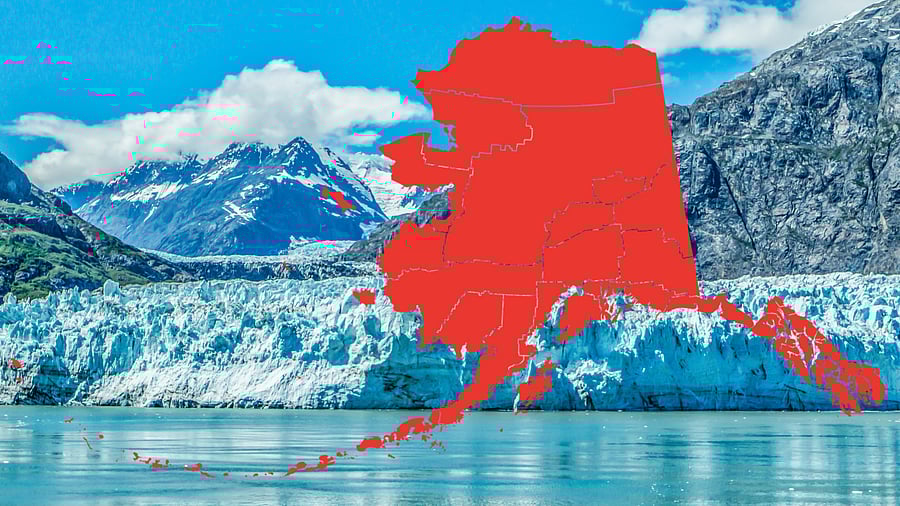
Representative image.
America's President Donald Trump has made his plans to 'take-over' Greenland to ensure the security of mainland US.
As per multiple reports, all possible means — from military to monetary — are being considered by the Trump administration.
Trump has also written to Norway Prime Minister Jonas Gahr Stoere saying, "Considering your Country decided not to give me the Nobel Peace Prize for having stopped 8 Wars PLUS, I no longer feel an obligation to think purely of Peace." Trump said he would now focus on "what is good and proper for the United States of America."
This is being seen as a precursor to Trump's plans with Greenland about which he has been very vocal on numerous occasions in the recent past.
Will the so-called 'takeover' be military, or are there other ways also to do that? One such way is the monetary nature which would essentially be a purchase of land.
The idea of the United States expanding its territory by purchasing distant land is not new. One of the most striking examples is the acquisition of Alaska, bought from Russia in 1867.
Alaska was once Russia's part, but by the mid-19th century, it became difficult for the Tsar administration to rule over the region sitting from Moscow. The region was sparsely populated, economically underperforming, and vulnerable to British expansion from neighboring Canada.
After the Crimean war, Tsar Alexander II decided to sell Alaska because of the financial strain. The argument was it was better to sell Alaska than risk losing it without compensation if imperial British forces ever try to annex it from neighboring Canada.
The Crimean war also gave financial strains to Russia and then, Tsar Alexander II decided to sell Alaska.
In 1867, Secretary of State William H Seward led the negotiations from the agreed cost of $7.2 million (about two cents per acre) for the entire region. Later that year, the treaty was ratified by the Senate, and Alaska formally became part of the United States.
The treaty was not accepted without criticism and 'Seward’s Folly' or 'Seward’s Icebox' were some of the adjectives used to refer to that. It all changed with the discovery of gold, oil, and other natural resources in the region. The geographical location of the US' coldest State is another aspect which made it an important feature of US' defence strategies during World War and Cold War.